



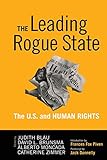
Judith Blau, David L. Brunsma, Alberto Moncada, Catherine Zimmer, eds. The Leading Rogue State: The U.S. and Human Rights. Boulder: Paradigm Publishers, 2009. 264 pp. $29.95 (paper), ISBN 978-1-59451-589-7.
Reviewed by Paul Parker (Political Science, Truman State University)
Published on H-Human-Rights (April, 2010)
Commissioned by Rebecca K. Root (Ramapo College of New Jersey)
Shame on US
The study of human rights has been heavily populated by political scientists and legal scholars, especially those in the field of international relations. By contrast, the present work “is a book by and for sociologists” (p. 238). This is one of the three notable virtues of the book, writes Jack Donnelly in a short, helpful, postscript. Donnelly sees the field of sociology as particularly well suited to the study of human rights, given the discipline’s central theme of stratification: “human rights violations are too often presented as the unfortunate consequences of the actions of evil men, or the result of readily remedied institutional or legal problems, rather than a predictable consequence of social structures of inequality and domination” (p. 238).
The collection is particularly well suited for beginning students who want to understand the range of issues encompassed by the field of human rights, as well as the international standards governing particular issues and how U.S. behavior falls short of those standards. The theoretical discussion of rights bookends the discussion of substantive rights. In chapter 1, Bryan Turner discusses the traditions of individual rights, preserved by limiting government power, and social rights, which require government power to enact and implement social welfare policies. This brief but rich discussion aligns the United States’ liberal culture with the tradition of negative freedom and against the tradition of positive freedom of the social welfare state. In the final chapter, co-editors Judith Blau and Alberto Moncada discuss the freedom promoted by individual rights and the security of social rights, protected by the International Covenant on Civil and Political Rights (ICCPR) and the International Covenant on Economic, Social, and Cultural Rights (ICESCR), respectively. The theoretical chapters could make for an excellent framework for consistent discussion across the chapters, and some authors do apply an earlier version of Blau and Moncada's discussion. However, without an introduction offering a clear overview of the text, I did not figure this out until I completed the book; if I were to use this in an introductory class setting, I would assign the last chapter before the discussion of substantive rights.
Sixteen of the remaining seventeen chapters do follow a formulaic approach that is excellent both for providing for a quick overview of a single issue, and for facilitating comparisons across issues. These chapters, ranging from ten to fifteen pages, introduce a human rights issue, present the international standards and treaties governing the issue, and discuss the actions, or more often, inactions, of the United States to ratify, implement, or comply with the treaties and conventions. Substantive topics include those focused on classes of people, such as the rights of children, women, indigenous people, and prisoners; and substantive rights that tend to affect poorer people, such as those relating to housing, labor, water, food, development, and the environment.
While the authors collectively do an excellent job documenting the roguish behavior of the United States, Donnelly’s analysis is accurate: “Too much attention is focused on introducing international norms to sociologists rather than engaging in sociological analysis of the state of American human rights practices” (p. 239). And as is common of “gap-analyses” which draw attention to the shortcomings of behavior measured against ideal standards, several authors implore or hector the United States to close the gap and live up to international norms. A reader can admire the commitment to promotion of ideals, but simultaneously desire more sophisticated analysis that recognizes the political realities contributing to the inaction that leaves the United States a rogue, standing apart from world norms. For instance, adoption of norms or covenants will require legislation agreed to by both chambers of Congress (which in 2010 generally means first securing sixty votes to end debate) or treaty ratification by sixty-seven senators. Thus, the discussion of non-self-executing treaties by Tonya Golash-Boza and Douglas Parker in a chapter on “Language Rights as Human Rights” helps to illuminate obstacles to formal U.S. compliance more than statements that the United States needs to honor its international commitments.
A second virtue cited by Donnelly is that the text “brings human rights home” (p. 239) to Americans, who may think that issues of human rights are for countries with military juntas and oligarchic dictators. While the sheer range of rights discussed in which the United States departs from international standards makes this case, individual chapters that do engage in sociological analysis are particularly useful here. For instance, John Hagan and Wenona Rymond-Richmond discuss how both Sudan and United States have “exclusionary policies” which disrupt the social and economic lives of minorities, the former through genocide, and the latter through incarceration. The analysis is nuanced, careful to draw contrasts as well as comparisons, and really succeeds in “bringing rights home.”
Donnelly also praises the book for being “critical, engaged, and intentionally provocative. It seeks out problems, not successes” (p. 239). The line between provocation and polemic can be a fine one, and it is a line drawn in part by the reader: do the handful of examples of school officials forbidding speaking Spanish at school demonstrate that the United States is a rogue regarding language rights? Does it matter that the few examples cited include evidence that the offending officials largely backtracked (pp.133-134)? While it is unfortunate that bureaucrats do not always act consistently with international norms, the evidence discussed in the chapter also accommodates the story of how community involvement successfully educated power-holders to abide by international norms and rights.
In addition to nineteen topical chapters addressing U.S. departures from international human rights standards, there is a short introduction by Frances Fox Piven. The Donnelly postscript, while even shorter at two-and-a-half pages, offers an excellent descriptive overview of this text, placing its significance in context. The index is serviceable and the chapters also include sources for further research.
The minor shortcomings noted here are quibbles that do not detract from the book's usefulness as suggested by Donnelly. Any reader interested in the international standards governing a particular right and U.S. action or inaction on that right, will find this a good place to start.
If there is additional discussion of this review, you may access it through the network, at: https://networks.h-net.org/h-human-rights.
Citation:
Paul Parker. Review of Blau, Judith; Brunsma, David L.; Moncada, Alberto; Zimmer, Catherine, eds., The Leading Rogue State: The U.S. and Human Rights.
H-Human-Rights, H-Net Reviews.
April, 2010.
URL: http://www.h-net.org/reviews/showrev.php?id=26282
 | This work is licensed under a Creative Commons Attribution-Noncommercial-No Derivative Works 3.0 United States License. |

