



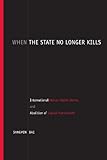
Sangmin Bae. When the State No Longer Kills: International Human Rights Norms and Abolition of Capital Punishment. SUNY Series in Human Rights. Albany: State University of New York Press, 2007. xv + 178 pp. $65.00 (cloth), ISBN 978-0-7914-7207-1; $21.95 (paper), ISBN 978-0-7914-7208-8.
Reviewed by Debora Di Dio (Development Studies, Macquarie University)
Published on H-Human-Rights (March, 2010)
Commissioned by Rebecca K. Root (Ramapo College of New Jersey)
From Abolitionists to Retentionists: The Politics of Capital Punishment
Why have some states abolished the death penalty, and why have others retained it despite international obligations? Do domestic and international agents influence norm compliance, and to what extent? In When the State No Longer Kills, the second book published in the SUNY series in Human Rights, Sangmin Bae seeks to explore how, when, and through what political processes states comply with international norms relating to the death penalty. She does so by examining how the effects of international norms are mediated or conditioned by different domestic political configurations and by demonstrating that human rights, and especially the death penalty, are inextricably linked to domestic and international politics.
The use of the death penalty has decreased worldwide, reflecting a growing international consensus that the death penalty is a violation of human rights and international laws specifying a right to life. According to Amnesty International, 109 countries have now abolished the death penalty in law or practice. Yet, despite the growing international movement to abolish capital punishment, the impact of human rights norms varies cross-nationally. Bae’s empirical research makes an important addition to the growing body of scholarly work that seeks to identify more precise hypotheses on the interaction between human rights norms and domestic factors. The book is divided into six chapters, in which Bae uses a case study approach to provide a comprehensive study of norm compliance with respect to the death penalty across four different contexts. In each of the case studies (Ukraine and South Africa as abolitionist countries, South Korea where death penalty is under moratorium, and the United States as a retentionist country), the author highlights the unique role and intervention of political leadership, domestic institutions, civil society, and international actors to help explain the cross-national variability in capital punishment.
Chapter 1 presents a broad overview of topics relevant to capital punishment, including a historical introduction on the evolution of the concept of the death penalty after World War II, international human rights instruments prohibiting the death penalty, and a summary of international relations theories related to norm compliance and state behavior. Bae also frames the structure of the following chapters and introduces a number of specific variables (domestic context and agents, such as major political events, and international human rights regimes and transnational networks), which she uses to explain states’ behaviors and responses in relation to human rights norms.
Chapters 2 and 3 focus on Ukraine and South Africa, countries where the abolition of the death penalty has overlapped with the opportunity for a radical political transformation (post-Soviet Union in Ukraine and post-apartheid in South Africa). Ukraine is an extremely interesting case that Bae has used well to illustrate how the strong influence of an international agent, the Council of Europe, can manage to enforce death penalty reform in a state especially unsympathetic to such reform. Through the experience of Ukraine, Bae demonstrates that contrary to the idea that national debate on the death penalty is conducted in purely domestic terms, the international dimension is sometimes equally significant. In South Africa (chapter 3), the abolition of capital punishment, which was once used as a political tool for enforcing racial separation, was made possible thanks to the joint effort of key domestic players, such as civil organizations, the Constitutional Court, and the African National Congress leadership. In both country analyses, Bae highlights the major factors that were crucial in norm compliance. In Ukraine, on the one hand, the admission to the Council of Europe and its consequent economic benefits encouraged the government to adhere to unwanted norms. In South Africa, on the other hand, strong social pressure and the need to create a post-apartheid identity were necessary in promoting a shared commitment to human rights and most of all the right to life.
In chapter 4, Bae explores the path of South Korea, a country that once regularly sentenced political dissidents and criminals to death, and that since 1997 has placed an unofficial moratorium on death sentences. Here, the domestic agents who have played a crucial role for the moratorium on executions include influential individuals, like the president and former death row prisoner Kim Dae-jung, and leaders of the domestic abolitionist movement. Furthermore, Bae provides an interesting analysis of obstacles to an outright abolition in South Korea, namely, the country’s authoritarian legacy, the lack of regional enforcement, and political manipulation of the Confucian values of order and social discipline.
Discussions about the death penalty and its abolition raise debates and profound challenges, domestically as well as internationally. Bae does an excellent job of highlighting the controversy surrounding the death penalty in the last case study of her book, which focuses on the United States. In the United States, the death penalty is an extremely politicized matter, reinforced by the populist nature of U.S. electoral politics and a vigilante mentality that still seems to have a strong influence on the contemporary imposition of death penalty in southern states. This is an example of a country where the death penalty is regarded as a matter of national sovereignty (in contrast to the global trend toward abolition), and where the issue still generates mixed support from the public. Bae might have explored the aggressive position of the United States on the death penalty in the aftermath of 9/11, and especially on the debates that have arisen over enforcing the death penalty to prosecute terrorists, but this is not discussed.
Overall Bae’s work is highly instructive. Its comprehensive, multidimensional approach presents detailed accounts of the individual case studies, their political background, history of international norm compliance, and human rights record. The chapters are highly readable, making this book appropriate for an undergraduate audience. Bae’s findings and conclusions are drawn from extensive documentation; in-depth research; and analysis of reports, public documents, and pieces of legislation, as well as speeches and interviews. This volume is also highly recommended to scholars of human rights, comparative politics, and political scientists in general, given the combination of methodologies and Bae’s presentation of the abolition of the death penalty as a truly multifaceted issue. However, experienced scholars may find that both the introduction and conclusion of the book are rather general, and some sections within chapters are very short, only summarizing important questions that deserve further investigation.
If there is additional discussion of this review, you may access it through the network, at: https://networks.h-net.org/h-human-rights.
Citation:
Debora Di Dio. Review of Bae, Sangmin, When the State No Longer Kills: International Human Rights Norms and Abolition of Capital Punishment.
H-Human-Rights, H-Net Reviews.
March, 2010.
URL: http://www.h-net.org/reviews/showrev.php?id=26118
 | This work is licensed under a Creative Commons Attribution-Noncommercial-No Derivative Works 3.0 United States License. |

