



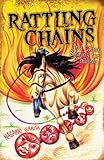
Nasario García. Rattling Chains and Other Stories for Children / Ruido de cadenas y otros cuentos para niños. Houston: Piñata Books, 2009. 160 pp. $9.95 (paper), ISBN 978-1-55885-544-1.
Reviewed by Melina V. Vizcaíno-Alemán (University of New Mexico)
Published on H-NewMexico (April, 2010)
Commissioned by Tomas Jaehn (Special Collections/Center for Southwest Research)
Reimagining Home in the Río Puerco Valley
Nasario García's bilingual collection of five short stories set in the Río Puerco Valley, New Mexico, is the latest from Arte Público's Piñata Books series for children. The book features an English cover on one side and a Spanish cover on the other, a publishing technique characteristic of the Piñata Books imprint. Despite the fact that the book is marketed for children, García's stories are pieces of modern-day folklore. They are both fictional and folkloric, and a product of New Mexican oral and written traditions. The stories take the perspective of protagonist Junie López, who mirrors the author as a young boy growing up in rural Río Puerco. By populating the stories with the voices of Junie's ancestors, and those of saints, witches, and owls, García maintains the integrity of southwestern literary and oral traditions.
New Mexico's Hispanic cuento (oral story) tradition dates back to the Spanish colonial period in the Southwest. Serious studies in this genre began after 1912 with the work of Aurelio M. Espinosa and later developed with the research and publications of Arthur L. Campa and George I. Sánchez. García's own oral histories of the Río Puerco Valley continue this tradition. New Mexico's cultural industry emerged contemporaneously with the study of Hispanic folklore, as artists and writers migrated to the Southwest in the early twentieth century. Alice Corbin Henderson and Mary Austin in Santa Fe, and Mabel Dodge Luhan in Taos focused their energy and representations of the Southwest on its "primitive" folk cultures, which today still populate the regional literary tradition.
Rattling Chains / Ruido de cadenas is set in the 1930s, a climactic decade for both Hispanic folk studies and southwestern literature. The New Deal created the New Mexico Federal Writers' Project, a state-run program that targeted rural New Mexican villages, and provides a historical backdrop for García's stories; it becomes a critical way to understand the book itself. New Mexico's Anglo literary heritage maintains the state's quaint depiction of rural communities, but García's stories redress this representation. In the first story, "The Magical Nicho / El nicho mágico," for instance, a popular New Mexican saint, El Santo Niño de Atocha, comes to life in the context of Junie's father's relief work. "My father had been working for the federal government building roads and other projects," says Junie. "He didn't' make much money, but he and Mom were able to save a few dollars" (p. 7). Although subtle, federal relief creates a spiritual dilemma in the story, and it sets the tone for the book's supernatural tales.
García's attention to geography makes the home a critical place in which progress and traditions come together. "The Magical Nicho / El nicho mágico" issues a lesson on how to incorporate progress without interrupting folk religious traditions. In fact, the home restores balance and order in all of García's stories. When Junie or the other fictional characters cross the Río Puerco into strange territory, the home keeps their place in the community. In "The Coquimbo Owl / El coqumibo," for instance, García tells about the folk Hispanic superstition of owls, but he also teaches about the home. Junie sneaks out of his grandma's house and encounters a bruja (witch) disguised as an owl, so that, by the end, the home he escapes becomes a place of refuge.
In the title story, García closes his short but delightful collection with a supernatural tale that also serves as a lesson on the modern significance of ghost towns. Literally it is about "El Coruco" (chicken coop), "an enchanted place where chains rattle," but allegorically the story is about the author's own rural home (p. 49). Junie begins telling the story, but his grandfather's voice takes over and he tells Junie two tales about fabled witches and bright lights in El Coruco. In one tale a fireball chases a man into the Río Puerco, and in the other a witch travels the sky in the form of a bright light. When Junie asks his grandpa if the lights were like airplanes, he replies "No hijito. There were no planes back then" (p. 56). Yet Junie's question evokes the modern. Bright lights are a supernatural force in grandpa's story, but in Junie's experience they are modern forces. As the first story reveals, Junie's father is a relief worker. At the end of the collection, when Junie's grandpa warns, "watch out for the moving lights. They could be witches," the book also issues a warning about progress (p. 61).
Though the stories take place during the 1930s, they carry a message about the present Río Puerco landscape and Junie's home. Junie mentions his village to locate his family's ranch and his grandparents' homes, but the village itself has no name. Moreover, the only characters besides his own family to appear in these stories are mythical figures or people from the past, suggesting that Junie's village suffered the fate of El Coruco and is now a ghost town. What comes to life is the Río Puerco, for the river marks the boundary between the familiar and the strange. Junie must learn how to cross and maintain those boundaries, as do the other fictional characters in the stories. As pieces of folklore, García's stories teach about the past, but as fictional pieces they teach through historical allegory about the present Río Puerco.
García's supernatural stories in Rattling Chains / Ruido de cadenas reveal something about modernity in rural New Mexico, even as they resolve through historical allegory the vanishing effects of progress. While the book's magic evokes a child's imagination, it also becomes a folk lesson. The home establishes Junie's place in the stories and in Río Puerco, but the stories themselves give the author a place to reimagine his home in a modern setting. The stories connect the supernatural to symbols of progress to teach Junie a lesson about transgression and homecoming. Yet the collection itself transgresses fictional and folkloric boundaries so as to stage the author's own homecoming. In the process, García modifies the folk tradition using fictional tools that restore the rural home in the present, making Rattling Chains / Ruido de cadenas and its lessons as relevant for today as in the past.
If there is additional discussion of this review, you may access it through the network, at: https://networks.h-net.org/h-newmexico.
Citation:
Melina V. Vizcaíno-Alemán. Review of García, Nasario, Rattling Chains and Other Stories for Children / Ruido de cadenas y otros cuentos para niños.
H-NewMexico, H-Net Reviews.
April, 2010.
URL: http://www.h-net.org/reviews/showrev.php?id=26050
 | This work is licensed under a Creative Commons Attribution-Noncommercial-No Derivative Works 3.0 United States License. |

