



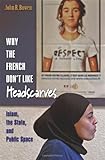
John R. Bowen. Why the French Don't Like Headscarves: Islam, the State, and Public Space. Princeton: Princeton University Press, 2008. 290 pp. $19.95 (paper), ISBN 978-0-691-13839-8.
Reviewed by Safiye Yildiz (Humboldt-Universität Berlin)
Published on H-German (December, 2009)
Commissioned by Susan R. Boettcher
Thinly Veiled Discourses
After September 11, 2001, public wearing of headscarves caused conflicts that significantly shaped public debate in many European nations. France is one of the few countries in Europe to ban the wearing of headscarves and religious symbols in primary schools. John R. Bowen's work as presented here poses many significant questions and gives valuable suggestions for further research projects in this area.
John R. Bowen starts his account in early 2001 in Paris and continues through the earthshaking events of that year before ending his narrative in 2005. His research on France thus witnesses to the aftermath of September 11 and the resulting debate about Islam among a range of peoples, institutions, and states. In attempting to characterize the conflicts with respect to the headscarf appropriately, Bowen delineates stages in the debate from 1989 to 2005. In his second and third chapters, he analyzes the history of thinking about religious symbols in France. Here, he focuses on republicanism and laïcité, which shape France politics, individual thinking, and society. In this mode of thought, which draws on the political philosophy of Jean-Jacques Rousseau, priority is given to general interests and defined values for ensuring uniformity. Individual interests and pluralism are secondary. Schools are seen as a "socializing agent," as an institution of the state for ensuring integration of individuals into the French nation (p. 12). Before this background, Bowen reveals the intertwined relationship between state and religion, state and law, and state and schools. Drawing on the conceptual framework of laïcité and the principles of republican values, and because of official rules about socializing individuals and integrating them into secular French society, schools have become central institutions in regulating Islam. Within this framework of values, headscarves and veils have become an urgent matter in schools and society in general. Although he focuses on the French public debate on headscarves, Bowen also makes analogies to discussions about headscarves that occur in other countries.
In subsequent chapters, Bowen observes various aspects of the discourse on Islam, which eventually opens up into a broader account of Islam as it is understood by different sections of the population, institutions, and individuals in France. During his research, he spoke with representatives of institutions, spokesmen of religious associations, party members, feminists, and women who wear veils. He also took part in official discussion forums, like those of the National Assembly, and talked with non-officials in order to understand various aspects of these phenomena. Additionally, he focuses on media coverage. Including different participants of the debate in his observations, he explains how the headscarf came to prominence in public discussions and highlights the complexity of disputes over it. Considering the relationship between the state, Islam, and public space, he poses many questions and emphasizes the contradictory positioning of the state with respect to headscarves. Bowen points out that even though the French republic has historically drawn on laïcité and republican principles, the state never excluded religion from politics--indeed, religion has typically been involved in it. Because the state allowed the presence of Islamic groups and the teaching of religion in public schools, the central question, "Why, then, did scarves in schools create a scandal?" (p. 4) points to the ambiguities of policies on religion and headscarves.
Bowen asserts that debates over Islam in France cannot be seen as an issue only of Islamic organizations or as a problem that began in Muslim states that has worked its way outward. Instead, he describes a complex situation that is reproduced internally in France. The social situation, education problems, and construction of community, especially in poor suburbs, reflect a French migration politics that cannot cope with the problems it creates. Indeed, he stresses that no attempt has been made to solve them. Because workers from former colonies were seen initially as temporary laborers, their children were encouraged to think in their own languages and understand their own cultures so that they might adjust more easily to their "own" countries upon return. Here, we can observe a similarity to German migration politics, with its terminology of "guest workers" and a pattern of residential segregation that has led to isolation. Given this background, ethnic and spatial segregation was caused by the beginning of migration to France. The author thus rejects notions of community based on religious affiliation or resulting from the religious activities of Islamic associations or fundamentalists.
In the 1980s, immigrants to France and their descendants began to demand rights, gain citizenship, and develop self-perception and self-positioning as members of the majority society. They demanded recognition with and for their differences. The self-perceptions and positioning of some Muslims in France as Beurs, which means "Arabs," emphasizes their affiliation and contextualizes their social lives. In this context, the attack on the World Trade Center became a remarkable watershed for the French debate on Islam and headscarves. Bowen analyzes the repercussions of the dispute over headscarves on Islamic definitions of community, Islamism, and sexism. To explain why headscarves are located at the center of negotiations in schools, the author includes the opinions of former presidents, leaders of Islamic associations, teachers, girls, and women who wear scarves as a personal choice, and feminists in order to explore arguments for and against wearing headscarves in schools. The various positions are thoughtfully taken into consideration. Notably, headscarves have surfaced in public debates as symbols of oppression, as "threats" to the public, and as a reflection of different anxieties. In these debates we observe the aftermath of the dominant debate on terrorism in the discussion about the threat from Muslim countries "outside" and Muslims inside France.
Increasing levels of debate over headscarves has led to attempts to regulate their wearing. The French media plays an important role in sustaining the fears of the French population. Debates over a law to ban headscarves in schools and public spaces caused serious dilemmas in France in late 2003 and 2004. The Stasi Commission (named after French ombudsman Bernard Stasi), which was set up by former president Jacques Chirac to address this issue in 2003, included experts on Islam, leaders of Muslim associations, school principals, political leaders, and social groups. But the inclusion of certain groups and individuals seemed to support the dominant public opinion that the veil itself was the cause of problems. Bowen mentions that the opinions of sociologists who have investigated reasons for wearing the headscarf and experiences of young women who had been expelled from school for doing so were not taken into account. The exclusion of these more critical stances and the undermining of research that did not support majority French ideals reproduced the dominant point of view, which suggested that headscarves and Muslims--rather than perceptions of them by outsiders--were the core problems.
In chapters 7, 8, and 9, Bowen attends to the central role played by television, radio, and print media in linking the headscarf to communalism, Islamism, and sexism. He also delves into the relationship between media and philosophy. He describes a main feature of the French debate by saying that "in no other country does applied philosophy intertwine with media campaigns to the extent it does in France. Perhaps also nowhere else are print and televised media as intertwined through overlapping directorships and gatekeepers as in France" (p. 155). This particular background has fanned the mounting tensions between immigrants and French society. In one particularly effective example of this point, Bowen discusses The Lost Territories of the Republic (2002), a book edited by a teacher that links Muslim communalism with antisemitic acts by Muslims and denounces them. Bowen shows how this kind of book influences public debates, working upon a wide range of people (ministers, school inspectors, teachers, politicians, and feminists) and reinforcing fixed ideas about Muslims that lead to social disapproval. He shows how the themes of Muslim communalism, violence, sexism, and rape are closely linked to the veil in the media.
The failure of the state to cope with social problems such as poverty, unemployment, education problems, and violence in poor suburbs of cities such as Paris, Lille, and Lyon, and the attribution of these difficulties to a single religious belief via its association with the headscarf, deepen the dilemma without solving any of the problems. To quote the author, "[i[t is never just about scarves" (p. 66). For all the useful information and insights included in this book, the focus on the headscarf can be just as distracting for the researcher as it is for society. The reason why religion is considered in many disciplines to be a main category of investigation certainly has to do with national politics and their relationship to religion; they dominate the public sphere and shape the consciousness of the population in different ways, among other things. We are currently witnesses to grave social and political changes. Even though there is certainly a need to look into the subject of religion, scholarly analyses of social and political systems should move beyond focusing on Islam and the headscarf, due to the risk of reproducing a mainstream debate that sees Islam as political issue and a "threat," and not as simply a religion like Christianity or any other. Without undermining the significance of the political instrumentalization of Islam, further studies that address the question of how religions, both Christianity and Islam, have traditionally contributed and continue to contribute to inequality between men and women should facilitate a broader understanding of debates over gender inequality from perspectives beyond that of the majority toward the minority. Incorporating a comparative analysis of gender relations and gender inequality in the historical context of the (post-)Christian tradition would yield worthwhile findings with respect to the effects of gender and inequality in western Europe that might illuminate discussions of these matters in Muslim migrant groups. In other words, we should ask why we speak about "Islamism" and not "Christianization." This concern aside, John R. Bowen's book certainly contributes to scholarly awareness of the subtle nuances and differentiated points of view on this topic.
If there is additional discussion of this review, you may access it through the network, at: https://networks.h-net.org/h-german.
Citation:
Safiye Yildiz. Review of Bowen, John R., Why the French Don't Like Headscarves: Islam, the State, and Public Space.
H-German, H-Net Reviews.
December, 2009.
URL: http://www.h-net.org/reviews/showrev.php?id=25927
 | This work is licensed under a Creative Commons Attribution-Noncommercial-No Derivative Works 3.0 United States License. |

