



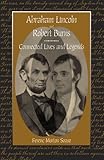
Ferenc Morton Szasz. Abraham Lincoln and Robert Burns: Connected Lives and Legends. Carbondale: Southern Illinois University Press, 2008. Illustrations. xii + 242 pp. $27.95 (cloth), ISBN 978-0-8093-2855-0.
Reviewed by James Percoco
Published on H-CivWar (March, 2010)
Commissioned by Martin P. Johnson (Miami University Hamilton)
The Bond across the Pond
Each New Year’s Eve, revelers, world over, as the clock ticks past midnight, break out in lusty versions of Auld Lang Syne. Few among them probably know that the famous lyrics to the anthem were penned by the Scottish poet Robert Burns. Fewer still, most likely, do not recognize that Burns’s oeuvre of poetry had a lasting influence on early American culture, particularly that of the Appalachian frontier. Settling along the Appalachian were many descendents of the Scottish bard’s homeland, and his poetry took root with its exhortations of social equality, nonjudgmental tolerance, and support for those seeking a better life. Within this milieu, argues Ferenc Morton Szasz, Burns found a kindred spirit with a youthful Abraham Lincoln. Raised out of stock influenced by the conventions of frontier Appalachia America, Lincoln by the time he was a teenager could freely quote Burns. Both men grew out of the ranks of the people. In 2009, the United States celebrated the bicentennial of Lincoln’s birth while Scotland marked the 250th anniversary of the birth of their national poet. How fitting then that both men, international giants, who shared a mutual fondness and natural empathy for those struggling to better their lives, should find championed their mutuality in Abraham Lincoln and Robert Burns.
On the surface it is easy to see the connection. Lincoln and Burns were born to families who lived in near poverty, Burns in a cottage near Ayr, Scotland, and Lincoln in a log cabin close to Hodgenville, Kentucky, both popular with tourists. But according to Szasz it is really words, cadence, and poetry that link the men. True, Lincoln was a doggerel rhyming poet at best, but the essence of Lincoln the wordsmith is rooted in a fundamental understanding of the power of words connected with strong ideas, something from which he was able to glean from Burns. Famously, in an 1859 speech about inventions, Lincoln argued that words were the greatest invention of humankind, providing people the ability to speak with the dead, the absent, and the unborn. Lincoln’s capacity to grasp this is clearly evident from his understanding of Burns not only as a poet but also as a philosopher and keen observer of humanity. Lincoln was shaped by Burns’s words and his moral conviction and philosophy.
In a wider sense, Szasz frames a book that seeks to make a broader Scottish connection with the sixteenth president. This would include the Scottish Presbytery. “The poetry of Robert Burns did not mark the sole Scottish impact on the life of Abraham Lincoln. Scottish immigrants and Scottish ideas were intertwined with his entire career. From his birth to his assassination, Lincoln never moved far from the long reach of Scots/Scotch-Irish cultural influences” (p. 87). This argument is plausible given the demographics of settlers of Appalachia America, of which both the Lincolns and his maternal Hanks family were members. “Thus, it seems clear that Abraham Lincoln’s world was shaped not only by the verse of Robert Burns but also by the activities and ideas of his fellow Scots” (p. 115). Yet in spite of this argument, subsequent evidence and “Lincoln’s well-documented love of Burns’s lyrics,” Lincoln only directly quoted Burns once, in a brief letter that appeared in the October 28, 1837, Sangamo Journal (p. 76). Szasz is quick to pick up on this and deftly handles the conceit recognizing that one must infer Burns’s influence on Lincoln through the content of Lincoln’s words.
Lincoln and Burns also share a communal link in the realm of historical memory. Both have had many statues raised to their memory, as well as portrait works of each in the United States and Scotland. “The memorialization process gradually melded Burns and Lincoln into the symbols of their respective nations” (p. 143). According to Carl Sandburg, by 1939 Lincoln had become “the symbol of America,” while in 1892 the influential Scotsman claimed that Burns had replaced Saint Andrew as the patron saint of Scotland (p. 144).
In the ever burgeoning field of Lincoln studies and Lincoln literature, Szasz has contributed an interesting, thoughtful, and well-researched account of how Burnsian the United States may be given the affinity the sixteenth president had for the humble Scottish poet.
If there is additional discussion of this review, you may access it through the network, at: https://networks.h-net.org/h-civwar.
Citation:
James Percoco. Review of Szasz, Ferenc Morton, Abraham Lincoln and Robert Burns: Connected Lives and Legends.
H-CivWar, H-Net Reviews.
March, 2010.
URL: http://www.h-net.org/reviews/showrev.php?id=25908
 | This work is licensed under a Creative Commons Attribution-Noncommercial-No Derivative Works 3.0 United States License. |

