



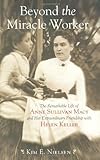
Kim E. Nielsen. Beyond the Miracle Worker: The Remarkable Life of Anne Sullivan Macy and Her Extraordinary Friendship with Helen Keller. Boston: Beacon Press, 2009. xv + 299 pp. $28.95 (cloth), ISBN 978-0-8070-5046-0.
Reviewed by Daniel S. Goldberg (Baylor College of Medicine)
Published on H-Disability (March, 2010)
Commissioned by Iain C. Hutchison (University of Glasgow)
The Disabled Leading the Disabled
Teacher, governess, interpreter, parent, caregiver, agent, child, and friend are but some of the roles Anne Sullivan Macy (1866-1936) played to Helen Keller (1880-1968). And for only the second occasion in the last sixty years, someone has stepped forward to remind readers that the story of Keller’s life is in an important sense the story of the relationship with her teacher (Macy), rather than simply an individual triumph. The popularity of Keller’s narrative played on Macy herself, as author Kim E. Nielsen takes pains to emphasize.
Nielsen’s work is a significant contribution for a number of reasons. First and foremost, it is testament to a basic tenet of the phenomenology of disability: the lived experiences of disability are largely a function of the social lives, support, and resources available to an impaired person, rather than of the clinical nature of the impairment itself. The profundity of Keller’s life and accomplishments is inextricably linked with the depth and quality of the decades-long relationship Keller shared with Macy. But it would be a grievous mistake to perceive the importance of Macy’s life story solely in terms of its role in shaping the Helen Keller that the world embraced, because this framework simply reinforces the aforementioned trope that pins Macy’s life as instrumental to the greater glory of Keller’s.
Nielsen inverts this hierarchy by examining Macy’s lifeworld through the letters, documents, and sources that have congregated around Keller’s own narratives. In other words, while it is true that we know about Macy primarily because she taught Keller, Nielsen demonstrates that we can use the plethora of primary sources surrounding Keller’s life to examine and interpret Macy’s own life. Of course, given the close relationship between the two women for over four decades, much of the material Nielsen draws on is correspondence between Macy and Keller. Even correspondence with others tends to revolve around the household life and the relationship between Macy and Keller, which included many domestic concerns common to families of the time (e.g., financial concerns, real estate transactions, occupational decisions, illness management, social engagements, travel plans, etc.).
The second contribution Nielsen makes is through the constant reminder that Macy’s narrative is itself a narrative of disability. Macy lived with trachoma and, as a result, she gradually lost her eyesight. She, like many impaired persons then and now, underwent multiple surgeries intended to fix the problem and, also like many impaired persons then and now, was a chronic pain sufferer for most of her life. Yet Keller’s success and the stigma of disability combined to prevent Macy from self-identifying as disabled. The social conventions that generally associated blindness with infirmity and incapacity would probably not, according to Nielsen, have tolerated the idea of a disabled teacher leading a disabled student to such heights. Ironically, these same conventions were the baseline through which Keller’s accomplishments were viewed as impossibly high--it was precisely because Keller was deaf and blind that her erudition and graduation from Radcliffe College were perceived as extraordinary.
Indeed, given the pervasiveness in the United States of discriminatory attitudes based on gender, alienage, class, and disability during the period Nielsen examines, it is unsurprising that a constant subtext of Macy’s life is stigma. Yet Nielsen does not explore in any detail the implications of this subtext in light of the vibrant historiography on the interplay between prejudice, illness, and disability, and in particular the tight linkages between alienage, illness, and stigma in the fin-de-siècle United States.[1] These associations are particularly important in light of their relevance to the contemporaneous U.S. discourse on eugenics, which would come to have profound implications for children (like Keller) born deaf-blind.[2] While delving into these matters would admittedly have run the risk of detracting from the biography of Macy herself, there is good reason to maintain that these larger contexts were critical in shaping and influencing the experiences of a disabled, lower-class, woman of Irish heritage (the most compelling and obvious example being Judith Walzer Leavitt’s exposition on the life and experiences of Mary Mallon in Typhoid Mary: Captive to the Public’s Health [1995]).
Nevertheless, Nielsen elegantly demonstrates the fluidity and ambiguity of disability, class, gender, and social roles at the fin de siècle and beyond. The sheer number and variety of roles Keller and Macy fulfilled for each other over the course of their forty years together is remarkable. The dynamism was a powerful force that was neither always within either woman’s control, nor always beneficial, as the dissolution of Macy’s marriage shows. Although primary source limitations force Nielsen to do little more than surmise at the core reasons for the estrangement, she judiciously uses the available data to suggest that the attempt of Macy, Keller, and Macy’s husband John to live as a nuclear family--with John as father, Macy as mother, and Keller as daughter--was an important factor in breaking the marital ties.
Nielsen emphasizes the demons that chased Macy throughout her life, avoiding the pitfalls of armchair and retrospective psychoanalysis by drawing primarily on the letters Macy wrote to friends, patrons, and loved ones, including to Keller. Many of these letters reveal a lifelong struggle with chronic pain; the fear of growing blindness; and feelings of low self-worth, sadness, and anger toward the many assaults she perceived on her own and Keller’s character. As to those assaults, in many cases it seems that Macy’s perception was quite accurate. But Nielsen emphasizes that Macy perceived many of her struggles through the lens of the childhood trauma she experienced after being surrendered by her father at the Tewksbury Almshouse. This trauma seemed to have had an enduring impact, a historical observation consistent with the best evidence suggesting the lifelong effects of deleterious social and economic conditions in her youth.[3] Keller was probably the only human being in whom Macy could vest most, if not all, of her trust after the death of her beloved--and disabled--brother Jimmie in the almshouse.
In conclusion, Nielsen has provided a learned, readable narrative of Macy, one that succeeds admirably in foregrounding a woman who, during her own life, stood in the shadow of Keller. Their relationship was complex and fluid, but nothing if not tender, and Nielsen’s careful scholarship does justice both to the intricacies and to the warmth of the friendship. By the end of the biography, this reader was left with the impression that, of all the social roles Macy and Keller fulfilled for each other, the one Macy cherished the most is the title by which Keller most frequently addressed her: “Teacher.” There is little doubt that Macy earned it.
Notes
[1]. Howard Markel and Alexandra Minna Stern, “The Foreignness of Germs: The Persistent Association of Immigrants and Disease in American Society,” The Milbank Quarterly 80, no. 4 (2002): 757-788; and Alan M. Kraut, Silent Travelers: Germs, Genes, and the Immigrant Menace (Baltimore: Johns Hopkins University Press, 1995).
[2]. Kraut, Silent Travelers; and Martin M. Pernick, The Black Stork: Eugenics and the Death of “Defective Babies” in American Medicine and Motion Pictures since 1915 (New York: Oxford University Press, 1999).
[3]. Michael Wadsworth and Suzie Butterworth, “Early Life,” in Social Determinants of Health, ed. Michael G. Marmot and Richard G. Wilkinson (New York: Oxford University Press, 2005), 31-53.
If there is additional discussion of this review, you may access it through the network, at: https://networks.h-net.org/h-disability.
Citation:
Daniel S. Goldberg. Review of Nielsen, Kim E., Beyond the Miracle Worker: The Remarkable Life of Anne Sullivan Macy and Her Extraordinary Friendship with Helen Keller.
H-Disability, H-Net Reviews.
March, 2010.
URL: http://www.h-net.org/reviews/showrev.php?id=25895
 | This work is licensed under a Creative Commons Attribution-Noncommercial-No Derivative Works 3.0 United States License. |

