



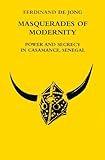
Ferdinand De Jong. Masquerades of Modernity: Power and Secrecy in Casamance, Senegal. Bloomington: Indiana University Press, 2008. x + 228 pp. $39.95 (cloth), ISBN 978-0-253-35172-2.
Reviewed by Mahir Saul (University of Illinois, Champaign-Urbana)
Published on H-Africa (June, 2010)
Commissioned by Esperanza Brizuela-Garcia (Montclair State University)
Masquerades, Politics, and Immigration: Ethnographic Reflections from Casamance, Senegal
This book is about masquerades and initiation ceremonies in the Casamance; secrecy as a cultural phenomenon that pervades them; and the changes wrought in these by work migrations, electoral politics, debates among Muslims, and all sorts of other developments. The Jola and the Mandinko play, as expected, center stage in the text, although a host of other ethnicities are also mentioned. Ferdinand De Jong focuses in one part of the book on the Kumpo and Kankurang masked performances associated with the Jola and the Mandinko respectively, in Ziguinchor, Diatock, and some other localities. Masquerades of Modernity is thus an addition to the literature of an ethnographic region along thematic lines that have numerous and admired or highly respected antecedents, all of which are listed in the bibliography.
The first four chapters deal with initiation. After a general introduction, the second chapter provides historical background on Thionck Essyl, a Jola town in the Boulouf region. De Jong describes the male and female initiations undertaken in 1994 and 1997, and argues that these traditions result in divided and opposed gender groups. The third chapter analyzes the participation of urban and international migrants in the male initiation ceremony. Chapter 4 extends this analysis by describing the staged "initiation" of one high profile politician and the advertised visits as spectators of a few others, who, by this means, try to forge a relationship with their electorate. De Jong also examines the ways in which initiation and Jola identity became factors in the internal elections of the Socialist Party in the area in 1995.
The next two chapters analyze Mandinko initiation. The first focuses on the city of Ziguinchor, which grew in the colonial period as a regional center by attracting a heterogeneous mix of migrants, among whom "Mandinka initiation," in an abridged and transformed version, became a standard in the context of widespread conversion to Islam. Muslims who follow the Tijaniyya brotherhood and some of the oldest converts do find it incompatible with their religious practice, and in general--departing from earlier usage--the circumcision operation for boys has been medicalized and dissociated from the rest of initiation. Apparently, however, the ceremony still serves as a boundary marker of "Mandinkized" Muslims from Catholics and other city residents. The second chapter of this section presents a case in which the Kankurang mask was involved in the lynch-like murder of two immigrants in the small town of Marsassoum and the legal proceedings that followed, underlining the ineffectiveness of the policing and judiciary apparatuses of the Senegalese state in this region.
Chapter 7 turns to the Jola fiber mask Kumpo and shows how its revival connects with the growing importance of labor migration. The relationship between senior men, junior farmers, and dependent young men and women who become migrants underlies this analysis. De Jong also examines the effects of the market economy and the tourist sector, and of the veering of the Senegalese state away from its non-tribal citizenship philosophy of the postindependence years toward the celebration of all ethnicities. The Kumpo is enshrined as "cultural heritage" in neighboring Gambia as well and the author explains that this is due to a politics of ethnic recognition pitting Mandinko against Jola. Chapter 8 is an essay on two Senegalese painters of different generations, Malang Badji and Omar Camara, who took up masquerades and initiation as thematic content for their art. A final chapter returns to the issue of secrecy and ethnographic writing with anecdotes from the author's experiences in a nod to the genre of reflexivity that gained currency in the 1990s.
De Jong confronted secrecy not only as a prevalent topic in the ethnography of this region but also as a stumbling bloc during field research, and seems to have been mystified by it. In the rare instance he is shown a secret, he is amazed at how unimpressive it is and doubts he is given the real thing. Secrecy is variously referred to as performance, discourse, practice, mode of communication, and body of knowledge. It is a boundary marker, between ethnic groups, between genders, or between smaller groups. It leads to "the production of translocality," even among young women who are excluded from it (p. 66). Can all of this be said at once without more sustained reflection on how these statements relate to each other? The discussion of the literature reveals the same penchant for aggregation and multiplication, rather than discernment. Beryl Bellman, Fredrik Barth on the Baktaman of New Guinea, Peter Weil, Johannes Fabian's observation that information was withheld from him to put him in his place, Michael Taussig, James Ferguson, the Comaroffs are all quoted side by side as if in perfect harmony; Max Gluckman and the urban ethnic studies of his students are dismissed without much understanding, although they would have shed light on the issues this book grapples with. Given this tone deafness, it is unfortunate that the flow of the text is constantly interrupted by salutes to one or another fashionable author, which distract from the developing narrative or train of thought, when they do not go against the grain of it. The ethnography appears thin. The most successful parts of the book are the capsule histories of towns and villages or of ethnic movements, offered as introductions to different sections, and the initiation of the politician in Thionck Essyl and the party politics that followed, which seem to have been observed with a clear head and presented with genuine interest.
If there is additional discussion of this review, you may access it through the network, at: https://networks.h-net.org/h-africa.
Citation:
Mahir Saul. Review of De Jong, Ferdinand, Masquerades of Modernity: Power and Secrecy in Casamance, Senegal.
H-Africa, H-Net Reviews.
June, 2010.
URL: http://www.h-net.org/reviews/showrev.php?id=25884
 | This work is licensed under a Creative Commons Attribution-Noncommercial-No Derivative Works 3.0 United States License. |

