



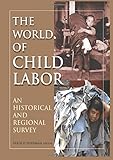
Hugh D. Hindman, ed. The World of Child Labor: An Historical and Regional Survey. Armonk: M.E. Sharpe, 2009. xxxii + 999 pp. $199.00 (cloth), ISBN 978-0-7656-1707-1.
Reviewed by Andrea Schapper (Bremen International Graduate School of Social Sciences)
Published on H-Human-Rights (January, 2010)
Commissioned by Rebecca K. Root (Ramapo College of New Jersey)
Attempting to Grasp a Multifaceted Phenomenon: The World of Child Labor
The edited volume, The World of Child Labor, dares something new; it attempts to comprehensively portray the highly complex and multifaceted phenomenon of child labor in a single book. Embracing 222 essays contributed by 190 authors and coauthors from multiple academic disciplines, it integrates an impressive variety of approaches and perspectives on working children. Particularly remarkable is how editor Hugh D. Hindman combines views from academic scholars as well as practitioners from all over the world engaged in the fight against child labor into what he calls an encyclopedia on the issue.
Following a brief editor's introduction and a note on how to measure child labor, the volume is divided into two major parts, each of which contains several thematic subsections. The first crucial division deals with child labor as a world phenomenon, starting with essays on "Understanding Child Labor." This first section not only helps explain child labor and its global implications, but also provides a spectrum of academic approaches for grasping it, ranging from historical and economic to social scientific views on the issue. It is rounded off by G. K. Lieten's endeavor to define major features in "Toward an Integrative Theory of Child Labor." A second section elaborates on child labor in the more developed regions of the world with an emphasis on historical perspectives, such as Peter N. Stearns's "Child Labor in the Industrial Revolution," Alec Fyfe's "The Historical Role of Education," and Bengt Sandin's "History of Child Welfare." The following section fleshes out child labor issues in less developed world regions, starting with a particular emphasis on the worst forms of child labor defined by the ILO (International Labor Organization) Convention 182. Certain economic sectors of concern with regard to the worst forms of child labor are highlighted, introduced by Fyfe's essay on "Agriculture," and followed by Jonathan Blagbrough's "Child Domestic Labor," David Maidment's "Street Children and Street Trades," Carmen Madrinan's "Commercial Sexual Exploitation of Children," Zoë Marriage's "Children and War," and Garance Genicot's "Child Bonded Labor." The fourth and last section of the volume's first part summarizes recent activities pertinent to the elimination of child labor, focusing on relevant actors, like the United Nations and UNICEF, the ILO and the International Program on the Elimination of Child Labor, nongovernmental organizations (NGOs), trade unions, and even organizations of working children themselves. Also of relevance in this section are global campaigns encompassing a variety of activities involving diverse actor constellations. Examples are the Millennium Development Initiative, wide-ranging consumer actions against products with child labor content, and the Global March Against Child Labor.
The second half of The World of Child Labor explores child labor in each region of the world, with subsections on respective country-specific child labor problems. It combines regional and national overviews on children's economic activity with thematic essays focusing on contemporary child labor issues. Here, indeed, the volume evolves into the character of an encyclopedia handling each nation with either a thematic essay or at least a single-page overview containing basic information on the country's economy, human development, and child activity data in the form of tables and figures.
Despite the diversity of contributors and perspectives in this volume, the majority of authors work with the fundamental definitions of "child labor" provided by the ILO Minimum Age Convention (C138, 1973) and the ILO Convention on the Worst Forms of Child Labor (C182, 1999). These define child laborers as all under-age persons in economic activity who have not yet completed compulsory schooling and who are below fifteen years of age in developed countries or below fourteen years of age in less developed nations.[1] Furthermore, the conventions demand the elimination of the worst forms of child labor, i.e., work that is likely to harm the health, safety, or morals of children, as a matter of urgency.[2] Additionally, most contributors implicitly or explicitly distinguish between the concepts of child work as benign or even beneficial forms of children's economic activity and more harmful types of child labor that are to be abolished in the long run.
Altogether, The World of Child Labor keeps the promise of providing encyclopedic coverage of the complex and multifaceted phenomenon of child labor. The collection of short essays, each comprising about five pages, comprehensively incorporates many relevant aspects pertinent to the issue. Contributions by authors with an academic as well as a pragmatic background and the integration of various approaches and disciplines enhance the quality of the edited volume considerably. Most contributing authors are recognized scholars or practitioners in the field; two names, however--even though cited frequently--are missing from the contributors' list. These are Kaushik Basu, well known for his research on the economics of child labor, first and foremost in South Asia; and Manfred Liebel, usually advocating for closer consideration of the embedding of child labor in local cultures and popular for researching movements of working children, predominantly in Latin America.
An outstanding feature of this book is that it touches on child labor issues that are usually neglected or under-researched. Prominent examples are Mario Biggeri's, Lorenzo Guarcello's, Scott Lyon's, and Furio C. Rosati's "The Puzzle of 'Idle' Children, Neither in School Nor Performing Economic Activity"; the taking-up of contemporary child labor problems in developed countries like the United States; or even diving into art history with George Dimock's "Visual Representations of Child Labor in the West."
The regional and country part, though, is balanced according to the availability of authors. In any case, it remains unclear why a significant part of the book focuses on child labor in the United States while there are only single pages treating Latin American countries with prevalent child labor problems, such as Chile, Ecuador, Paraguay, Peru, and Venezuela, to name a few. Another point of critique must be the "References and Further Reading" section following each essay. It is mostly outdated and usually only lists the works cited without making useful suggestions for further information and current research as has been promised by the editor. Some essays include repetitive messages; for example, regulations of the predominant ILO conventions elaborated on above are revived by many contributors. Finally, with all the complexity uncovered, there are no concluding remarks that might have helped the reader to recognize what direction The World of Child Labor is taking or what current implications it might have.
To sum up, The World of Child Labor is what it intends to be: an encyclopedia and a not only historical but also contemporary and regional survey. Its strength lies in its variety and comprehensiveness; for human rights researchers, however, the volume might not be more than an introduction or a collection on child labor issues inspiring further research elsewhere.
Notes
[1]. Exceptions are provided for children engaged in light work; hazardous work is prohibited for all persons under eighteen years of age.
[2]. ILO Convention Concerning Minimum Age for Admission to Employment (C138), adopted by the International Labour Conference,June 26, 1973, Geneva, Switzerland; and ILO Convention Concerning the Prohibition and Immediate Action for the Elimination of the Worst Forms of Child Labour (C182), adopted by the International Labour Conference, June 17, 1999, Geneva, Switzerland.
If there is additional discussion of this review, you may access it through the network, at: https://networks.h-net.org/h-human-rights.
Citation:
Andrea Schapper. Review of Hindman, Hugh D., ed., The World of Child Labor: An Historical and Regional Survey.
H-Human-Rights, H-Net Reviews.
January, 2010.
URL: http://www.h-net.org/reviews/showrev.php?id=25882
 | This work is licensed under a Creative Commons Attribution-Noncommercial-No Derivative Works 3.0 United States License. |

