



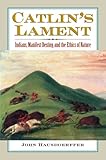
John Hausdoerffer. Catlin's Lament: Indians, Manifest Destiny, and the Ethics of Nature. Lawrence: University Press of Kansas, 2009. xvi + 184 pp. $34.95 (cloth), ISBN 978-0-7006-1631-2.
Reviewed by James Buss (Oklahoma City University)
Published on H-AmIndian (December, 2009)
Commissioned by Patrick G. Bottiger (Florida Gulf Coast University)
To Save or Lament?
John Hausdoerffer begins Catlin’s Lament: Indians, Manifest Destiny, and the Ethics of Nature by arguing that the book “grapples with George Catlin’s attempts to challenge nineteenth-century Indian Removal and environmental exploitation” (p. x). The opening passage indicates that Hausdoerffer plans on sharing something new about Catlin’s psyche, especially how it relates to both American Indians and the environment, but this concise volume is not your standard biography. In fact, its main scholarly contribution moves far beyond what a biography about Catlin could alone provide. Instead, Hausdoerffer, director of the Environmental Studies Program at Western State College, has given readers a book that challenges our basic assumption about nineteenth-century societal views on Indian Removal and, in a larger sense, nature. No longer can scholars of the period simply classify individuals as either for or against Indian Removal. Catlin’s Lament demonstrates how social constructions of progress and civilization in the removal era limited the efficacy of advocates, like Catlin, who sympathized with the plight of native peoples and sought to humanize them for an eastern audience but also found themselves participating in the very process of historicizing native peoples in ways that suggested that the “vanished” Indian was inevitable. In this way, Hausdoerffer uses George Catlin as a window through which we might better understand the banality of American colonialism in the nineteenth century.
George Catlin, a painter who traveled west of the Mississippi River in the 1830s to record images of America’s native people, has long eluded biographers attempting to analyze his motivations or the muse behind his artwork. Despite having published his own writings and thoughts, Catlin remains an elusive figure. Some historians have viewed him as a shrewd exhibitionist, mostly concerned with turning paintings into profit, while others believe he sympathized with his subjects and sought to change American attitudes toward the dispossession and disempowerment of America’s indigenous peoples. Hausdoerffer posits that Catlin “set out to address the ethical conundrum of his times but enacted the very narratives that limited the possibility of ethics” (p. 159). He investigates this “ethical conundrum” through four very different chapters, each of which addresses a separate issue, including nineteenth-century American attitudes toward an enlightened view of civilization and nature, American western expansion, Indian Removal, and Catlin’s infatuation with “collecting” Native America.
The four main chapters of Catlin’s Lament read as though they are a loosely connected collection of expository essays as opposed to narrative chapters of a standard biography. Rather than being a hindrance, this organization is, in many ways, the strength of the book. Each chapter requires the reader to view nineteenth-century America, and in turn Catlin, in a new context and provokes questions that hopefully will lead to further academic studies.
Chapter 1, titled “Catlin’s Epiphany,” initially sets out to explore the making of the artist. Hausdoerffer argues that Catlin’s observation of an Indian delegation in Philadelphia in the mid-1820s inspired his later goals of painting native people. Despite beginning with an examination of Catlin, the chapter really tells the reader more about the larger context of American scientific and Enlightenment views than about Catlin himself. The bulk of the chapter explores the exhibition of nature and science in Charles Wilson Peale’s Philadelphia Museum and the philosophy behind portraiture painting in early nineteenth-century America--one of Catlin’s first careers. And, it is this context that leads Hausdoerffer to conclude that these influences drove Catlin eventually to believe that “nature could be preserved through art” (p. 48). Chapter 1 hints at the significance of Hausdoerffer’s work, as he connects these larger cultural and societal threads to the decisions and writings of the well-known subject of the book.
Chapter 2, “Catlin’s Gaze,” provides the framework for understanding Catlin’s eventual lament. Using the work of cultural historian Mary Louise Pratt, Hausdoerffer briefly explores Catlin’s role as a colonial explorer who acted passively as an agent of American imperialism, lamenting his and his nation’s role in dispossessing the residents of America’s western landscape. These “imperial eyes” (as Pratt has deemed them), or “Catlin’s gaze” (as Hausdoerffer has dubbed it), allowed Catlin to “dearly wish he could halt the violent treatment of Indians,” while simultaneously participating in the very process of American expansion that threatened the subjects of his paintings (p. 66). In this chapter, Hausdoerffer again demonstrates his ability to link Catlin to larger trends in nineteenth-century America by tying the painter’s sense of remorse to the writings of contemporary Transcendentalist authors who focused on overconsumption and the destruction of the environment.
In chapter 3, “Catlin’s Lament,” Hausdoerffer addresses larger American attitudes toward Indian Removal. In subsections on Thomas Jefferson’s Notes on the State of Virginia (1787), James Fenimore Cooper’s Leatherstocking Tales (1823-41), Washington Irving’s Sketchbook (1819), and the depiction of Native Americans on nineteenth-century stages, Hausdoerffer attempts to demonstrate how American literature and theater both lamented the “Vanishing Indian,” as Catlin had done, while simultaneously perpetuating a narrative that ultimately concluded that removal or extinction was inevitable. Unfortunately these short sidebars (most only a few pages long) detract from Hausdoerffer’s brilliant examination of Catlin’s paintings of Black Hawk and the Seminole leader Osceola at the end of the chapter. While trying to paint a broad portrait of Jacksonian attitudes toward Indian Removal, Hausdoerffer instead leaves the reader confused, as the disjointed elements of the chapter do not provide a clear picture of either the artist or his contemporaries.
Not until the final chapter does Catlin’s Lament read like a standard biography, as the author examines Catlin’s tour of Europe and his work in establishing a national park. Here, Catlin’s voice stands out above others as Hausdoerffer relies on Catlin’s own writings to drive his conclusions. In speeches to European audiences, Catlin clearly demonstrated his criticism of American imperialism in a way that, according to Hausdoerffer, was meant to “preserve images of nature and thus icons of knowledge to enlighten the colonizer in hopes of inspiring a more humane global frontier” (p. 133). In the end, one wonders how Catlin’s ideals differed from those of early nineteenth-century Americans who pushed for assimilation.
Catlin’s Lament asks important questions about George Catlin’s sincerity about “saving” native people and about America’s lament of removing or assimilating native peoples. Moreover, it questions the sincerity of any nineteenth-century American who defended American Indian rights while simultaneously speaking about American progress. Ultimately, Hausdoerffer’s examination of nineteenth-century America speaks faintly about a present-day America and its commitment to a modern environmental movement that, on one hand, fights to defend the environment as a pristine and untouched landscape, while on the other hand, refuses to cede a way of life that is directly responsible for destroying it. Hausdoerffer opens the third chapter with perhaps the most powerful and apt statement of the entire book: “There is a thin line between saving and lamenting the dying” (p. 90). This paradox is at the heart of Catlin’s Lament and perhaps, as Hausdoerffer suggests, our current understanding of nature and the environment.
If there is additional discussion of this review, you may access it through the network, at: https://networks.h-net.org/h-amindian.
Citation:
James Buss. Review of Hausdoerffer, John, Catlin's Lament: Indians, Manifest Destiny, and the Ethics of Nature.
H-AmIndian, H-Net Reviews.
December, 2009.
URL: http://www.h-net.org/reviews/showrev.php?id=25878
 | This work is licensed under a Creative Commons Attribution-Noncommercial-No Derivative Works 3.0 United States License. |

