




Karen Bayer, Frank Sparing, Wolfgang Woelk, eds. Universitäten und Hochschulen im Nationalsozialismus und in der frühen Nachkriegszeit. Stuttgart: Franz Steiner Verlag, 2004. 292 pp. EUR 60.00 (paper), ISBN 978-3-515-08175-7.

Mathias Beer, Gerhard Seewann, eds. Südostforschung im Schatten des Dritten Reiches: Institutionen – Inhalte – Personen. Reihe Südosteuropäische Arbeiten. Munich: Oldenbourg Wissenschaftsverlag, 2004. 288 pp. EUR 44.80 (cloth), ISBN 978-3-486-57564-4.

Bernd Gausemeier. Natürliche Ordnungen und Politische Allianzen: Biologische und Biochemische Forschung an Kaiser-Wilhelm-Instituten, 1933-1945. Geschichte der Kaiser-Wilhelm-Gesellschaft im Nationalsozialismus. Göttingen: Wallstein Verlag, 2005. 352 pp. EUR 27.00 (paper), ISBN 978-3-89244-954-6.
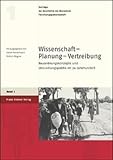
Isabel Heinemann, Patrick Wagner, eds. Wissenschaft - Planung - Vertreibung: Neuordnungskonzepte und Umsiedlungspolitik im 20. Jahrhundert. Beiträge zur Geschichte der Deutschen Forschungsgemeinschaft. Stuttgart: Franz Steiner Verlag, 2006. 222 pp. EUR 36.00 (paper), ISBN 978-3-515-08733-9.

Lothar Mertens. 'Nur politisch Würdige': Die DFG-Forschungsförderung im Dritten Reich 1933-1937. Berlin: Akademie Verlag, 2004. 414 pp. EUR 64.80 (cloth), ISBN 978-3-05-003877-3.

Hans Schmuhl, Reinhard Rürup, eds. Rassenforschung an Kaiser-Wilhelm-Instituten vor und nach 1933. Geschichte der Kaiser-Wilhelm-Gesellschaft im Nationalsozialismus. Göttingen: Wallstein Verlag, 2003. 358 pp. EUR 27.00 (paper), ISBN 978-3-89244-471-8.
Reviewed by Mitchell G. Ash (Department of History / Working Group in History of Science, University of Vienna)
Published on H-German (December, 2009)
Commissioned by Susan R. Boettcher
Politicizing "Normal Science" in Nazi Germany
The last twenty years have witnessed a vast expansion in research on twentieth-century German science and higher education, including but by no means limited to the National Socialist period. In many respects, this work continues the fundamental revision of earlier viewpoints that began in the 1980s.[1] Among scholars of the subject, it has become clear that older distinctions between apolitical "normal" science and politicized "pseudoscience" are untenable.[2] It is questionable in any case to apply current standards of what counts as science to the period in question; much research that now seems obviously flawed only came to be seen in that light after 1945. It is equally clear, however, that a wider range of case studies and new interpretations is needed, in order to understand more precisely how science that seemed "normal" at the time interacted with politics during the Nazi era, and how scientists repositioned themselves and their research at the time as well as after 1945.
New in recent work are two trends. First, scholars are taking a more intensive and detailed look at changes in agendas and content of top-level science not directly linked with Nazi medical crimes, nuclear research, or the aviation and rocketry programs. In this regard, special emphasis has been placed on research funded by two organizations: the central third-party funding organization for basic research in universities, founded in 1923 as the Notgemeinschaft der deutschen Wissenschaft, which came to be called by its present name, the Deutsche Forschungsgemeinschaft (DFG), during the Nazi era; and the Kaiser-Wilhelm-Gesellschaft (KWG), a prestigious association of extra-university research institutes founded in 1911. Second, recent work has also focused on the role of the social sciences and humanities, with special emphasis on interdisciplinary "spatial research" (Raumforschung), or area studies, in Nazi occupation policy.
This review discusses six disparate contributions to this expanding literature on the sciences and higher education under Nazism, unified by a common concern with continuities and discontinuities. The discussion is divided into three parts: research supported by the DFG; research at KWG institutes; and university and spatial research. The works reviewed here only exemplify wider trends, and should not be taken pars pro toto.[3]
We begin with the DFG. Lothar Mertens's controversial study is based on his discovery of important sources relating to the central administration of the DFG, which were then located at the former East German archive in Hoppegarten, near Berlin.[4] Mertens supplemented these materials with further work in West German archives. The volume appears to have been meant as a counterweight to Notker Hammerstein's more widely focused study of the DFG from 1922 to 1945.[5] Hammerstein maintains that "normal science" continued largely undisturbed under Nazism, because the Nazis never succeeded in developing a coherent science policy. Though he devotes some attention to the directorship of physicist Johannes Starck--a Nobel Prize winner, avowed Nazi, and proponent of so-called German physics--he downplays Starck's impact and emphasizes that established scientists, aided by Starck's own erratic behavior and his lack of skill in bureaucratic infighting, succeeded in getting him deposed from his position at the DFG by 1936. In exhaustive detail, Mertens establishes that party political considerations as well as Starck's personal preferences indeed played a role in the reorganization of the DFG, and also in the distribution of some research funds under Starck's directorship.
The vast material presented here offers a service to scholars in the way that Helmut Heiber's multiple volumes on universities in the early years of the regime also provide food for thought and fodder for research.[6] Unfortunately, Mertens's implied claim that the whole story of the DFG under Nazism has now been told is simply incorrect. There is insufficient consideration here of the impact of all this political maneuvering on the content of specific research programs, or of the complex repositioning of scientists who had previously been funded by the DFG after 1933. Hammerstein's assertion that what was funded was largely "normal science" is, sadly, no better, since he nowhere defines what he means by this term. Nor does he take note of the irony involved in being so contemptuous of the alleged "chaos" in Nazi-era science policy. After all, if this "chaos" actually existed, perhaps we should be glad; imagine the result if Nazi science policy had actually been coherent! The dichotomy between apologetics and polemical denunciation exemplified in these two books represents a fallback to an earlier era in historiography.
The extensive research program funded by the president's office of the DFG from 2003 to 2008 was put in place as a counterweight to both kinds of tendentiousness. In addition to numerous studies on specialized topics, such as genetics or "eastern research" (Ostforschung) after 1945, a number of volumes in the monograph series linked with the project present selected papers from conferences focusing on controversial issues. The collection edited by Isabel Heinemann and Patrick Wagner was the first such volume, and also the first item in the monograph series.
The editors' introduction links this issue to the history of the DFG clearly enough. As they write, research behind the infamous Generalplan Ost (GPO)--a plan for forced resettlement of "racially inferior" peoples in eastern Europe and their replacement by German agriculturalists--was financed by the DFG to the tune of 500,000 RM between 1941 and 1945 (Heinemann notes that one-fifth of these funds were applied for in 1945, but never dispersed). As the editors acknowledge, the GPO has been extensively researched in recent years. They position this volume in that literature by focusing on three themes: the role of DFG-financed researchers and projects in GPO and Nazi occupation policy; the relationship of the GPO to actual occupation policy in eastern Europe; and studies of planning, ethnic cleansing, and genocide in other places in the twentieth century, included for comparative purposes. The first chapter in the volume, by Gabriele Metzler and Dirk van Laak, establishes a conceptual basis for such comparisons by presenting a broad overview of planning utopias in the 1920s--including Fordist perspectives in the United States. Unfortunately, their implicit argument that the work of Nazi-era planners was part of a larger technocratic trend is persuasive only in part, because they do not show that an explicitly racialist mentality actually informed all of these utopias.
The following chapters focus concretely on the Nazi period. Isabel Heinemann's chapter on agriculturalist and planner Konrad Meyer, the GPO, and the DFG is the only contribution directly linked to the research program described above. As she shows, DFG support for research related to the GPO began not in its early development phases, but simultaneously with the presentation of the initial version of the plan to Heinrich Himmler in July 1941. Extensive support was applied for and received for the second, expanded version of the GPO in 1942 and for the even more expansive "general settlement plan" for all Nazi-held territories of 1942-43. University institutes and all members of Meyer's planning department in the agriculture ministry received funding for statistical studies, agricultural survey reports--including settlement card catalogues for the Altreich--and basic research on the "folk biological foundations" of settlement and land use patterns. Whereas Notker Hammerstein, in the study cited above, claims that Meyer's work was independent of ideology, Heinemann shows that the research he directed in Berlin and his priorities as head of the section for agricultural science in the Reich Research Council were clearly oriented to conquest and colonization policy in the East. Moreover, the planners' role was not limited to legitimation; they helped to define the problems to be solved in the first place, and provided specific policy recommendations--initially mass deportation, later forced labor and de-urbanization. Moreover, in contrast to exculpatory claims made by Meyer and others after 1945, parts of the plan were indeed put into practice, with fatal results for many of those singled out for Umvolkung. Subsequent chapters take up the question of the relationship of the GPO to actual Nazi occupation policy. Uwe Mai broadly discusses forced population redistribution in general; Christoph Dieckmann discusses German settlement policy in occupied Lithuania and its links with the GPO.
Important for the comparative issues the volume raises are the final three chapters by Michael G. Esch on resettlement in Poland after1945, Jörg Baberowski on "order through terror" in Stalinist Russia, and Christoph Marx on the forced resettlement of 3.5 million black South Africans into so-called Bantustans between 1960 and 1985 in order to create space for a white South African nation. Esch shows that the expulsion of Germans and Ukrainians from Polish territory as defined by the Potsdam agreement was largely improvised rather than planned. Experts became more involved in the subsequent debate over how to use events on the ground to forward the economic and social restructuring of Poland under communist rule; concepts from the Polish underground movement played a role in these discussions. Ironically, it proved more difficult to carry out centralized technocratic population planning and transfer in postwar Poland than it had been on the same territory under Nazism. According to Baberowski, Soviet nationalities policy began as a decades-long effort by the Bolsheviks to establish clarity in unclear circumstances. The effort to establish clear categories for this policy involved ethnologists, orientalists, statisticians, and linguists, but the results proved problematic even from the standpoint of Bolsheviks themselves. Problems presented by remaining populations--such as the Tatars--were solved by forced population transfer and/or murder, tasks in which policy planning experts were no longer central. As Marx's chapter shows, South African resettlement programs carried out in the 1950s and 60s were conceived on the basis of ideas developed by Boer historians and social scientists beginning in the 1930s, but the influence of scholars or scientists on actual practice remained marginal.
Since the conference from which this volume emerged was held, the central role of forced population transfer and ethnic identity politics in twentieth-century European and world history has gained wide recognition. Interestingly, the editors suggest at the end of their introduction that a look at forced resettlements outside Europe in the twentieth century might show that the ideal of ethnically "purified" territory was not a necessary feature of such policies.
Turning to the KWG and its institutes, two of the volumes under review present results from another, equally ambitious research program that focuses on these institutions under Nazism. The research program was initiated under the leadership of the then-president of the Max Planck Society, Hubert Markl, in the late 1990s. The program was supervised by two highly respected historians, Theodor Schieder and Reinhard Rürup, and directed successively by Doris Kaufmann, Carola Sachse, Susanne Heim, and Rüdiger Hachtmann. The program's work is now complete, and an impressive monograph series of seventeen often weighty volumes has been published. I confine myself to two relatively early volumes of the series: a volume of essays on "race research" (Rassenforschung) edited by Hans-Walter Schmuhl, and Bernd Gausemeier's monograph on biological and biochemical research.
Work on the history of "race research" has long been complicated by extreme difficulty in defining the term itself. The term's slipperiness in past usage is too often repeated in the literature on the subject. In his clearly written introduction to the volume under review, Schmuhl confronts the issue straightforwardly, distinguishing between two constructions. The first is a typological, generally non- or even anti-Darwinian approach, exemplified in the work of Count Gobineau and Hans F. K. Günther in the nineteenth and twentieth centuries, and intended to distinguish "races" from one another using physical and cultural criteria, with the aim of achieving "purity" in the "race" deemed superior (Systemrasse). The second, not always linked with the first, is a developmental, generally Darwinist approach, focusing on populations and diagnosing the danger to dominant peoples presented by alleged "degeneration" caused by industrialized civilization, with the aim of curing this "illness" by eugenic means. As the contributions to this volume show, relevant research at Kaiser Wilhelm institutes tended largely, though not entirely, to be in the second category.
Of course, research can have a racist agenda without actually using the term "race," and this description applies to much of the work studied in this book. It would have been helpful if the authors had made this central point of the book clearer throughout. The volume's first two chapters, on the Department of Genealogical Research at the Kaiser Wilhelm Institute for Psychiatry in Munich, headed by eugenicist Ernst Rüdin, make this difficulty clear. Volker Roelcke damns Rüdin effectively, but says little about why work at his institute could or should be called "race research." In his chapter, Richard Wetzell does not address the issue at all, but summarizes material already published in his excellent book on the history of criminology. The two subsequent chapters, by Michael Hagner and Helga Satzinger on research at Oskar and Cecilie Vogt's KWI for Brain Research, disagree on many points, but both establish the lack of serious research publications by the Vogts from the 1920s onward. Most interesting is their common finding that the vocabulary in Oskar Vogt's popular publications contrasts with quite different language used in actual research.
The next two chapters in the volume focus on KWG's center for "race research," the KWI for Anthropology, Human Genetics, and Eugenics headed by Eugen Fischer. Benoit Massin's long, not always well-focused text presents interesting information on aspects of the institute's research programs, but has since been superseded by Schmuhl's own detailed monograph on the subject.[7] Paul Weindling attempts to indict Hans Nachtsheim, a department head at the KWI for Anthropology in its final years, for his involvement in a research network using animal models, some of the members of which were also involved in eugenic killings. Nachtsheim appears to have benefited from the so-called euthanasia program by receiving brain samples from children murdered at the center in Brandenburg-Görden for use in a parallel study of epileptic seizures in rabbits and humans. No proof has yet been found that the killing itself was done in order to benefit the study. Use of legal and moral categories to establish guilt in this case makes it seem as though Weindling wishes to make up for the failure to prosecute Nachtsheim or his nominal superior, institute director Othmar von Verschuer, after 1945. An interesting chapter by Thomas Potthast on the use of the race category in botanical and zoological research and one by Doris Kaufmann on Franz Boas's attack on the race category in anthropology provide useful counterpoint to the other chapters.
Bernd Gausemeier presents a fascinating, detailed study of life sciences research in Alfred Kühn's KWI for Biology and Adolph Butenandt's KWI for Biochemistry. This is one of the most detailed and thoughtful efforts yet undertaken to confront the issues raised at the beginning of this essay. Gausemeier summarizes recent research on science and Nazism clearly in the introduction,[8] and argues there, correctly, that it is insufficient to ask only whether scientists conformed or evaded conformity with Nazi ideology, however defined. More important than outward demonstrations of ideological conformity, Gausemeier suggests, are changes in actual research priorities as well as institutional and laboratory practices. The author uses the term "alliances" to describe the needed linkages with state-funded, industrial, and other supporting institutions; in doing so, he points to a central category in the work of Bruno Latour,[9] a leading theorist in science studies, whose actor-network theory he uses extensively. Despite such theoretical pretensions, his analysis of the impact of the Nazi seizure of power in 1933 on the KWI for Biology, and of the dismissal of KWI for Biochemistry director Carl Neuburg and the appointment of Adolf Butenandt as his successor, is classic institutional history of high quality.
New is Gausemeier's effort to combine institutional analysis with the microhistory of scientific research programs and practices pioneered by Hans-Jörg Rheinberger.[10] Gausemeier reconstructs in detail several microhistories of what Rheinberger has called "experimental systems." One example is the work led by Alfred Kühn on the moth Ephestia kühniella, used as a model organism for a broadly based research program to establish the role of hormones in the genetic control of development in organisms, a program that shaped the conceptual framework of the research in the KWI for Biology in the late 1930s. Because this topic area was of great interest to the Rockefeller Foundation, Ephestia became "a fundamentally political animal" (p. 101), precisely because work using this creature seemed politically innocent. Gausemeier establishes more direct linkages between such research programs and political projects in the case of studies of the impact of radiation on genetic mutations directed by Nikolai Timoféev-Ressovsky at the KWI for Brain Research--which Timoféev himself claimed was potentially relevant to "race hygiene," as well as the multiple political repositionings of research projects led by Adolf Butenandt during the Second World War. Not always clear is Gausemeier's answer to the broader question of how the histories of "experimental systems" and the political alliances of scientists in dictatorships can be placed within a common explanatory framework. Sometimes he speaks of the mobilization of potential or alleged military importance (Kriegswichtigkeit) as a resource for "basic science," and at other times he speaks instead of "basic science" (reine Wissenschaft) as a resource for war. Could both relationships be possible, and is it possible that at times something new and unexpected emerged from such alliances? Apparently all three of these possibilities are imaginable, and examples of each can be shown to have occurred.
We turn, finally, to higher education and Raumforschung. The volume edited by Karen Bayer, Frank Sparing, and Wolfgang Woelk is the concluding publication of a research project concerned primarily with history of the medical academy in Düsseldorf. Apparently the conference from which this volume resulted had to be held and the volume published as a sort of project wrap-up; perhaps it would have been wiser to deviate from the German norm that mandates such publications in this case. The primary results of the project have been published elsewhere and are summarized competently by Karen Bayer in her chapter.[11] The volume appears to make a well-meaning attempt to place that work in broader context, but only some of the chapters actually link up with history of the Düsseldorf institution in any direct or meaningful way. The linkages are clearest in chapters with a regional orientation, as well as in those on medical research and practice. Karsten Klingemann's chapter on the involvement of Nazi-era West researchers in social research on German refugees from eastern Europe is an interesting contribution to the discussion of continuities after 1945. Most embarrassing is Hans Peter Voswinckel's chapter, grandiloquently entitled "Damnatio memoriae: Kanonisierung, Willkür und Fälschung in der ärtzlichen Biographik," in which he lists a series of flaws in the published version of a biographical lexicon of physicians on which he himself worked. Woelk's introduction is also problematic, due to entirely uninformed remarks about the alleged nonexistence of historical scholarship on universities and science in the Soviet occupation zone and East Germany.
Equally regional in focus, but showing more positive results, is the pioneering volume on southeastern European area studies (Südostforschung) edited by Matthias Beer and Gerhard Seewann. In the past ten years, Raumforschung and its linkages with occupation policy and practices during the Second World War have attracted much attention, with good reason. Such work has significant implications for a better understanding of the sciences under Nazism, for two reasons: the modern forms of interdisciplinary research organization and policy planning employed, also discussed in the collection edited by Heinemann and Wagner; and the active involvement of social scientists and humanists not only in the production of ideology, but in the politics of occupation. Previous work has focused largely on "east research" (Ostforschung) and "west research" (Westforschung). Similar questions are now finally being raised about southeastern European studies, focusing on Austria and the Nazi-occupied Balkans, for which analogous interdisciplinary organizations were created under the leadership of Vienna geographer Hugo Hassinger, historian Otto Brunner, and others.[12] The volume under review takes a welcome first step toward opening up this research field.
The volume's chapters include broad overviews of regionalism and historical Volkstumsforschung in the period1890-1960 by Will Oberkrome and of the European southeast in studies of "race theory" before and after 1933 by Christian Töchterle; institutional surveys of the history of the Munich Südost-Institut by Gerhard Seewann, the Munich institute's activities in Graz by Christian Promitzer, as well as chapters on institutes in Slovakia and Rumania; a chapter by Isabel Heinemann on the "racial experts" of the SS and one by Michael Fahlbusch on experts on southeastern Europe as participants in crimes against humanity; and a number of chapters focusing on one such scholar, Friedrich Valjavec, who became head of the Munich institute in the 1950s although, as Fahlbusch shows, he participated actively--once with a pistol--in "ethnic cleansing" operations in occupied Russia.
Unfortunately, the collection's overemphasis on historiography, both in Beer's introduction and in the volume as a whole, seems misdirected. As other research on Ostforschung, Westforschung, and the humanities under Nazism in general has shown, the interdisciplinary character of regional research and its team organization are two of the most significant and innovative features of these programs. Thus it is disappointing that fields like geography, cartography, demography, or ethnography are not included or even mentioned in this volume. Equally disappointing is the absence of contributions discussing the participation of scholars from Vienna or Leipzig in "southeast research," as well as a paucity of perspectives from the southeastern European countries themselves.[13] The Munich-centered focus of this volume is understandable, given its sponsorship, but the editors themselves are well aware that the net should be cast more widely. Their important first step in this new direction is surely not the last.
Notes
[1]. For reviews of this earlier work, see Mitchell G. Ash, "Science, Technology and Higher Education in Nazi Germany" Isis 86 (1995): 458-462; Jonathan Harwood, "German Science and Technology under National Socialism," Perspectives on Science 5 (1997): 128-151; and Margit Szöllöszi-Janze, "National Socialism and the Sciences: Reflections, Conclusions, and Historical Perspectives," in Science in the Third Reich (New York: Berg, 2001), 1-36.
[2]. Veronika Lipphardt, Dirk Rupnow, Jens Thiel, and Christina Wessely, eds., Pseudowissenschaft: Konzeptionen von Nicht-/Wissenschaftlichkeit in der Wissenschaftsgeschichte (Frankfurt am Main: Suhrkamp, 2008).
[3]. Publications related to the history of the DFG and the KWG before, during and after Nazism have continued to appear since the works under review were received. Reviews of some of these will appear separately in H-German.
[4]. Lothar Mertens, "Forschungsförderung im Dritten Reich," Zeitschrift für Geschichtswissenschaft 19 (1996): 119-126.
[5]. Notker Hammerstein, Die Deutsche Forschungsgemeinschaft in der Weimarer Republik und im Dritten Reich: Wissenschaftspolitik in Republik und Diktatur (Munich: C. H. Beck, 1999).
[6]. Helmut Heiber, Universität unterm Hakenkreuz: Der Professor im Dritten Reich (Munich: K. G. Saur, 1991); Helmut Heiber, Die Kapitulation der Hohen Schulen, vol. 1 (Munich: K. G. Saur, 1992); Helmut Heiber, Die Kapitulation der Hohen Schulen, vol. 2 (Munich: K. G. Saur, 1994).
[7]. Hans-Walter Schmuhl, Grenzüberschreitungen: Das Kaiser-Wilhelm-Institut für Anthropologie, menschliche Erblehre und Eugenik 1927-1945 (Göttingen: Wallstein Verlag, 2005).
[8]. In this introduction, Gausemeier discusses a paper of mine that has been widely cited in the German literature: Mitchell G. Ash, "Wissenschaft und Politik als Ressourcen für einander," in Wissenschaften und Wissenschaftspolitik: Bestandaufnahmen zu Formationen, Brüchen und Kontinuitäten im Deutschland des 20. Jahrhunderts, ed. Rüdiger vom Bruch and Brigitte Kaderas (Stuttgart: Franz Steiner Verlag, 2002), 32-51. Unfortunately, he wildly misinterprets it, claiming that it limits the resource concept to its conventional economic meaning. In fact, the aim is the exact opposite, to expand the concept and show how scientific personnel, ideas, and practices can all become, or be turned into, resources for political undertakings. Gausemeier's study actually provides effective and welcome support for my thesis.
[9]. Bruno Latour, Science in Action: Following Scientists through Society (Cambridge: Harvard University Press, 1987).
[10]. Hans-Jörg Rheinberger, Toward a History of Epistemic Things: Synthesizing Proteins in the Test Tube (Stanford: Stanford University Press, 1997).
[11]. Wolfgang Woelk, Frank Sparing, Karin Bayer, and Michael G. Esch, eds., Nach der Diktatur: Die Medizinische Akademie Düsseldorf vom Ende des Zweiten Weltkriegs bis in die 1960er Jahre (Essen: Klartext, 2003).
[12]. The basic issues were raised in Michael Fahlbusch, "'Die Südostdeutsche Forschungsgemeinschaft': Politische Beratung und NS-Volkstumspolitik," in Deutsche Historiker im Nationalsozialismus, ed. Winfried Schulze and Otto Gerhard Oexle (Frankfurt am Main: Fischer Taschenbuch Verlag, 1999), 241-264.
[13]. With respect to Austria, a pioneering paper appears to have escaped the editors' attention: Siegfried Mattl and Karl Stuhlpfarrer, "Angewandte Wissenschaft im Nationalsozialismus: Großraumphantasien, Geopolitik, Wissenschaftspolitik" in Willfährige Wissenschaft: Die Universität Wien 1938-1945, ed. Gernot Heiß et al. (Vienna: Verlag für Gesellschaftskritik, 1989), 283-301.
If there is additional discussion of this review, you may access it through the network, at: https://networks.h-net.org/h-german.
Citation:
Mitchell G. Ash. Review of Bayer, Karen; Sparing, Frank; Woelk, Wolfgang, eds., Universitäten und Hochschulen im Nationalsozialismus und in der frühen Nachkriegszeit and
Beer, Mathias; Seewann, Gerhard, eds., Südostforschung im Schatten des Dritten Reiches: Institutionen – Inhalte – Personen and
Gausemeier, Bernd, Natürliche Ordnungen und Politische Allianzen: Biologische und Biochemische Forschung an Kaiser-Wilhelm-Instituten, 1933-1945 and
Heinemann, Isabel; Wagner, Patrick, eds., Wissenschaft - Planung - Vertreibung: Neuordnungskonzepte und Umsiedlungspolitik im 20. Jahrhundert and
Mertens, Lothar, 'Nur politisch Würdige': Die DFG-Forschungsförderung im Dritten Reich 1933-1937 and
Schmuhl, Hans; Rürup, Reinhard, eds., Rassenforschung an Kaiser-Wilhelm-Instituten vor und nach 1933.
H-German, H-Net Reviews.
December, 2009.
URL: http://www.h-net.org/reviews/showrev.php?id=25865
 | This work is licensed under a Creative Commons Attribution-Noncommercial-No Derivative Works 3.0 United States License. |

