



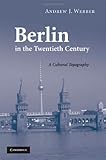
Andrew Webber. Berlin in the Twentieth Century: A Cultural Topography. Cambridge: Cambridge University Press, 2008. viii + 322 pp. $90.00 (cloth), ISBN 978-0-521-89572-9.
Reviewed by Peter Höyng (Department of German Studies, Emory University)
Published on H-Urban (June, 2010)
Commissioned by Alexander Vari (Marywood University)
Objective Vertigo While Meandering through Berlin’s Cultural Topography
The fall of the Berlin Wall in 1989 led not only to the open transfer of people, goods, and ideas between East and West but also to a paradigm shift toward the city’s history. After all, the wall had both isolated the city from its surroundings and blurred its history. The notion of yesterday and beyond appeared as a terra incognita, or taboo, despite Berlin’s abundantly visible scars. Like the character of Homer in Wim Wenders’s Der Himmel über Berlin (Wings of Desire [1987]) who, disoriented and lost, roams the then no-man’s-land of Potsdamer Platz, the divided city’s history was sealed off by the ongoing struggle between the two reigning superpowers and their split ideologies.
Twenty plus years later, one can observe the discussion of Berlin’s Holocaust Memorial that the journalist Lea Rosh instigated in 1988 unintentionally fused with the seismic changes after the opening of the wall, an event that led to Germany’s unification in 1990. Both events initiated a culture of memory including a rediscovery of Berlin’s complex (cultural) history of the past hundred years. If any proof of this would be needed, a quick stop at Berlin Story, the only bookstore in Berlin “that is exclusively devoted to Berlin” as the self-promotion on its Web site proudly claims, will do.
Of the three hundred or so English titles on Berlin, Andrew Webber’s Berlin in the Twentieth Century nonetheless distinguishes itself including from those of his scholarly colleagues, such as Brian Ladd (The Ghosts of Berlin: Confronting German History in the Urban Landscape [1997]), Jennifer Jordan (Structures of Memory: Understanding Urban Change in Berlin and Beyond [2006]), Karen Till (The New Berlin: Memory, Politics, Place [2005]), or Katrin Gerstenberger (Writing the New Berlin: The German Capital in Post-Wall Literature [2008]). Webber merges various strands of theoretical thinking--especially the critical dialectics according to Walter Benjamin and psychoanalysis according to Sigmund Freud--to unearth “a metapsychology of city life.” He mainly reads texts and films “in a symptomatological fashion, looking for structures of fantasy, dreams, trauma, melancholia, hysteria, and paranoia in the cultural cityscape” (p. 5). The book’s ambitious goals are obvious in the prologue where it frames a critical methodology that is now much en vogue in cultural and literary studies: texts by Henri Lefebvre, Michel de Certeau, Roland Barthes, Gilles Deleuze, and Felix Guattari provide for Webber as much the mental space as do Benjamin and Freud for the aforementioned critics. So how does this high ground fare?
For one, Berlin in the Twentieth Century tests a reader’s patience by repeating itself and its many claims. The “Introduction: Capital of the Twentieth Century” meanders, both in topographical and temporal terms, and, by doing so, reiterates similar observations. Webber does so because, as he puts it, “the present study follows the example of Benjamin, whose interest constantly modulates between interiors and exteriors, across the thresholds that at once unite and separate them” (p. 17). Consequently, Benjamin provides for Webber not only the analytical lens but also the rhetorical structure of his writing. Webber’s text wants to be an allegorical representation of Berlin’s ever-unstable grounds, when “this study works both proleptically and analeptically, through techniques of flash-forward and flashback, and thereby shows that the city’s history is always constructed as much through its future and its past as through the present moment” (p. 57). Yet this interlacing of theoretical references and political and cultural time periods of the city in the making results all too often in a relatively predictable and hence conventional conclusion: “If cities are indeed only ever conceivable as sites of being in transit, this city built on sand, with its extraordinary career of transitions between ideological extremes, between construction and destruction seems ready to stand (and fall) as a paradigm case” (p. 26).
The deliberate emulation of Benjamin’s flaneur for structuring the text might be responsible for the many keen insights and numerous references Webber provides that sometimes become lost in the methodical fray, as, for example, when he analyzes Berlin’s topographical and physical elements of sand and water, and the political significance of the Allied air-bridge and fires of World War II as signs of “insubstantiality and transience” (p. 32). Toward the end of the introduction, it indeed comes as no surprise that “this book cannot hope to provide a comprehensive cultural historical map or chronicle of the twentieth-century” (p. 57). Yet there is a certain irony in that the reader must first be on firm ground in regard to Berlin’s political and cultural history, a history catalogued by the sweeping chronological narratives of either Alexandra Richie (Faust’s Metropolis. A History of Berlin [1998]) or David Large (Berlin: A Modern History [2000]), before one can afford to comprehend Webber’s “select gallery of case studies” (p. 10). And as much as Webber’s text can be understood as an allegorical representation of Berlin’s transitional character in the past hundred years, it postures itself (once again fashioned after Benjamin) as “constitutionally incomplete,” deliberately resistant to a resolution between similarity and difference (p. 60).
Once more, it comes as no surprise that before the six chapters begin, the author deconstructs the introduction’s question whether Berlin can be considered the capital of the twentieth century as a rhetorical one. “Berlin cannot fully work as an allegorical representation of the psycho-political condition of the twentieth-century humanity, as its representative ‘capital,’” a claim that directly echoes Benjamin’s assessment of Paris in the nineteenth century (p. 60). Yet the next and final sentence of the introduction belies the very premise Webber makes when characterizing Berlin in the superlative as “this most complex and fascinating, unsettled and unsettling cities,” and hence locates the city as the pinnacle of much of the twentieth century’s vicissitudes that signifies the city’s allegorical potential (ibid.).
In the following 240 pages, Webber approaches Berlin in the twentieth century in six different chapters, the first entitled “Berlin Chronicle: Thresholds and Boundaries.” Here, he discusses in greater detail Benjamin’s historio-topographical conditions of Berlin as a Schauplatz, a space that directs the view to both look at and to show and a place that contains and melds the temporal structures of the past and present. In this sense, the Hof (courtyard), the Weichbild (city limits), the Markplatz (marketplace), and the Bannraum (space of exclusion) become for Benjamin the allegorical sites for an alternative perspective on Berlin.
Chapter 2 focuses mainly on Bertolt Brecht and the ambiguous relationship of the “most influential figure in twentieth-century theatre” to Berlin and the city’s “contractual obligation towards Brecht” (pp. 104, 105). Appropriately, the chapter shares the title after Brecht’s postwar theater: “Berlin Ensemble: Inhabitations and Accommodations.” The ensemble in the title, however, promises not only to refer to the theatrical institution or Brecht’s collective approach of authorship but also to Webber’s notion that Brecht’s Berlin serves “as a site of experiment and engagement between the individual and the ensemble” (p. 105). Finally, the chapter’s title plays on the meanings of ensemble and also includes Brecht’s “most significant successor, Heiner Müller,” whose melancholic work preserves Brecht’s legacy by betraying “his historical accommodations” (pp. 104, 145). By now, the reader might be accustomed to the accumulations of superlatives that make Berlin stand out in signifying larger contradictions of the twentieth century.
Chapter 3, “Berlin Symphonies: Movements and Stills,” borrows its structure from Walther Ruttmann’s classic film Berlin: Die Sinfonie der Grosstadt (Berlin: Symphony of a metropolis [1927]), that Thomas Schadt recast as “Berlin: Sinfonie einer Großstadt” (Berlin: Symphony of a metropolis [2002]). After Webber provides a critical reading of Ruttmann’s film based on Brecht’s and Benjamin’s critique of image theory, Webber is equally critical of Schadt’s “remake” because he sees “the two works closer to each other in their aesthetic-political disposition than might be assumed” (p. 155).
After having moved through Berlin by critically viewing its architecture, and by focusing on theater and film, Webber shifts attention in his fourth chapter to yet another genre: Alfred Döblin’s modernist epic “Berlin Alexanderplatz” (1929), and titles it “Alterations and Reconstructions,” only to settle again on the visual genre and in this case on the filmmaker Rainer Fassbinder who adapted Döblin’s novel for television in 1980.
It is only in chapter 5, “Berlin Wall: Divisions and Falls,” that Webber focuses exclusively on postwar Berlin. Ever eclectic, he chooses for his critical reading of the divided city Ingeborg Bachmann’s essay “Ein Ort für Zufälle” (A place for coincidences [1964]), Christa Wolf’s short story “Unter den Linden” (1969), Uwe Johnson’s novel Zwei Ansichten (Two Views [1965]), and Wenders’s discontented epic Der Himmel über Berlin.
In chapter 6, “Berlin Marathon: Openings and Closures,” Webber breaks down “the treatment of space in Berlin films since the Wende,” by focusing first--in more abstract terms--on how the interior and exterior space in Berlin is negotiated, and then on how films set in Berlin create a double-bind between a new freedom and openness (outside) and a restriction and entrenchment (inside). Only in the second half of the chapter does Webber specifically focus on Kutlug Ataman’s Lola und Bilidikid (1999) and Tom Tykwer’s popular Lola rennt (Run Lola Run [1998]).
The book’s epilogue, “Afterword: Goodbye to Berlin?” the shortest chapter, remarks once more on the city’s haunted past, a past that is utterly steeped in looking toward the future that it can barely look back.
This brief synopsis of the various chapters highlights how Webber’s analysis of the “psycho-topographical disposition of the city” becomes a dense reading experience by utilizing mainly the visual arts as the lenses through which our eyes are opened to Berlin’s “traumatism, uncanniness and melancholia” (p. 300). But when read as a whole, it is less exhaustive than exhausting. The latter mainly derives from the fact that Webber possesses no tolerance for analyzing his chosen artifacts other than by deploying his theoretical high ground that leads inevitably and predictably to his preferences for melancholia, ambivalence, and contradictions as the only legitimate mind-set in dealing with Berlin’s past.
It is as if we, the readers, become ever more lost while Webber attempts to guide us through the side streets and alleys of the city. One often wonders why we now must walk down this avenue to end up on this square or where we might end up taking the next corner in order to arrive where we have already been before. The study’s wealth creates a sense of randomness that results in disorientation, so much so that one “of Brecht’s late poems provides an image that can serve as emblematic for [the lack of] negotiation” of Webber’s cultural topography of Berlin (p. 111): “‘Hier ist die Karte, da ist die Straße / Sieh hier die Biegung, sieh da das Gefäll!’ / ‘Gib mir die Karte, da will ich gehen. / Nach der Karte / Geht es sich schnell.” (‘Here is the map, there is the street / See here the bend, there the slope’ / ‘Give me the map, that’s were I want to go. You can go quickly / By the map.’)[1] Walking fast is not possible because the map is too often lacking in scale, just as the maps themselves after unification could not keep pace with the rapidly changing Berlin.
While an abbreviated summary of each chapter might serve as a rough sketch for this review, a brief discussion of the Brecht chapter should suffice to point out the book’s temptations and traps. That Brecht and Berlin deserve a chapter is more than legitimate. Even though Brecht often refrains from addressing the city in a direct fashion, he nevertheless absorbs “the sights and sounds, the behaviours and voices of the city,... its gestic fabric” (p. 110). As Webber points out, Brecht privileges Berlin due “to its constant changeability” (p. 107). For Brecht, Berlin becomes a generic city, a paradigm for what a modern city and its subsequent freedom offers as well as the nightmares it creates.
Webber does not shy away from the inherent contradictions in Brecht’s relationship toward Berlin. Yet the discussion of the Brecht-Benjamin relationship, their brief encounter in 1931, and Benjamin’s commentary of Brecht’s Hauspostille in chapter 2, worthwhile as it might be, is one of these turns that leads nowhere or everywhere. Why, for example, is Brecht’s antagonist, Gottfried Benn, not mentioned in this section on Brecht’s poetry, or, for that matter, is not included at all in the cultural topography? Similarly, when Webber turns from Brecht the poet to Brecht the playwright, one wonders about the selection of plays found in his discussion. He interprets the early Trommeln in der Nacht (Drums in the Night [1922]), moves on to Furcht und Elend des Dritten Reiches (Fear and Misery of the Third Reich [1935]), before settling for the Vorspiel (Prelude) that Brecht wrote for his version of Antigone (1948).
For someone familiar with Brecht’s plays, one might argue that this selection is not the only one possible or even the best possible way to highlight Brecht’s uneasy relationship to Berlin (after all in 1950 he became a citizen of Austria). Yet to assume that every reader comprehends Webber’s choices is asking too much. It is this lack of negotiated pathways that often makes the book difficult to follow. Why then do we have to follow after his choice of plays a very close reading, i.e., a sequence-by-sequence analysis, of the Bert-Brecht-film Kuhle Wampe, oder Wem gehört die Welt? (Kuhle Wampe or To Whom Does the World Belong? [1932])? While this section concludes with the observation of the film that “the ownership of the streets of Berlin, and of the world at large, is in balance,” one wonders whether the detailed reading and description of this film simply tipped the balance between Brecht the poet and Brecht the playwright, worthwhile as it might be to focus on Brecht’s interest on new media (p. 143).
While the book does not claim to provide a cultural topography of Berlin or a history of cultural institutions or even the formations of these institutions, it nevertheless assumes that the reader is, to a large extent, familiar with the city’s cultural topography, allowing the author to zoom in and out of whatever seems worthwhile to him for a close reading. This in turn creates lacunae, neglecting such key authors as Benn, Joseph Roth, or Nelly Sachs, to mention a few, or for that matter other cultural figures and genres that Webber deems irrelevant to Berlin’s cultural topography. When the chapter ends with “After Brecht: Heiner Müller,” one encounters déjà vu when Webber asserts that “Müller’s refunctioning of Brecht involves a teasing out of the author’s dialogues with Benjamin and their triangulation with Kafka” (p. 145). Could it be that this observation is more a triangulation of Webber favoring more avant-garde authors? While, once again, providing no overview or context for Müller’s plays or, for that matter, East German theatre before or after the unification, Webber predictably ends up, allegorically speaking, on a dead end street: “The catastrophic view of history fixes Müller the performance writer in a place of aporia, but this is also a site of production, however abject” (pp. 150-151). This sentence is so laden with a by now predictable dystopia that it aptly summarizes not only Müller but also Webber’s overall cultural topography of Berlin in the twentieth century. The problem, then, is that Webber’s rich details and insightful observations of cultural artifacts, different as they might be, end up being much the same. It is as if Berlin becomes the backdrop for every new movie showing at a given time, only it is the same movie over and over again.
If one accepts the fact that Webber’s mapping of Berlin’s cultural topography is one of Berlin in and not of the twentieth century, and if one enjoys the eclectic meandering and company of a flaneur that takes you through some familiar streets as well as some neglected streetlets and squares, one can be enriched by Webber’s critical and dialectical mind. If, however, one is prone to vertigo due to the staggering amount of theoretical baggage, and if one easily gets woozy from all the endless crisscrossing of space, time, and seemingly arbitrary artifacts that inevitably return to the same topoi of Berlin’s ambivalent and transitional character, one might be advised to nibble at the text only in small helpings.
Note
[1]. Bertolt Brecht, Werke (Frankfurt: Suhrkamp, 1988-2000), 15:286.
If there is additional discussion of this review, you may access it through the network, at: https://networks.h-net.org/h-urban.
Citation:
Peter Höyng. Review of Webber, Andrew, Berlin in the Twentieth Century: A Cultural Topography.
H-Urban, H-Net Reviews.
June, 2010.
URL: http://www.h-net.org/reviews/showrev.php?id=25856
 | This work is licensed under a Creative Commons Attribution-Noncommercial-No Derivative Works 3.0 United States License. |

