



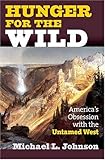
Michael L. Johnson. Hunger for the Wild: America's Obsession with the Untamed West. Lawrence: University Press of Kansas, 2007. 533 pp. $34.95 (cloth), ISBN 978-0-7006-1501-8.
Reviewed by Jonathan Clapperton
Published on H-Environment (November, 2009)
Commissioned by Charles-François Mathis (Paris-Sorbonne University)
De-mythologizing the Wildness of the West
Michael L. Johnson wrote Hunger for the Wild to dig down to the roots of the Wild West cliché and investigate "how the West came to be known as wild, how the kinds of wilderness implicit in that generalization have manifested themselves, and why they have been and remain fascinating" (p. 1). The finished product is the result of over a decade of research into the cultural and intellectual history of the West and its association with wilderness. Johnson is a professor of English and not a trained historian, but he nonetheless proclaims himself an "informed student of Western history" (p. xvii). He is, indeed, extremely well read in western history and his book is an excellent synthesis. Covering a broad range of topics and a lengthy stretch of historical time, Johnson delves into an incredibly rich historiography, including the works of Richard White, Roderick Nash, Max Oelschaleger, Patricia Nelson Limerick, Frederick Turner, and Donald Worster, to construct, a "deeper" and an "inner cultural" history of the West (p. 1). Considering the arguments of these historians, Johnson arrives at his central thesis: Though the West has always been "a wild place," its human residents and visitors have "perceived or misperceived the wilderness of the West in various ways, construing its meaning by their own culturally tailored ideas" (p. 2). And while some of these creations have fed what makes the West culturally colorful, Johnson continues, such ideas configured into a changing and ever more ambivalent ideology of conquest.
Johnson begins the first part of his narrative with a short natural history of the prehuman "West," before summarizing the pre-European, Native view of nature in the West. This Native view, Johnson argues, did not divide nature and culture, nor did it have any concept of wilderness. Part 2, which covers the 1530s to the 1840s, investigates early European (mostly Spanish and English) constructions of the West as simultaneously a garden, a wilderness, and a place of treasure. Native Americans remain part of this encounter too, and Johnson describes how the idea of the "Noble Savage" came to exist during a time of conflicting European opinions of both nature and Aboriginal people.[1] Ultimately, he argues, fear of both came to dominate the cultural atmosphere of these newcomers, who saw the wilderness and the Natives as barriers and threats, as something to be defeated and tamed. This desire to dominate really exploded, Johnson continues, when the West "became" the Kentucky frontier. Certain iconic figures, such as Daniel Boone, Lewis and Clark, and Davy Crockett, epitomized a growing western mythology as well as provided inroads to the real (rather than ideological) exploitation of the West via commerce.
In part 3, Johnson contends that violence and ambivalence became further entrenched as part of the frontier myth from the 1840s to the 1890s when even those who regarded western wilderness in awe simultaneously applauded its destruction as progressive or inevitable. Johnson uses numerous case studies to prove this point, such as mining, the continued demonization of American Indians as plains warfare intensified, big game hunting, and the mythologization of guns as central to America's selfhood.
Part 4, which covers the 1890s to the 1960s, turns once again to the theme of fear, but this time it was the fear that the West was in peril. The West was becoming seen as a region (a space enclosed by lines) rather than being wild, open, and free. Instead of letting go of the myth of the West, though, Johnson argues that it was refashioned into a "tourist West" where the myth could be kept alive. In much the same way as in the previous sections, Johnson draws on a wide array of examples to make his points. Though this works well in earlier parts of the book, it is here that Johnson's method of "leap frogging" from topic to topic and from time period to time period becomes distracting and causes the book to lose some of its historicity, especially as he is not always careful to make connections between his case studies. For example, he moves from subjects as diverse as the history of the "ending of the Indian," to preservation and conservation as well as from John Muir, Clifford Pinchot, and Teddy Roosevelt, to Buffalo Bill, rodeos, the 1930s Dust Bowl, the issue of urban frontiers, and others, without tying them together.
The fifth and final part of Hunger for the Wild is as equally disjointed as part 4, but it remains very interesting and full of insightful observations. Johnson contends that by the 1960s the West was more park than wild, and that people's ambivalence toward the wild continued unabated despite the environmentalist and "back to land" movements. Johnson also uses this section to include a random selection of topics that, while well researched, nonetheless lack coherence. Some of these historical phenomena he critiques as being the same old destructive practices, while others he applauds for their innovativeness. He critiques pollution, the continued destruction of wild species (what he terms the "wildlife-holocaust mentality" [p. 310]), the permeation of Walt Disney in all aspects of American conceptions of wilderness, the postmodern technologization of the West, Las Vegas, Montana's conservative and antigovernment culture, the backlash against environmentalism, and others. He goes on to investigate, and praise, any event or structure that he perceives as creating a more diversified and inclusive western mythology. He points to, for example, gay and lesbian rodeos, feminist writings, eco-criticism, Native literature, and the rise of urban nature.
Johnson concludes by prescribing a laundry list of characteristics from which he believes everyone in the West would benefit. He argues that the mythology of the West needs to be based on nurture rather than pillage, truth rather than deception, community rather than individuality, sustainability rather than short-term exploitation, and/or flexibility rather than rigidity. Unfortunately, while this wish list sounds great, Johnson does not explain what any of these terms mean nor how to accomplish any of the goals or how the outcomes might differ from the mythologizing of previous generations.
Despite Johnson's excellent and impressive work, the book does have a number of problems. First, while Johnson does an excellent job in pointing out the contradictions in others' actions and thoughts toward the West and wilderness, his own contradictions and ambivalence go largely unmentioned, though they are nonetheless there. In particular, he certainly believes in the "wild" being a real, tangible state of natural being, and argues, for example, that the West was wild long before "us" and will be long after "we" are gone. Yet he also shows how each and every conception of western "wildness," including parks or wilderness areas, has been a cultural invention. Consequently, it is sometimes confusing whether or not he is talking about the "wild" as a state of nature or as a cultural construction, and where he stands in this debate; this is an internal tension in the book that is never resolved. Second, a definition of the boundaries or general area that defines the "West" is lacking throughout most of the book. Though it is clear that the "West" means a different place at different times and according to different conceptions, it is otherwise quite an amorphous, shadowed area.
Notwithstanding these issues, Hunger for the Wild is an enjoyable read that is firmly based in the secondary literature and apt in synthesizing many of the most popular issues in historical study today, along with some that tend to get overlooked but that are equally revealing. Though I did not find this book to be innovative in method nor revolutionary in argument, it is a welcome addition to the highly populated body of works that exist on the West. In fact, it may be most useful for its reference potential since its short sections on each topic usually cite the most important authors in the field. In turn, this can provide one with an important starting point for research or creating a lecture on an unfamiliar topic. Hunger for the Wild would make an excellent required text for an upper-level undergraduate course on the history of the American West. If you are a historian of the West (however defined), this book is definitely worth having on your shelf.
Note
[1]. Notably absent from Johnson's discussion about the "Noble Savage" ideology is Ter Ellingson's controversial work that refutes the standardized narrative of the "Noble Savage" genesis. Ellingson argues that the "Noble Savage" ideology that most often gets described actually did not emerge until the mid-nineteenth century. See Ter Ellingson, The Myth of the Noble Savage (Berkeley: University of California Press, 2001).
If there is additional discussion of this review, you may access it through the network, at: https://networks.h-net.org/h-environment.
Citation:
Jonathan Clapperton. Review of Johnson, Michael L., Hunger for the Wild: America's Obsession with the Untamed West.
H-Environment, H-Net Reviews.
November, 2009.
URL: http://www.h-net.org/reviews/showrev.php?id=25800
 | This work is licensed under a Creative Commons Attribution-Noncommercial-No Derivative Works 3.0 United States License. |

