

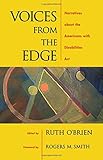
Ruth O'Brien, ed. Voices from the Edge: Narratives about the Americans with Disabilities Act. Oxford: Oxford University Press, 2004. xix + 286 pp. $45.00 (paper), ISBN 978-0-19-515687-4.
Reviewed by Allison Carey (Shippensburg University)
Published on H-Disability (October, 2009)
Commissioned by Iain C. Hutchison (University of Glasgow)
Bringing the Americans with Disabilities Act to Life through Narrative and Legal Analysis
Ruth O’Brien’s work, Voices from the Edge, offers an exciting addition to the growing body of scholarship on the Americans with Disabilities Act (ADA). Voices from the Edge takes readers on a thought-provoking journey, juxtaposing narratives about discrimination and legal analysis, to bring to the fore issues of discrimination based on disability and to consider the potential of the ADA to address such discrimination. The narratives provide readers with the opportunity to identify with the characters and to consider how they might react in similar situations. Then, in the legal analysis, O’Brien draws on these narratives as the key material by which to illustrate and explore the potential power and limitations of the ADA. The book is divided into four parts, each containing several narratives about discrimination followed by a legal analysis. The first part focuses on the ADA’s definition of “disability.” The other three parts address Titles I, II, and III of the ADA respectively. This book does not provide a history of the ADA, an analysis of ADA court cases, or personal stories specifically about filing ADA claims. These are not limitations, but rather outside the central goal of the book.
Fictional and nonfictional writings are used to showcase the discrimination and barriers faced by people with disabilities. A variety of persons with disabilities contribute to the narratives, including persons with HIV/AIDS, multiple sclerosis, deafness, mobility impairments, and other physical impairments. The barriers discussed come in many forms, but all are related to attitudes that dismiss and demean people with disabilities. Stories include, for example, taxi drivers who do not want to get out of their cabs to store a wheelchair, officials at the Department of Motor Vehicles who impose unnecessary modifications and restrictions on persons with disabilities, and employers who simply fear and avoid applicants with disabilities. These narratives explore how the social response to disability limits and at times shuts down opportunities, including opportunities that may be vital to one’s health and independence.
O’Brien situates these experiences in a legal context, and examines how and why the courts might interpret and deal with these experiences given present legislation and recent court cases. She offers a clear discussion of complex issues, such as the definition of “disability,” the relationship between medical definitions and civil rights, tensions around disclosure, interpretations of reasonable accommodations, sovereign immunity of state and federal governments, and judicial scrutiny. And, time and time again, she shows how narrow interpretations and misguided logic render the ADA ineffective in addressing discrimination as commonly experienced.
I particularly enjoyed her discussion of the various, and at times contradictory, definitions of “disability.” O’Brien argues, “Essentially, the federal courts’ rulings have put disabled people in a Catch-22 position. Either you are not impaired enough to have a disability or your impairment impedes you from doing the job” (p. 100). In her analysis of several narratives, O’Brien shows how the presence of disability, which is supposed to qualify one for ADA protections, is invalidated or actually used to legitimate discrimination. Since the meaning of “disability” and therefore access to ADA protections are often ambiguous, the process of disclosure becomes precarious to say the least. According to the ADA, one must disclose one’s disability when requesting accommodations. While this may seem logical, disclosure can leave one vulnerable to stigma, intolerance, and unwanted paternalism without the actual protection of the ADA. One of my favorite narratives involves a man with HIV/AIDS, Achim Nowak, who is navigating the world of employment. In the ideal world, Nowak would, upon being hired, disclose his disability, specify necessary reasonable accommodations, and receive them or have redress through the ADA. However, in each employment setting, Nowak instead finds that he must weigh such factors as the response to disclosure, the likelihood of actually receiving accommodations, the likelihood of becoming a victim to discrimination, the likelihood that the ADA could protect him from subtle and not-so-subtle forms of discrimination, and the potential that his disclosure and the ADA could even be used against him (a recent court case found in favor of an employer who sought to fire or demote an employee with a disability because the current job posed a health risk given his disability). Nowak ultimately decides, “I tell only when it suits me, and when it gives me power” (p. 62). He is all too aware that disclosure can empower as well as disempower, and he carefully weighs the likely outcome prior to revealing his private life to others. Thoughts of the ADA are only one of many factors under consideration as he negotiates the interpersonal dynamics and politics of each workplace.
Through the method of juxtaposition, O’Brien is able to show the incongruity between personal experience and the law; too often the law does not address the forms of discrimination experienced by people with disabilities. It is often unclear who is responsible to enforce the law. Loopholes and legal terminology render seemingly clear-cut claims of discrimination to be without legal standing. The cost of pursuing a lawsuit is often far greater than the potential reward. Most characters in the narratives consider many options to address discrimination, including ignoring discrimination, subtly making requests without asserting “rights,” directly asserting their rights, threatening a lawsuit, and pursuing legal action. O’Brien argues that, unfortunately, pursuing a formal ADA lawsuit is often costly and ineffective. Her message is somber and pessimistic about the power of the ADA as currently written and interpreted to bring about significant changes for people with disabilities.
To speak briefly of the limitations of O’Brien’s work, by concentrating on the failures of the ADA, O’Brien may minimize the positive impact of the ADA. The narratives illustrate some of these positive outcomes, yet O’Brien seems largely to overlook them. For example, several of the characters identify as rights-bearers and fight for their rights (albeit outside of the courts), an act of informal negotiation probably less likely before the ADA. At times, characters interact with people who respect and acknowledge the rights of people with disabilities. The ADA has created a rhetoric of rights that offers a language to people with disabilities as they assert equality and a threat that, while not easily enforced, still challenges those who stomp on the rights of the disabled. It promotes knowledge and awareness of accessible architecture and programming, and openly recognizes that people with disabilities are equal and valued members of the community. While I agree with O’Brien’s assessment of the ADA’s limitations in securing the rights of people with disabilities, the narratives offer only glimpses of positive effects that deserve attention too. A second limitation is that the inclusion of fictional stories seems to undermine the point of the narratives. The narratives offer a window into and prioritize the real life experiences of people with disabilities. While providing interesting stories, I am unsure how fictional accounts ultimately add to this goal.
Despite the minor limitations, this book is valuable for people in numerous fields, including disability studies, disability law, civil rights, citizenship studies, sociology of law, and political science. Since the writing is so clear, this book would work well in the classroom. I particularly appreciate her format as it opens exciting teaching opportunities. Professors can first draw on the narratives to encourage discussion and debate on issues like whether the actions described within the narratives are discriminatory, if they should be illegal, and how they could be handled. Students can explore the intricacies of terminology, loopholes, enforcement, and court interpretations. This book encourages readers to identify with the characters as real people, not legal cases, and to consider what if anything can and should be done. Most important perhaps, O’Brien stresses that the passage of the ADA does not indicate the end of the struggle for equal rights. Rather, she shows that there is still a long road ahead, and she urges us to understand the current barriers as we consider how to move forward in the pursuit of equality, rights, and justice.
If there is additional discussion of this review, you may access it through the network, at: https://networks.h-net.org/h-disability.
Citation:
Allison Carey. Review of O'Brien, Ruth, ed., Voices from the Edge: Narratives about the Americans with Disabilities Act.
H-Disability, H-Net Reviews.
October, 2009.
URL: http://www.h-net.org/reviews/showrev.php?id=25765
 | This work is licensed under a Creative Commons Attribution-Noncommercial-No Derivative Works 3.0 United States License. |

