



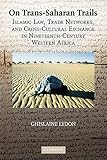
Ghislaine Lydon. On Trans-Saharan Trails: Islamic Law, Trade Networks, and Cross-Cultural Exchange in Nineteenth-Century Western Africa. Cambridge: Cambridge University Press, 2009. xxviii + 468 pp. $95.00 (cloth), ISBN 978-0-521-88724-3.
Reviewed by Anissa Helie (John Jay College of Criminal Justice, CUNY)
Published on H-Law (February, 2010)
Commissioned by Michael J. Pfeifer (John Jay College of Criminal Justice, City University of New York)
A Bountiful Desert: Trade and Culture within and across the Sahara
On Trans-Saharan Trails successfully delivers on its author’s ambitious promises. Ghislaine Lydon pledges to challenge the long-standing divide between North and sub-Saharan Africa that led to a “disregard [of] North Africa’s 'African' roots” (p. 5) in African studies. Given the overall paucity of scholarship focusing on the Saharan region and the quality of the research, this book will certainly bridge the gap and contribute to a deeper understanding of the Sahara “as a dynamic space with a deep history” (p. 4).
Through an analysis of the Wād Nūn trade network (based in the northern tip of Western Sahara) Lydon focuses on a region which was islamicized early and was “less affected by colonial rule.” By recalling the testimonies of a “dying breed” (p. 28)--the caravaners--the book evokes the risky nature of their business, as they face deadly sandstorms, unforgiving heat, ongoing threats of pillages and murders, or increased regional instability due to jihads in the second half of the nineteenth century. This endemic insecurity sometimes had dramatic human and economic consequences (for example, five hundred camels were seized one single raid in 1875-76, p. 406). More broadly, the book examines the extent to which cross-cultural exchange and business ventures were facilitated by institutional frameworks inspired by literacy and a Muslim legal culture.
The author consulted sources in Morocco, Mauritania, Mali, Senegal, and Libya, visiting over thirty-five private libraries and national archives. She also conducted over two hundred interviews and rightly insists on the centrality of orality. Apart from the wealth of oral testimonies, the diversity of written primary sources (contracts, fatwas, estates, pilgrims’ accounts, but also colonial ethnography) is impressive, ensuring a multiplicity of perspectives. The book is divided into eight coherent chapters, and offers several maps, a glossary, and useful appendices (including a timeline and a list of interviewees.) Throughout the entire book, Lydon zooms in and out with ease, linking anecdotal details to larger contextual trends. On Trans-Saharan Trails will appeal to those interested in legal history, economic history, cultural history, world history, and African history, and to scholars of Muslim societies.
One of Trans-Saharan Trails innovative aspects lies in its acknowledgement that family involvement and community participation were key to the caravan economy. While a majority of social actors directly involved in trans-regional trading were men, the author does not neglect to explore the crucial roles played by women. By interviewing a significant number of women, Lydon appears to have tried to rectify the imbalance of written sources (both colonial and local), which are “produced almost exclusively by men” and in which women’s voices are “for the most part interpreted by a male cleric or judge” (p. 31). She provides evidence of women involved in the book trade (pp.101, 103) or in the caravan trade--either as part of nomadic families, as labor force, or as elite widows seeking redress in legal matters (pp. 232-240). Yet, one still wishes to see women’s diverse contributions further highlighted. For example, a hint about secretive long-distance polygyny patterns makes one wonder about the prostitution networks caravaners may have relied on while away from home for months on end.
Nevertheless, the author provides a wealth of information with regard to social actors. While her main focus is the Tikna clan, she also documents its trading partners (noting that Jewish traders were pioneers in the region) or individuals’ reactions to colonial encroachment. Lydon’s historical ethnography approach helps assert the multiple levels of skills which caravaners displayed. For example, astronomical expertise was needed for night navigation, and knowledge of grazing fields led to selecting varied seasonal routes across the desert. In addition, the ability to handle diverse languages and various currencies (from salt bars to cotton and cowry shells, to coins and, beginning in the early 1900s, paper money) was crucial--especially in a context devoid of standardized weights and measures. Furthermore, trans-Saharan trading required fluid knowledge as the structure, frequency, and itineraries of camel caravans varied over time, as did their size. (Some convoys were very large: prior to the mid-1800s along western routes, caravans could gather several thousand camels and hundreds of men.) The success of such international and inter-regional ventures required leadership, labor force, resources, complex logistics, as well as a strong “home base.”
Above all--and even in a context where “oral testimony and sworn oath of faithful Muslims” were seen as “more reliable” than written documents (p. 294)--literacy and the “paper economy” played a key role in keeping track of complex exchanges across distant marketplaces. In this respect, qādīs, muftīs, and other Muslim “legal service providers” helped ensure fairness, enforce contractual agreements, and limit commercial disputes. Lydon’s careful analysis of the use of legal tools in encouraging entrepreneurship is fascinating while her discussion of the contentious issue of usury provides much food for thought. The fact that a number of Muslim legal scholars were themselves active merchants helped ensure that jurisprudence was informed by references to religious codes but also by the complex realities of the caravan trade.
Lydon’s catalogue of the variety of goods exchanged over time is enlightening, ranging from the basic to the luxurious. It includes well-known export items such as salt, gold, cotton, ivory, and slaves. But she also reminds readers about wood (used locally for tents’ poles), ostrich feathers, tobacco, honey, seeds, laxatives, highly valued paper and books, and firearms. Whenever possible concrete price ranges are provided for many of those products, while Lydon hints at ethical dilemmas--for example, the debate related to “whether trading in slaves with Christians was legal in the eyes of Islam” (p. 92). When attempting to convey a more nuanced understanding of the “competition between caravans and caravels” (p. 94)--i.e., between trans-Saharan and Atlantic trade--the author could have further elaborated her dismissal of the economic threat associated with Port Saint Louis in Senegal. But the truly global nature of the trans-Saharan commerce itself remains evident through the importation of beads (from Venice), black cotton (manufactured in South Asia), cowries from Persia or the Maldives, and prized green tea (from China and India via British ships into Morocco); or the exportation of tanned leather from Kano to Europe or gum Arabic (a key ingredient for European textile industry).
Overall, Lydon envisages a broad range of issues and themes, pulling diverse threads together in a truly multidisciplinary fashion. Focusing on the nineteenth and early twentieth centuries, yet grounded in the longue durée, the author’s assertion that the Sahara served throughout centuries as a “bridge to intercontinental exchange” (p. 105) is indeed thoroughly demonstrated throughout the book.
However, while the Mālikī school of thought is rightfully presented as the prevalent framework in the region, this otherwise excellent research could approach the concept of “Islamic law” more critically. References to “Islamic law” (in the title) or “the Islamic legal system” (elsewhere) seem to contradict what Lydon already observed with regard to gender: that “Islamic practice” was “defined by cultural norms, local interpretations of the scriptures, and the extent to which these were enforced” (p. 233). This awareness of plurality and diversity could be more clearly acknowledged in relation to legal practices. Hence, the use of the plural form would be more accurate when referring to legal frameworks--since the singular “Islamic law” can misleadingly point toward a unified normative legal system, common to all Muslims. Furthermore, Nigerian researcher Ayesha Imam argues against the “conflation between ‘Islamic’ and ‘Muslim.’ Islam is the religion or faith (the way of Allah), while Muslims are those who believe in Islam and attempt to practice it.... The recognition that Islamic and Muslim are not synonymous is important because it helps avoid essentialising Islam and reifying it as an a-historical, disembodied ideal which is more-or-less imperfectly actualized in this or that community.”[1] “Muslim laws” would be a more adequate terminology, both conceptually and politically--and could further support Lydon’s assertion that “commercial practices of Muslims diverged from the often constraining legal codes of Islam” (p. 338).
One of the main premises of On Trans-Saharan Trails is the centrality of religion: “The pervasiveness of Islam in Western Africa makes it difficult to understand Saharan exchange outside its religious framework” (p. 337). The author insists that “Muslim religious practices, which promoted the acquisition of literacy, provided structure and agency that shaped the activities of trans-Saharan traders” (p. 3). Lydon convincingly demonstrates that traders sought fatwas to clarify the status of loans, exchange rates, or transactions (p. 255) or to settle disputes (p. 275). But she also shows that learned Muslim scholars and Muslim “legal service providers,” while crucial, were not the only relevant actors: there were other forms of social support and regulations. For example, market rules were also devised and strengthened through clan alliances and customary norms, while non-Muslims also successfully conducted business ventures for centuries (even though indigenous Jewish communities also relied on the Mālikī codes).
Lydon’s research highlights the complexity of factors involved. Yet it is worth emphasizing the weight of local customs other than religious--especially when, with the heightened interest in Muslim contexts, scholarly works (but also politicized discourses) place a major emphasis on Islam as the main marker of cultural identity, to the exclusion of others. Abdullahi Ahmed An-Na’im, specialist in Muslim jurisprudence, points out: “Let us be social scientists in trying to understand Muslim societies, their history and their present. Let us be social scientists in understanding that religion has relevance but that it is not definitive of what Muslims do. In fact, often, conditions in which Muslims live influence and shape their understanding of Islam more than Islam, as a sort of free-standing agent, influences their thinking.”[2]
On Trans-Saharan Trails, with its focus on regions bordering Western Sahara in the nineteenth century, is essential reading for understanding the mental landscape and social stratification, as well as the political and economic order within this specific ecological space. Its precise yet accessible style allows for a concrete appreciation of the workings of global history, providing a welcome reminder of the interconnectedness of our world--in terms of goods, techniques, or skills exchanged, but also in terms of the dissemination of shared vocabulary, cultural practices, ideas, beliefs, and peoples’ migratory patterns.
Notes
[1]. Ayesha M. Imam, “The Muslim Religious Right (‘Fundamentalists’) and Sexuality: Women Living Under Muslim Laws,” Dossier 17 (1997): 7.
[2]. Abdullahi Ahmed An-Nai’m is professor of law at Emory University and author of the recently published Islam and the Secular State. This quote is excerpted from a conversation focusing on “Secularism, Islam and Liberty of Conscience” (moderated by John Torpey, with An-Nai’m and Patrick Weil), CUNY Graduate Center, New York, October 2009, podcast available at:http://www1.cuny.edu/portal_ur/news/radio/podcast/lecture_250.mp3.
If there is additional discussion of this review, you may access it through the network, at: https://networks.h-net.org/h-law.
Citation:
Anissa Helie. Review of Lydon, Ghislaine, On Trans-Saharan Trails: Islamic Law, Trade Networks, and Cross-Cultural Exchange in Nineteenth-Century Western Africa.
H-Law, H-Net Reviews.
February, 2010.
URL: http://www.h-net.org/reviews/showrev.php?id=25745
 | This work is licensed under a Creative Commons Attribution-Noncommercial-No Derivative Works 3.0 United States License. |

