



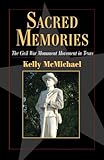
Kelly McMichael. Sacred Memories: The Civil War Monument Movement in Texas. Denton: Texas State Historical Association, 2009. Maps. 128 pp. $9.95 (paper), ISBN 978-0-87611-238-0.
Reviewed by Mercy Harper (Rice University)
Published on H-CivWar (October, 2009)
Commissioned by Martin P. Johnson (Miami University Hamilton)
Texas Civil War Monuments
Kelly McMichael’s Sacred Memories is a brief but highly useful addition to the burgeoning study of Civil War monuments and their role in the construction of postbellum memory. After the Confederacy’s collapse, white volunteer organizations, such as the United Daughters of the Confederacy (UDC), erected monuments across the South to honor fallen soldiers and to cultivate an affirmative public memory of the Confederacy. While today we may pass by these silent stone soldiers without a second thought, historians have come to view Civil War monuments as a crucial index to understanding white southern culture and community in the late nineteenth and early twentieth centuries. These monuments, many erected decades after the war, often reveal more about the individuals who created them than they do about the soldiers whose memory they honor. McMichael argues, “Monuments and the process of choosing, fundraising, building, and unveiling provide a select group with the opportunity to shape society’s memory of an event or individual” (p. 3). Women were often (although not always) a crucial element of this “select group” empowered to shape their community’s memory. Thus the process of decision making surrounding the erection of Civil War monuments was also a site of complex negotiation of gender roles. In Sacred Memories, McMichael explores the history of sixty-eight Civil War monuments found throughout Texas, and in so doing sheds light on how postwar southern monument culture shaped white southerners’ collective memory of the Civil War.
McMichael’s work spans seven distinct regions in Texas, covering sixty counties in total. For each county, McMichael provides a concise history of the Civil War monument there. She weaves local newspapers, such national magazines as the Confederate Veteran, and the minutes of memorial organizations together to craft a succinct narrative for each monument’s creation. In brisk prose, she delineates what group erected each monument, how they secured funding and a location, and how the dedication ceremony proceeded. She also includes directions to find the monument, and a physical description of its appearance. McMichael argues that Civil War monuments were “reflections of the towns that unveiled them, mirroring the community’s perception of its place in history and sense of itself economically and culturally compared to neighboring towns” (p. 15). If so, the placement and variety of these monuments should be revealing in any research of late nineteenth- and early twentieth-century Texas history. Historians hoping to explore this connection will be aided not only by McMichael’s analysis but also by the well-organized references available in Sacred Memories.
The maps provided in Sacred Memories will be particularly useful to historians of the Civil War and monument culture. McMichael presents the reader with individual maps of each Texas region showing the placement of Confederate and Union monuments, as well as which counties voted for and against secession. These maps clearly show how often counties that initially voted against secession later came to erect a Confederate, rather than a Union, monument. McMichael also offers a handy appendix that lists the city, county, year of dedication, creator, location, and type (Union or Confederate) of each Civil War monument. This will provide historians of Civil War monuments in and outside of Texas, as well as historians of the UDC, with a quick method of surveying regional differences and commonalities in monument efforts.
Although Sacred Memories is a well-written and exhaustively researched work, it does suffer from a lack of a conclusion. Including a conclusion would have allowed McMichael to further expand on the threads that emerge in her research of the monuments, such as the occasions of later vandalism and controversy surrounding monuments. McMichael relays several instances of mid- to late twentieth-century reaction against the romanticized memory of the Civil War asserted by these monuments, but does not offer much commentary or analysis regarding them. This is largely due to her wide scope, covering sixty-eight monuments, which limits the amount of description and analysis she can dedicate to each monument. Including a conclusion also would have allowed McMichael to perhaps connect her analysis of these memorial efforts, mostly executed by Texas members of the UDC, to the larger UDC organization. As McMichael notes, “Texas consistently registered more chapters and more members than any other state” in the UDC (p. 8). In her seminal work on the UDC, Dixie’s Daughters, historian Karen Cox confirms that Texans did comprise one-fifth of the total UDC membership.[1] However, the centrality and influence of the Texas UDC to the national UDC remains an issue for historians to explore further. Did Texans hope their dedication to memorial efforts would serve as an example to other southern states? Or did Texas, suffering less damage from the war than many other states, simply have more financial resources to pour into commemoration and monuments? Although Sacred Memories leaves questions such as these unanswered, McMichael’s study provides an excellent reference for further work on Civil War monument culture and postwar memory to build on.
Note
[1]. Karen Cox, Dixie’s Daughters: The United Daughters of the Confederacy and the Preservation of Confederate Culture (Gainesville: University Press of Florida, 2003), 170.
If there is additional discussion of this review, you may access it through the network, at: https://networks.h-net.org/h-civwar.
Citation:
Mercy Harper. Review of McMichael, Kelly, Sacred Memories: The Civil War Monument Movement in Texas.
H-CivWar, H-Net Reviews.
October, 2009.
URL: http://www.h-net.org/reviews/showrev.php?id=25728
 | This work is licensed under a Creative Commons Attribution-Noncommercial-No Derivative Works 3.0 United States License. |

