



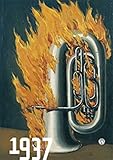
Thomas Kellein, ed. 1937: Perfektion und Zerstörung. Exhibit at the Kunsthalle Bielefeld. With assistance from Roman Grabner and Felicitas von Richthofen. Tübingen: Ernst Wasmuth Verlag, 2007. 527 pp. EUR 49.00 (cloth), ISBN 978-3-8030-3319-2.
Reviewed by Keith Holz (Department of Art, Western Illinois University)
Published on H-German (October, 2009)
Commissioned by Susan R. Boettcher
Modern Art and Politics, circa 1937
Unlike the centripetal pull Bielefeld exerts within certain social-historical galaxies, it has never been the hub of the international art world, never been recognized as a major center for art historians, and never been designated a must-stop for cultural tourists moving about Europe. Thus, the current volume and the major art exhibition of the same name, which it was produced to accompany at the Kunsthalle Bielefeld between September 2007 and January 2008, may have eluded the attention of art historians and historians interested in mid-twentieth-century modern art and politics. The volume's editor, principal author, and exhibition curator recounts in the foreword how this project arose from efforts to conceive of an exhibition on the theme at the time of National Socialism. As he explored the topic, he encountered a disproportionately high number of artworks from 1937. The resulting volume builds upon the foundational scholarship on the National Socialist government of Germany's anti-modernist art campaigns. These included the early chamber of horrors exhibitions, the degenerate art exhibitions, and the auctioning off of vilified state collections at Lucerne's Galerie Fischer.[1] Thomas Kellein's opening essays relate the National Socialist exhibitions of art to other Nazi propaganda exhibitions often overlooked by art historians, and also consider responses of individual artists as divergent as Franz Radziwill within Germany to George Grosz in New York exile. Kellein demonstrates little shyness in his stirring narratives, going so far as to link Germany's defamation of modern, Jewish, and Bolshevik art with the state's expansionist war aims and even to the "systematic mass murder in Auschwitz" (p. 26).
As a material artifact, this hefty volume is defined by several hundred reproductions of artworks (mostly color and full page) produced by 178 artists. This mammoth assembly of works from 1937 is drawn from dozens of international public and private collections. The book thus delivers a rich documentation of contemporary visual art at a particular moment in twentieth-century history. Anyone conversant with European art of the interwar years will already have some sense of the momentousness the year 1937 held for the exhibition and reception of new art in Europe and the United States. As I have argued elsewhere, 1937 marked a sea change in the political evaluation of modernist art, with modern art becoming widely championed (and often accepted) as tantamount to democratic individualism by year's end.[2] The importance of that year for modern art also has been assessed and commemorated before, and nowhere more thoroughly than in nearby Düsseldorf, where in 1987 the art museums of that city realized no fewer than four jubilee exhibitions with scholarly catalogues historicizing aspects of European modernism, ca. 1937.[3] In 1987, Peter-Klaus Schuster also organized an exhibition in Munich that documented and critically commented upon the first venue of the traveling degenerate art exhibition campaign, which opened in that city on July 19, 1937, the day after the opening of the first Great German Art Exhibition (of officially endorsed Nazi art) at the new House of German Art.[4] In the spring of 1937, the Paris World Exposition opened with numerous national pavilions utilizing new art and design to project national ideals, none more visually imposing than the Soviet and German pavilions of Boris Iofan and Albert Speer squaring off in opposition to one another along the Seine. Pablo Picasso's mural-scale painting responsive to the aerial bombing of civilian populations in Spain, Guernica (1937), also made its sensational world debut then and there in Josep Lluís Sert's Pavilion of the Spanish Republican government, the reception of which included the first portrayal of the world's leading modern artist (Picasso) as a hero of democratic individualism standing down totalitarianism. None of this context is lost upon the authors of this volume.
A particularly valuable contribution made by this volume is its printing between two covers reproductions of an extraordinary number of artworks, often by minor or overlooked artists. Each of the excellent reproductions is accompanied by a fulsome biographical sketch on its artist, usually addressing the pictured work of art as well. Most of these biographical sketches situate specific artworks within larger cultural and political discourses. The eleven major essays focus on Germany, Italy, the United States, and the Soviet Union, or on international phenomena, such as developments in photography, the human image in sculpture, the politicization of surrealism, or abstraction and constructivism. Artworks by artists from the aforementioned countries comprise the overwhelming number of included works, while those by artists from Czechoslovakia, England, France, Spain, and other countries make sporadic appearances. Particular attention is given to artworks that wear political history and politicized social history on their sleeves, and much is said about the relation between art and propaganda. In departing from the canonical hierarchies so often upheld by art museums, the curator and his team give similar exposure and analytical attention to artworks by lesser known artists as to the century's most celebrated artists. For example, Heinz Lohmar and Magnus Zeller are discussed nearly to the same extent as Max Beckmann and Max Ernst.
The volume's sheer scope of pictorial and sculptural material will contribute to ongoing reassessments of modernist, National Socialist, and Soviet art. For more than a decade, these assessments have been overturning old assumptions and truisms about modernist and abstract art as standing on the side of democracy and progress, and opposing (and differing with) the idealized naturalisms and realisms embraced by the forces of fascist reaction and Stalinist retrenchment. In specific ways, the numerous thematic essays offer embedded readings of extensive numbers of artworks from this year (sometimes straying into 1936 or 1938). Kellein authored both the introduction on the National Socialists' assault on modernist art, and an essay "Kunst in Nationalsozialismus." His opening essays are followed by another lengthy article by Jutta Hülsewig-Johnen, "Die Kunst in Deutschland." Subsequently, in "Das Menschenbild in der Skulptur," Hülseweg-Johnen considers the human figure in art produced in several nations; Felicitas von Richthofen treats photography in "'Anlitz der Zeit': Vom Porträt zur Sozialfotografie"; Kellein discusses international support for the Spanish Republic by artists and others in "Aufschrei in Spanien" and treats the political aspects of surrealism in a separate contribution that includes a far-flung range of practitioners including Frida Kahlo, Roland Penrose, Karel Teige, Wolfgang Paalen, and Gordon Onslow Ford; and finally, in "Von der Abstraktion zur Konstruktion," Kellein situates strands of international constructivism in relation to political developments. Also included are major chapters on art in Italy, Spain, the Soviet Union, and the United States.
The opportunity this volume offers readers to peruse so many quality reproductions of international art from the same time, and to compare and contrast them with one another should not be underestimated. One might use the volume to begin comparing the representation of a particular theme, such as Soviet, German, French, and U.S. paintings of agricultural labor from 1937. Looking closely at these works, one may find the much-vaunted differences between the style, techniques, and themes of such canvases less conspicuous than voices within the art world then (and seldom since) have acknowledged. With book in hand, some readers will find it to be a useful catalyst to think about and develop categories in terms more transnational about artistic practices and tendencies within art typically considered within national boundaries. Along these lines, I only regret that an essay on the state of the widely practiced genre of landscape painting, ca. 1937, was not commissioned for the volume. And although French art and artists, including exiles residing in France, figure prominently, it is curious that no section or essay is devoted to French art or the French art world.
In sum, art historians and other students of western visual culture of the 1930s will be remiss to neglect this treasure trove of quality reproductions from 1936 to 1939 and the ambitious historical essays which contextualize them. The exhibition and this volume also designate Kellein as an art museum curator able to historicize artworks and to nudge them out of disinterested realms of mere aesthetic contemplation by resituating them within their historical and political contexts.
Notes
[1]. Stephanie Barron, ed., "Degenerate Art": The Fate of the Avant-Garde in Nazi Germany (New York: Harry N. Abrams, 1991); and Christoph Zuschlag, "Entartete Kunst": Ausstellungsstrategien im Nazi-Deutschland (Worms: Wernersche Verlagsgesellschaft, 1995).
[2]. Keith Holz, Modern German Art for Thirties Paris, Prague, and London: Resistance and Acquiescence in a Democratic Public Sphere (Ann Arbor: University of Michigan Press, 2004), 196-197, 276-282.
[3]. Anette Kruszynski, Dirk Luckow, and Freya Mülhaupt, eds., Museum der Gegenwart: Kunst in öffentlichen Sammlungen bis 1937 (Düsseldorf: Kunstsammlung Nordrhein-Westfalen, 1987); Thomas Brandt and Freya Müllhaupt, eds., "--und nicht die leiseste Spur einer Vorschrift": Positionen unabhängiger Kunst in Europa um 1937 (Düsseldorf: Kunstmuseum Düsseldorf, 1987); Hans Albert Peters and Stephan von Wiese, eds., Alfred Flechtheim, Sammler, Kunsthändler, Verleger (Düsseldorf: Die Kunstsammlung, 1987); Jürgen Harten, Hans-Werner Schmidt, and Marie Luise Syring, "Die Axt hat geblüht--": Europäische Konflikte der 30er Jahre in Erinnerung an die frühe Avantgarde (Düsseldorf: Städtische Kunsthalle Düsseldorf, 1987).
[4]. Peter-Klaus Schuster, ed., Nationalsozialismus und "Entartete Kunst": Die "Kunststadt" München 1937 (Munich: Prestel Verlag, 1987).
If there is additional discussion of this review, you may access it through the network, at: https://networks.h-net.org/h-german.
Citation:
Keith Holz. Review of Kellein, Thomas, ed., 1937: Perfektion und Zerstörung.
H-German, H-Net Reviews.
October, 2009.
URL: http://www.h-net.org/reviews/showrev.php?id=25716
 | This work is licensed under a Creative Commons Attribution-Noncommercial-No Derivative Works 3.0 United States License. |

