



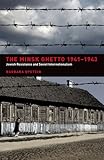
Barbara Leslie Epstein. The Minsk Ghetto 1941-1943: Jewish Resistance and Soviet Internationalism. Berkeley: University of California Press, 2008. xiv + 351 pp. $39.95 (cloth), ISBN 978-0-520-24242-5.
Reviewed by Catherine Epstein (Department of History, Amherst College)
Published on H-German (October, 2009)
Commissioned by Susan R. Boettcher
The Holocaust in Minsk
Since the mid-1990s, a host of regional studies has shown that the Holocaust unfolded differently throughout Nazi-occupied Europe. In some places, Jews were massacred almost immediately after they came under National Socialist rule; in others, they were put into ghettos. In some places, virtually all ghettoized Jews were murdered early on; in others, those deemed "capable of work" were exploited for their labor. Barbara Epstein shows that just as German policy toward genocide differed by region, so, too, did Jewish resistance. In a fine study of the Minsk ghetto, she explores why Jews there did not try to engage in an internal revolt, but rather tried to flee into nearby forests to join partisan groups. As Epstein argues, this "forest/partisan model of resistance" (p. 284) was an effective survival strategy. At its height, the Minsk ghetto had a population of about 100,000 Jews. Roughly 10,000 of them reached the forests; of those who did, most survived the war.
The Minsk case was unusual. As Epstein cogently analyses, a series of correlating factors made it possible for Jews there to flee. The Germans surrounded the Minsk ghetto with barbed wire, rather than a less porous wall; they also patrolled the perimeter less strictly than other ghetto borders. Geography helped, too. The Jews could flee to nearby forests that housed a growing partisan movement. The pine forests and pushcha (ancient forest with thick, overgrown trees), typical of the region, also proved difficult for the Germans to penetrate. Most important, though, Jews in Minsk were able to maintain a rich network of contacts outside the ghetto. This system was a legacy of Soviet cosmopolitanism, as well as of the fact that nineteenth-century Belorussia experienced a less virulent antisemitism and a weaker national consciousness than other areas of eastern Europe. Unlike most other Jews in Nazi-occupied Europe, inhabitants of the Minsk ghetto could often count on the solidarity of non-Jews. Indeed, the ghetto hierarchy was part of a citywide underground movement, another unusual phenomenon in Nazi-occupied eastern Europe. The first two ghetto Judenräte were also closely linked with the resistance; they collaborated less with the Germans than Judenräte elsewhere, although they were eventually replaced with Jewish collaborators who were not Minsk natives. Epstein strengthens her analysis by devoting a chapter to the situation in Kovno and, in less detail, three other major ghettos (Warsaw, Vilna, and Bialystok), in order to underscore the unusual combination of factors that obtained in Minsk.
For her book, Epstein undertook painstaking research. She arranged numerous interviews and made fine use of surviving documents and memoirs written in multiple languages. This material demonstrates that the success of all underground ghetto activity in Minsk rested on solidarity between Jews and non-Jews. The citywide resistance managed to operate a clandestine press that printed materials for the ghetto. Jewish children were removed and housed in other parts of Minsk; this campaign probably saved hundreds of lives. Jews and non-Jews together engaged in sabotage of German factories. Most important, the citywide underground helped to send Jews to the forests. Although the non-Jewish resistance was initially reluctant to send Jews (and partisans were often reluctant to accept them), this attitude was eventually overcome. By 1943, thousands of Minsk Jews, often led by child guides and helped by non-Jewish contacts, made their way into the forests.
In some of the most interesting passages of her book, Epstein explores why the Minsk story has received little recognition. After 1945, the official Soviet line maintained that the Minsk resistance had collaborated with the Germans. In part, this claim was made because after the arrests of the first and second leaderships of the underground, their members divulged names, leading to additional arrests. But in fact, as Epstein documents, the branding of the Minsk underground as traitorous had little to do with events in Minsk and much to do with Soviet politics. When the Germans invaded in June 1941, Panteleimon Ponomarenko and other Belorussian Communist Party leaders fled the city, leaving no one in charge of underground activity. To make up for his hasty flight, Ponomarenko invented a story according to which he and others had organized a massive evacuation from the city. Had this been the case, most communists would have left the city, and remaining inhabitants would have stayed because they chose to live under German occupation. By definition, then, the Minsk underground would have been collaborationist. After the war, Ponomarenko and his allies continued to cast aspersions on the Minsk underground in order to burnish the reputation of their own wartime activities. Hundreds of former members of the Minsk underground were arrested; many were not rehabilitated until the 1950s or 1960s. In this atmosphere, it was not possible to circulate the true story of the Minsk resistance.
Epstein also argues that the "Warsaw ghetto uprising and the strategy of internal ghetto rebellion that it followed have come to be regarded as the gold standard of Holocaust resistance" (p. 283). This attitude, she argues, has developed from the prevalence of Zionist attitudes in the forging of Holocaust memory. Many Zionists thought that when Jews escaped from the ghettos they were privileging their personal survival, while abandoning that of their people. At the same time, they believed that the uprising story could help forge a Jewish national identity. Jewish survivors in Israel and the United States were also more likely to have come from areas west of the Soviet Union (where internal ghetto revolts were the preferred resistance strategy)--and they were the ones in a position to have their stories heard. Yet, as Epstein argues, while the Warsaw uprising is inspiring, it was born of futility. Since no hope remained for most of the Jews in Warsaw to survive (no nearby forests housed partisans), uprising leaders believed that it was better to die heroically than to go like sheep to the slaughter. But in places where escape was possible--in Minsk, and less so in Kovno--Jews were much more eager to survive than to create a heroic narrative for future Jews. At the same time, the Minsk story, which emphasized cooperation between Jews and non-Jews (rather than the heroic self-help of the Warsaw ghetto uprising), was less suited to the Zionist goal of creating a purely Jewish homeland. It also showcased positive elements of the Soviet experiment--cosmopolitanism, the repression of nationalism, and pre-World War II campaigns against antisemitism--that had little resonance in the Cold War West. Epstein concludes that the Minsk ghetto's strategy of forest/partisan resistance, with saving lives as its major goal, should be viewed as "to its credit" (p. 292).
This book suffers from one major flaw: it is terribly repetitive. Whether a strand of analysis or an anecdote--such as the information that partisan leader Semyon Ganzenko and several other prisoners of war were put in garbage barrels, given straws to breathe through, and taken into the forest (told at least three times)--Epstein repeats herself over and over again. The book also includes some minor factual errors. The Nazis, for example, could not possibly have arrested the first leader of the Judenrat, Ilya Mushkin, in February 1941; they had not yet invaded the Soviet Union. These drawbacks, however, should not stand in the way of an appreciation of what Epstein has achieved. She has constructed a fine history of the Minsk ghetto; expertly analyzed that history in comparative perspective; and deftly explained why we have known so little about it.
Epstein's work makes an excellent contribution to the growing literature on regional differences in the Holocaust. Yet despite regional variations, the outcome of the Holocaust was sadly the same throughout eastern Europe: everywhere, regardless of survival strategy, only a tiny remnant of vibrant Jewish life survived the Nazi onslaught. While Minsk Jews enjoyed higher survival rates than those in other areas of Nazi-occupied eastern Europe, in the end, the vast majority of them were murdered, too.
If there is additional discussion of this review, you may access it through the network, at: https://networks.h-net.org/h-german.
Citation:
Catherine Epstein. Review of Epstein, Barbara Leslie, The Minsk Ghetto 1941-1943: Jewish Resistance and Soviet Internationalism.
H-German, H-Net Reviews.
October, 2009.
URL: http://www.h-net.org/reviews/showrev.php?id=25712
 | This work is licensed under a Creative Commons Attribution-Noncommercial-No Derivative Works 3.0 United States License. |

