



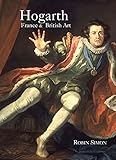
Robin Simon. Hogarth, France and British Art. London: Greenhill Books/Lionel Leventhal, 2007. 313 pp. $90.00 (cloth), ISBN 978-0-9554063-0-0.
Reviewed by Douglas Fordham (University of Virginia)
Published on H-Albion (January, 2010)
Commissioned by David S. Karr (Columbia College)
William Hogarth’s Surprising Cosmopolitanism
Since his death in 1764, William Hogarth has become a protean figurehead for a great many impulses in British culture. John Trusler’s Hogarth Moralized (1768) was an early and overt instance of the ends to which Hogarth’s life and oeuvre could be put, and Hogarth continues to be, if not moralized, then at least channeled into a disparate series of voices and roles. While the “New Art History” of the past two decades has turned its pragmatic sights on Hogarth the calculating businessman, it has also tended to reduce the artist to a somewhat bland spokesman for a polite and commercial age. In the writings of David Solkin and David Bindman, in particular, Hogarth has been cast as a cultural latitudinarian, mainstream in his preoccupations and eager to please. To the extent that Hogarth’s works reveal contradictions, unpleasant truths, or impolite expressions they tend to be viewed as apt reflections of an anxious age.[1] This view of the artist offered a calculated response to Ronald Paulson’s towering contribution to Hogarth scholarship, beginning in the 1970s, which emphasized the artist’s antinomian impulses and his empathetic eye for the sub-cultural. If Hogarth merges seamlessly into hegemonic discourses in the former, he activates a dizzying array of allusions and a daunting density of meaning in the voluminous writings of Paulson.[2] While each of these accounts, and a great many others, have transformed our understanding of the artist and his age, readers are ultimately tasked with choosing which Hogarth they prefer. For it hardly seems possible for one individual to embody so many contrary impulses
Robin Simon makes a welcome contribution to this debate in Hogarth, France and British Art, where he offers a surprisingly fresh iteration of the artist and his milieu. Simon’s Hogarth is cosmopolitan in his understanding of European Old Masters and contemporary French art, sophisticated in his handling of oil paints, and a friend to “Tory wits” and Whig politicians alike. Hogarth emerges in Simon’s account as an intellectually serious artist and a deeply gifted painter who almost single-handedly elevated British art to a Continental level of refinement. In his desire to translate French theories and standards into a uniquely English vernacular, “Hogarth demands to be ranked with the literary giants of the ‘Augustan’ age in England” (p. 8). Simon shares with Paulson a propensity for making analogies between English literature and art, and some of Simon’s most compelling observations entail comparisons between Hogarth’s paintings and the English stage. Like Paulson, Simon is eager to embrace a heroic vision of the artist with contrarian tendencies. “Whatever his political beliefs may or may not have been,” Simon writes, “Hogarth was, as it were, instinctively and perpetually ‘in opposition’” (p. 47). But Simon places his emphasis squarely on the high end of the cultural scale, examining Hogarth’s work in the light of French aesthetic theory, Alexander Pope’s poetry, and opera, among others. Simon actually takes up a number of arguments first articulated in Frederick Antal’s Hogarth and his Place in European art (1962), which sought to anchor Hogarth’s legacy to a Continental foundation. Where Antal countered the dismissiveness of English critics and art historians towards Hogarth and British art more generally, Simon counters what he perceives to be an unfortunate disregard in recent scholarship towards intricate webs of patronage and good old-fashioned connoisseurship. Latent in Antal’s British art history were two possible directions, and if the social history of art embraced the neo-Marxist potentialities of Antal’s project, Simon returns not just to Antal’s cosmopolitan thesis, but also to an older commitment to iconology and the paths of artistic emulation.
Simon’s book is divided into two parts, the first of which contains eight chapters that deal with Hogarth’s response to French art and aesthetic theory from a variety of perspectives. Simon meticulously traces networks of exchange between British and French artists in the first half of the eighteenth century, and he emphasizes the centrality of Huguenot refugees to the London art world. Simon emphasizes, for example, Hogarth’s debt to Louis Chéron, the once eminent but now largely forgotten French artist who became his drawing master, and who comes into focus in the first five chapters. British art historians have been slow to recognize the significance to their own discipline of Thomas Crow’s Painters and Public Life in Eighteenth-Century Paris (1985), where the Académie royale de peinture et de sculpture in Paris emerges as a disputatious institution that encompassed a broad array of artistic positions and values. Without diminishing Hogarth’s long-standing enmity against the French academy as a model for British art organization, Simon teases out individual aesthetic positions from which he had much to learn, including those espoused by Roger de Piles and the Crozat circle. “Hogarth’s French Connections,” the title of chapter 3, nonetheless remain elusive, and the art-historical payoff of this kind of Namierite interpersonal history rests, at least for me, in a cumulative sense of the kinds of cultural interactions that took place between London and Paris rather than in specific personal relationships and artistic borrowings. In chapter 6 Simon productively examines Hogarth’s painting Garrick as Richard III (1745) as “directly confronting the French history painting tradition” (p. 99). In order to substantiate this claim Simon further argues that “British theatre was in many ways in a position analogous to that of painting: influenced by French theory, and impelled by a desire to match up with its demands. But the theatre was at the same time also conscious of a great native tradition that had paid surprisingly little attention to continental niceties” (pp. 99-100). The Enlightenment debate over Shakespeare, of which the writings of Voltaire and the adaptations of David Garrick are paradigmatic, provides Simon with a means of triangulating Hogarth’s work via French academic theory and the English stage. In a book that can feel a touch miscellaneous the theater provides a crucial continuity, and it is surprising that the term did not make it into the book’s title.
The second part of the book also contains eight chapters, and together they examine the relationship between Hogarth’s art and a variety of other English art forms including sculpture, Augustan poetry, and opera. Particularly compelling are Simon’s analyses of Hogarth’s portraits in chapter 9, in which he captures formal and emotional nuances in portraits that have been all too easy to overlook. Returning again to literary analogies, Simon describes Hogarth’s working method as a variant of Augustan literary imitation, which once again elevates Hogarth’s work to the highest possible cultural plane. There are moments when Hogarth chafes against such grandiloquence, as, for example, when he failed to commit to memory even a few brief lines in his role as Grilliardo in a friendly staging of his theatrical parody Ragandjaw (p. 128). For Simon this anecdote reveals Hogarth’s intimate relation with the theater, but it also reminds us that Hogarth’s genius was fundamentally visual. Perhaps literary terms are not the best way to characterize the accomplishments of a man who was forced to read a few comic lines off the back of a lantern. Simon seems to recognize this in his analysis of the Harlot’s and Rake’s progresses in relation to the English novel in chapter 13. What is striking about this comparison is not that Hogarth relied on literary structures, but rather that the novel, which largely postdates the early progresses, became intensely visual. “It is not therefore that Hogarth imitates the novel; rather that, as the novel developed, it did so in part because the ideas of its practitioners about what fictional narrative could and ought to be were themselves formed by their experience of Hogarth’s progresses” (p. 233). Cumulatively, the last eight chapters turn to arts as diverse as opera, sculpture, and poetry in order to assess Hogarth’s own contribution to a British vernacular art.
The paradox latent in Simon’s approach is that Hogarth already had an English visual vernacular at his disposal in London printshops, on painted street signs, and in countless urban spectacles. While Simon deliberately challenges the “determinedly insular” (p. 3) quality of recent Hogarth scholarship, at what cost does Hogarth the cosmopolitan painter become divested from Hogarth the graphic satirist as Diana Donald and Mark Hallett, for example, have presented him?[3] This is a question of synthesis, however, rather than a legitimate critique of Simon’s stated aims. On its own terms, Simon’s book deserves to be read by everyone with an interest in British culture in the first half of the eighteenth century, and it dramatically improves our understanding of Anglo-French relations. It also manages to present us with yet another incarnation of the artist from which to choose. This is a significant accomplishment in itself, and if this new Hogarth sits uncomfortably alongside his forebearers, then it can only encourage us to look anew at Hogarth’s astonishingly diverse and provocative career.
Notes
[1]. David Solkin, Painting for Money: The Visual Arts and the Public Sphere in Eighteenth-Century England (New Haven and London: Yale University Press, 1993); and David Bindman, Hogarth and his Times: Serious Comedy (Berkeley and Los Angeles: University of California Press, 1997). This view of the artist also predominates in the most recent Tate exhibition and catalogue by Mark Hallett and Christine Riding, Hogarth (London: Tate Publishing, 2006), which provides a thorough bibliography related to the artist.
[2]. Ronald Paulson’s pioneering early writings on Hogarth include Hogarth: His Life, Art and Times (New Haven and London: Yale University Press, 1971), The Art of Hogarth (London: Phaidon, 1975), Emblem and Expression: Meaning in English Art of the Eighteenth Century (London: Thames and Hudson,1975), and Popular and Polite Art in the Age of Hogarth and Fielding (Notre Dame and London: University of Notre Dame Press, 1979).
[3]. Diana Donald, The Age of Caricature: Satirical Prints in the Reign of George III (New Haven and London: Yale University Press, 1996); and Mark Hallett, The Spectacle of Difference: Graphic Satire in the Age of Hogarth (New Haven and London: Yale University Press, 1999).
If there is additional discussion of this review, you may access it through the network, at: https://networks.h-net.org/h-albion.
Citation:
Douglas Fordham. Review of Simon, Robin, Hogarth, France and British Art.
H-Albion, H-Net Reviews.
January, 2010.
URL: http://www.h-net.org/reviews/showrev.php?id=25691
 | This work is licensed under a Creative Commons Attribution-Noncommercial-No Derivative Works 3.0 United States License. |

