



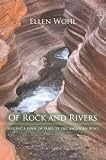
Ellen Wohl. Of Rock and Rivers: Seeking a Sense of Place in the American West. Berkeley: University of California Press, 2009. xix + 267 pp. $24.95 (cloth), ISBN 978-0-520-25703-0.
Reviewed by Jamie Linton (Queen's University)
Published on H-Water (March, 2010)
Commissioned by Justin M. Scott-Coe (Monte Vista Water District; Claremont Graduate University)
Thinking Geologically
Ellen Wohl is a highly accomplished fluvial geomorphologist with strong literary sensibilities, a reverential attachment to landscape, and a powerful turn of phrase. In Of Rock and Rivers, she combines her considerable strengths and enthusiasms in a book on the American West that is part memoir, part polemic, part textbook, and part poetry. That she succeeds in bringing this all together in a very good read is testimony to her profound knowledge of, and feeling for, the place that has helped form her.
Standing in the tradition of scientists who write clearly and passionately about nature, Wohl brings geomorphology--the study of processes that shape landforms--to life in a text that would serve exceptionally well as an introduction to prospective students. To readers of H-Water, it is especially significant that the predominant force driving geomorphological processes is water. Flowing through Wohl's narrative as it does through the places that she describes, water is presented as a history maker, forming the predominant features of the landscape as well as the key moments in Wohl's personal story of becoming acquainted with and seized by the West.
Wohl made her own discovery of that vast region stretching from approximately the 100th meridian to the coastal mountain ranges when she moved from Ohio to study geology in Arizona. Marking the beginning of her narrative, that moment also marked the beginning of a dialectical process by which geology, geomorphology, and the landforms of the West opened themselves up to each other in her research and in the research of her graduate students, of which several feature prominently in the story. It is the story of a mind trained to experience the world from a geologist's perspective, imbuing "a sense of infinite time and of the slow but ongoing change of the Earth's surface" (p. 34).
This sense of landscape as process runs constantly through the book, serving as a counterpoint to the vivid, often gorgeous descriptions of places, ecosystems, and their floral and faunal denizens. The geographical focus of the book is on Colorado and, to a lesser extent, Arizona, where Wohl and her students have conducted their research. There are chapters on such topics as the Arizona desert; the Colorado River; the canyon of the Paria River (a tributary of the Colorado); the Rocky Mountains; the plains/prairies of eastern Colorado; fire as a geomorphological process; the hydrological and ecological effects of snowmaking for the Colorado ski industry; the history and basic theoretical underpinnings of American geomorphology; the question of what it means to restore a river to its "natural" state; and the morality of angling for what are, in most cases, nonnative, introduced fish species.
Two themes come out most strongly. The first theme is the folly of seeing landscapes as fixed and eternal. Wohl asserts a geologist's perspective on human settlement and activity: "Geology gave me a sense of infinite time and of the slow but ongoing change of the Earth's surface. It also gave me a sense of accelerating change as the landscape responds to human activities, and of the human ability to ignore or forget these changes" (p. 34). Ignorance of landscape processes, she shows, often leads to lax regulatory regimes, which allow development in attractive places that are nevertheless subject to debris flows: "Those who admire mountain scenery and wish to live in it must realize that the scenery is not static" (p. 102). In a chapter on fire as a landscape process in the Huachuca Mountains of southern Arizona, she notes: "What the homeowners at the base of the mountains saw as a single, preventable catastrophe struck me very differently. I viewed it as the latest occurrence in a long and continuing sequence of landscape evolution ... and an occurrence that was fairly predictable given some knowledge of the range's recent geomorphic history" (p. 128). In these and in other examples, Wohl advocates for policies that better respect the nature and limitations of these places.
A second, related theme is the complexity of the relationship between nature and human society. We learn that Wohl's experience living and doing research in the West disabused her of an earlier misconception (based on a common American cultural myth) of the pristine, untouched, uncivilized West, a place where nature prevails over humanity, and where wilderness still reigns: "More than two decades of living in the West has changed my perceptions of the Western landscape.... It has started me on the path toward recognizing that landscapes and ecosystems are not so much discrete entities as ongoing processes of change that have been everywhere affected by humans for thousands of years" (p. 13). Research in the natural sciences, she concludes, has taught moreover that "we can learn to define humans as an integral part of the landscape" (p. 238). And yet, this lesson (which we have also learned in abundance from the work of environmental historians, cultural geographers, anthropologists, and others) sometimes runs against a tendency in the narrative to define people as part of the landscape only when they behave in accordance with the natural processes that form the main actors in the book. When involved in things like building dams, making snow for ski runs, engaging in intensive agriculture, or angling for nonnative species, people are presented as an alien force, divorced from the landscape and at odds with nature.
Seeing humans as an integral part of the landscape is an important prerequisite to imagining and realizing sustainable natures. In an era described by many in terms of the Anthropocene, it would seem that we have little choice but to develop ways of thinking that integrate nature and society in constructive ways. Geologically inspired writing offers a great deal of useful material for such thinking, of which this book serves as a prime example.
If there is additional discussion of this review, you may access it through the network, at: https://networks.h-net.org/h-water.
Citation:
Jamie Linton. Review of Wohl, Ellen, Of Rock and Rivers: Seeking a Sense of Place in the American West.
H-Water, H-Net Reviews.
March, 2010.
URL: http://www.h-net.org/reviews/showrev.php?id=25610
 | This work is licensed under a Creative Commons Attribution-Noncommercial-No Derivative Works 3.0 United States License. |

