



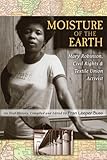
Mary Robinson. Moisture of the Earth: Mary Robinson, Civil Rights and Textile Union Activist. Compiled and Edited by Fran Leeper Buss. Ann Arbor: University of Michigan Press, 2009. Illustrations. xv + 222 pp. $60.00 (cloth), ISBN 978-0-472-09587-2; $22.95 (paper), ISBN 978-0-472-06587-5.
Reviewed by Annette Cox (University of North Carolina at Wilmington)
Published on H-South (May, 2011)
Commissioned by Catherine A. Cardno (American Society of Civil Engineers)
Tales of a Sharecropper's Daughter: Race, Sex, and Unions in Modern Alabama
In Moisture of the Earth, Mary Robinson, an Alabama textile union activist, tells her life story in vivid and poignant detail. Assembled from oral history interviews conducted over twenty-three years by Fran Leeper Buss, the book describes the life of a southern African American sharecropper’s daughter who became a spokeswoman for the 1970s J. P. Stevens organizing drive. By transforming the Robinson interviews into an autobiography, Buss demonstrates one way scholars can successfully rely on oral history to create a lucid and gripping manuscript. Buss adeptly rearranges her interviews into a chronological narrative as if Robinson were telling the story all at once rather than over a period of more than two decades. She eliminates her interview questions and any repetitions in Robinson’s answers, thereby making the book read more like a novel than a monograph. Buss deposited her material at Radcliffe’s Schlesinger Library for others to consult
Reading Moisture of the Earth brings to mind the works of Zora Neale Hurston, Toni Morrison, and Alice Walker. Robinson recounts a youth in the rural, segregated South where racial violence, domestic turmoil, and sexual exploitation were familiar occurrences. One of the most horrifying stories involves the shotgun murder of one of Robinson’s childhood friends, Virga Mae, by her stepfather. Adept at using detail that brings a character to life, Robinson remembers that Mae, described as a child who “never caught up with her age,” acknowledged friends by gently switching their legs with a small branch she always carried with her (p. 68). Robinson learned after Mae’s death that her stepfather had been molesting her.
Robinson’s own family met with considerable misfortune. Her sharecropper father worked hard for little reward. He constantly cheated on his wife, had a shadow family, and mercilessly whipped Robinson’s sister when she defied him. When another of Robinson’s sisters brought home a prospective boyfriend, Robinson’s parents forbade her to see him because he was actually her stepbrother, a child with one of her father’s mistresses. When Robinson married, her husband beat her regularly and brought his girlfriends into their home while she was away.
Robinson’s portrayal of race relations exposes the daily cruelties of life in postwar Elmore County, Alabama. The local sheriff terrorized the neighborhood blacks, a fear made more vivid by Robinson’s memory of his “car coming down the road, its tall old antenna swaying from side to side, be putting fear in us childrens. ‘Cause we knowed the stories, the things that he did to African American people” (p. 34). She firmly believed that God punished such brutality and carefully noted when such a figure met with a horrible fate.
At other times, she describes her warm relationship with white fellow workers and even gives some credit to the white landowner on whose property the family farmed. After the landowner’s death, Robinson concludes that “Mr. Paul was good to us and he was a gentle man” (p. 102). In his will, he left her father sixty-five acres of land, only to have it effectively stolen by his widow who paid Robinson’s father a nominal sum for the acreage. Robinson expresses bitterness over the fraud, but reminds her readers that “God really put something on her,” a curse that Robinson believed led to the widow’s suicide (p. 142). For Robinson, the event was made even more tragic by her father’s betrayal. What little money he made on the sale, he gave to his girlfriend, not to his own family.
While these horrifying incidents occur regularly throughout the book, its tone is not sensational. Instead, the book, as a whole, is a celebration of her mother’s courage, the delight her family took in southern rural life, and the bonds of friendship in the factory and union. While work in the cotton fields was grueling, the family reveled in the time spent with neighbors, in their own garden, and at fishing holes. Robinson identifies her family’s love of their land as the central force in its life. “She [Robinson’s mother] had her garden, and in the summer nobody suffered when it came to food. Sometimes it seemed like fields of food. Peas, butter beans, sugarcane, and sweet potatoes” (p. 66). To compensate for the many hours working with a hoe, her mother, Robinson reminisces, made cooking the focal point for her social life. When she cooked hominy, “folkses came over to eat it with us, then after they ate, the grown-ups sat up and told stories” (p. 68). Robinson grows rhapsodic about her mother’s meals when she recalls, “Then on Sundays she fried chicken and cooked collard greens that smelled so good your heart almost stopped, waiting for it to be done” (p. 66). Her mother’s favorite pastime was fishing, a time when she shared folk wisdom with her daughter: “Mama told me about plants while we fished. She showed me wild lilies and the difference between the safe and the poisonous sassafras, and she showed me one plant that would make your hair grow” (pp. 76-77). Robinson’s descriptions of nature and family ring true and demonstrate the comfort that they found in their rural setting.
Because Robinson and her family drew so much sustenance from the land, their loss of the farm was a great tragedy. She bitterly remembers that “new owners came, then swooped our past off the earth. They tore down our house, wiped up our poor little childhood, and threw it away. Now they got two three-hundred-thousand-dollar houses sitting where we loved and worked and bled” (p. xiii). Robinson’s home county, Elmore, lies in central Alabama between Montgomery and Birmingham, two rapidly growing urban areas, and benefits from its neighbors’ prosperity. For example, automobile manufacturer Hyundai chose Montgomery for a new factory in 2004.
The book’s final chapters concentrate on Robinson’s years in the textile industry. She began in the winding room on the night shift and then moved to spinning. She enjoyed the work and camaraderie of her coworkers, but found factory conditions abysmal. The factory had no air conditioning, the looms made a terrible racket, and cotton dust covered both equipment and workers. When J. P. Stevens bought the factory, Robinson concluded that outside management was profoundly unsympathetic to the Alabama workforce. She was particularly angered by the treatment of female employees who were overlooked for supervisory and better paying jobs. When older white or black women mastered their jobs and qualified for a higher position, mill management simple moved them to another piece of equipment where they began again as novices. She contends that “the men thought they had the advantage over womens and made wisecracks or told us dirty jokes when we didn’t want to hear them.” Robinson notes that some young white female workers got involved with “one or another redneck supervisor,” a relationship that only created serious problems (p. 147). If the supervisor tired of his girlfriend, he would fire her or make her life miserable.
Robinson’s life changed when she met a union organizer, “a little old short, bewildered-looking fellah with curly hair” (p. 149). She began attending meetings of the local Amalgamated Clothing and Textile Workers Union in 1976 where she took a leadership role in the organizing drive because, as she puts it, she had the nerve to talk back to her supervisors. The company responded with spies and intimidation. By 1977, her union had signed up enough workers to force Stevens to the bargaining table. After the union recognized Robinson’s dynamic personality, it asked her to represent her fellow workers at shareholders’ meetings, national labor conventions, and other organizing drives. After the collapse of southern textiles, Robinson found work as a school bus driver where she continued her efforts for unionization.
In the final chapter, Buss and Robinson discover that there was a brutal and violent confrontation between whites and black sharecroppers during the Depression in neighboring Tallapoosa County. They find a survivor, an elderly man who confirmed the story and added considerable detail to the narrative. Buss employs this incident to link Robinson’s life to the histories of southern radicalism by Robin D. G. Kelly, Theodore Rosengarten, and Glenda Gilmore. The confrontation involved the Alabama Share Croppers Union, probably organized by Communists in 1931. In December 1932, an armed posse of three hundred whites pursued union members into a swamp and killed a number of them. This union and its violent history were unknown to Robinson. She attributes black silence about the matter to the need of parents to protect their children. Her own father attended meetings of the National Association for the Advancement of Colored People and constantly urged his children to keep quiet about it.
This book’s strength does not lie with its analysis of union activism but with Robinson’s tales of growing up in rural, segregated Alabama. Looking back on her organizing career, Robinson attributes her fighting spirit to her religion, a faith rooted in southern churches: “I was put on earth for the underdog, for the people that can’t fight for themselves. I just raise all kinds of hell and cause all kinds of problems--God gives me the ability, he gives me the strength and guides me, and we do it. That’s it” (p. 190). Late in life while she was at the wheel of her school bus, she had a religious vision that convinced her that her life had had meaning and that salvation was hers. Moisture of the Earth proves that Robinson is all about family and God. Her loyalty to the homestead where she grew up and its loss are at the core of her life. Hers is a story of profound attachment to family, land, and faith.
If there is additional discussion of this review, you may access it through the network, at: https://networks.h-net.org/h-south.
Citation:
Annette Cox. Review of Robinson, Mary, Moisture of the Earth: Mary Robinson, Civil Rights and Textile Union Activist.
H-South, H-Net Reviews.
May, 2011.
URL: http://www.h-net.org/reviews/showrev.php?id=25484
 | This work is licensed under a Creative Commons Attribution-Noncommercial-No Derivative Works 3.0 United States License. |

