



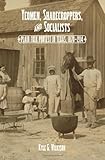
Kyle G. Wilkison. Yeomen, Sharecroppers, and Socialists: Plain Folk Protest in Texas, 1870-1914. College Station: Texas A&M University Press, 2008. x + 297 pp. $40.00 (cloth), ISBN 978-1-60344-065-3.
Reviewed by Debra A. Reid (Eastern Illinois University)
Published on H-South (January, 2012)
Commissioned by Catherine A. Cardno (American Society of Civil Engineers)
Agrarian Socialism: A Political Frontier on East Texas Soil
Journals often do not include reviews of books more than three years old, but this reviewer believes that it is never too late to reflect on award-winning books not previously reviewed. Kyle G. Wilkison’s Yeomen, Sharecroppers, and Socialists received every major award for books published on Texas history, including the 2008 T. R. Fehrenbach Award (Texas Historical Commission), the 2009 Ottis Lock Award for the Best Book in East Texas History (East Texas Historical Society), and the 2009 Kate Broocks Bates Award for Historical Research (Texas State Historical Association). In addition, CHOICE: The Journal of the American Library Association recognized Yeomen, Sharecroppers, and Socialists as a Choice Outstanding Academic Title. When such a convergence happens, the author, a professor of history at Collin College in Plano, Texas, must have done many things right.
Wilkison does not mince his words but makes his points clear and precise. “The rate of landownership versus tenancy composed the single most important factor in explaining production choices ... [and] in counties where a majority of farmers still owned their own land, security-first production flourished” (p. 29). Yet where the majority of farmers farmed other people’s land, monoculture took hold. Wilkison focuses his analysis on a place in Texas where “more Texas farmers faced a bleak[er] outlook in 1910 than had their class forty years earlier in the aftermath of the Civil War. More owned no property and had less control over their own lives” (p. 30). According to Wilkison, farmers’ lack of independence derived from their lack of property ownership, and this constrained them to farming someone else’s land and planting what the landlords dictated, namely, cotton.
These farmers did not flee their impoverished condition in Hunt County, a place in Texas situated squarely in the Blackland Prairie on the western edge of the cotton South. They did not take the train to a less physically taxing job in a growing Texas city. Instead, the families remained bound to the fertile ground that generated one-third of all cotton produced in the nation. They held firmly to their race biases against people of African origin, which either resulted from or helped account for the whiteness of Hunt County compared to neighboring counties. A few of these landless farm families, approximately 16 percent, further defied historic trends by launching “an extraordinary critique of the economic system during the first two decades of the twentieth century” (p. 147). They found cultural release through primitive Protestantism; and with their moral outrage at their landless condition reaffirmed, one out of six voted for Socialist candidates in 1912.
Sources more numerous than the stock on Hunt County farms provided the evidence that Wilkison poured over as he thought about the relationships between tenancy and independence, rural mutuality and division, and public lands and the closing of the frontier. He gathered data from tax rolls and church rolls, from sermons and census compendia, and from agrarian newspapers and election returns. He draws on oral interviews with elderly residents who remembered their rural youth. This variety allows Wilkison to combine rural culture and rural politics in ways that help explain how a radical leftist political and cultural movement emerged in a capitalist and racist one-party county but failed to exert significant influence in the capitalist and racist one-party state, region, or nation.
Wilkison’s monograph warrants professional recognition because he explains the choices made by a distinct minority within the white landless farmer majority. Specifically Wilkison argues that the rural poor expressed their frustration with their economic plight through their religious as well as their political choices. According to Wilkison, primitive religious revivals in the form of the Holiness movement became another way for the poorest farmers in Hunt County to challenge greed. Wilkison implies that the closing of the frontier caused plain folk to panic; no public land existed within their price range. Without migration as a safety valve, they turned to radical politics. The farmers who voted Socialist in the 1912 election challenged basic tenants of American political and economic philosophy, specifically the ways that private property rights and free-market capitalism protected the interests of those who took the means of production out of the hands of family farmers. Yet the Socialist farmers remained dedicated to agrarianism; they expressed their moral outrage at a system that prevented them from securing their own piece of the American landscape. Wilkison ultimately claims that “those one out of six who cast ballots for socialism were more like their Democratic or non-voting fellows than they were different” (p. 210). They did not advocate public ownership; they did not turn away from capitalism.
Other historians of rural Texas have addressed other aspects of plain folk culture into which Wilkison does not delve or touches on only tangentially. Rebecca Sharpless focuses on women on the Blackland Prairie in her award-winning Fertile Ground, Narrow Choices: Women on Texas Cotton Farms, 1900-1940 (1999). Neil Foley explains the complexity of race relations in an agricultural economy populated by three competing racial and ethnic groups, including plain folk, in his award-winning White Scourge: Mexicans, Blacks, and Poor Whites in Texas Cotton Culture (1997). Other studies address socialism and its origins and demise in the rural South and West. Wilkison credits James R. Green’s monograph, Grass-Roots Socialism: Radical Movements in the Southwest, 1895-1943 (1978), which focuses on Oklahoma, for introducing him to rural Texas protest. Wilkison realizes the breadth of scholarship on socialism that Yeomen, Sharecroppers, and Socialism does not address, and he has coedited with his colleague, David O’Donald Cullen, a collection of essays that explores socialism more completely as expressed by women, African Americans, Mexican Americans, and other white Texans historically. The Texas Left: The Radical Roots of Lone Star Liberalism (2010) and Yeomen, Sharecroppers, and Socialists provide important context for future studies of rural radicals. Layering focused studies that address one agricultural zone, such as the Blackland Prairie, from different perspectives (Sharpless on women, Foley on tripartite race relations, and Wilkison on radical politics) affirms the importance of social history as a method to understand both change over time as well as the constraints that prevented substantive change from happening.
If there is additional discussion of this review, you may access it through the network, at: https://networks.h-net.org/h-south.
Citation:
Debra A. Reid. Review of Wilkison, Kyle G., Yeomen, Sharecroppers, and Socialists: Plain Folk Protest in Texas, 1870-1914.
H-South, H-Net Reviews.
January, 2012.
URL: http://www.h-net.org/reviews/showrev.php?id=25480
 | This work is licensed under a Creative Commons Attribution-Noncommercial-No Derivative Works 3.0 United States License. |

