



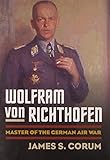
James S. Corum. Wolfram von Richthofen: Master of the German Air War. Modern War Studies. Lawrence: University Press of Kansas, 2008. vii + 421 pp. $34.95 (cloth), ISBN 978-0-7006-1598-8.
Reviewed by Peter Kilduff (Central Connecticut State University)
Published on H-German (September, 2009)
Commissioned by Susan R. Boettcher
Beyond the Red Baron
The mark of achievement among many World War I pilots was the number of enemy aircraft shot down--called aerial victories. The most successful Jagdflieger of all World War I belligerents, Rittmeister Manfred Freiherr von Richthofen, shot down eighty adversaries from red-colored airplanes, an act that earned him the sobriquet "the Red Baron." His younger brother, Lothar, downed forty enemy planes, and a cousin, Leutnant Wolfram Freiherr von Richthofen, had eight aerial victories to his credit. Their success makes it no wonder that over the years many authors, myself included, have written books about the two Richthofen brothers. Despite a low "score" of enemy aircraft, however, Wolfram von Richthofen was no mere footnote to the Red Baron story and has long merited a book devoted exclusively to his life. His actions before and during World War II were on a scope far exceeding that of any Jagdflieger. Wolfram was the youngest of the three Richthofen combat pilots, but he attained the highest rank of all the military members in his family and exercised broad influence on the conduct of a major theater of operations. Promoted to Generalfeldmarschall at age forty-eight in 1943, Wolfram became best known as a master air tactician and air operations commander. Some minor problems in its details aside, James S. Corum's new biography provides a good overview of Wolfram von Richthofen's life. A variety of seldom seen photos and the author's exploitation of excellent sources make the work worthwhile reading.
Understandably, Corum focuses more heavily on Wolfram von Richthofen's post-World War I experiences than on his exploits during the war. These included his role in helping to develop the post-World War I "secret" Luftwaffe, in contravention of the Treaty of Versailles, as well as his leadership in Spanish Civil War air operations and major World War II air campaigns. Thanks to access to diaries, photographs, and family papers, the author offers the reader a great deal of information about Wolfram's military career and the forces that drove him to succeed to the Wehrmacht's highest rank. He also provides a summary of Richthofen family history, explanations of social conditions that helped to mold Wolfram as a person of his times, and the deployment and development of ground and air forces in both World Wars. Corum's observations are well focused and delivered in effective and sometimes moving prose, as in his discussion of Wolfram's luck in surviving World War I: "Wolfram von Richthofen had emerged from the Great War with a very good record. He had served in ground battles for two and one-half years and commanded a cavalry platoon and squadron (company) in battle. He had learned to fly and, by all accounts, had become a very competent aviator. He had served for eight months as a pilot in Germany's most elite fighter unit during the most intense period of the air war and had shot down eight enemy planes. Awarded the Iron Cross Second Class for service as a cavalry officer and the Iron Cross First Class for his bravery in aerial combat, he had demonstrated the courage under fire that is necessary for a leader of men in war. Most important, Wolfram was lucky. He had come through the war in one piece and in good health ... and this in a branch of the service that was inherently dangerous, as accidents were just as likely to kill pilots as was combat. Wolfram's considerable luck in surviving four years of war is remarkable when one considers the huge cost in blood that German families had paid. No fewer than six young men among the von Richthofen clan died in battle during the war, all cousins of Wolfram. The number of wounded is unknown but would have been higher. And that was just the casualty list on his father's side" (pp. 76-77).
Regardless of the focused prose, the work is not complete or accurate in every detail. Historians might wish to know, for example, the source of the casualty list that identified the six Richthofens who fell in combat, but did not quantify other combat-related incidents. Some questionable details are apparent in the early narrative, such as the decision to translate the term "Luftstreitkräfte" as "Imperial German Air Service" (rather than Air Force) when the German air arm bore no imperial nomenclature; the crediting of Wolfram's cousin, Lothar von Richthofen, with a final tally of twenty-six enemy aircraft shot down (rather than the forty officially credited by the Luftstreitkräfte Commanding General's office); the misidentification of Red Baron protégé Hans Joachim Wolff as "Hans Jürgen"; the description of Fokker D.VII fighter aircraft as powered by Mercedes Benz engines (the Daimler and Benz companies merged only in 1926); and giving Manfred von Richthofen's age at death as twenty-six (he was twenty-five).
As the highest points of his career were achieved during service to the Third Reich, it is almost inevitable for Richthofen to be compared to such top Nazi leaders as Hermann Göring; accordingly, Corum tries very hard to bring a broader perspective to Richthofen's record. The author will not likely satisfy critics of the National Socialist horrors--including those concerned about Richthofen's role in the bombing of Guernica in the Spanish Civil War--but Corum is no apologist. A career military officer, he has written other books on the German Luftwaffe and clearly approaches the subject from a military viewpoint. For instance, on Guernica, he writes: "The tendency to paint von Richthofen as a war criminal ... is based on mythology that has grown up around the bombing of Guernica--characterized as the first use of 'terror bombing' in history, the destruction of a city with the intention of killing civilians in order to terrorize the enemy into surrender. In fact, Guernica was a tactical operation carried out for sound tactical military reasons. [Guernica] was, in fact, just one of many small towns that were bombed during the Spanish Civil War. In this case, the town was targeted because it was a road hub whose destruction would inhibit the retreat of a large part of the Basque army. Inaccurate and sensational press coverage, grossly inflated casualty figures, and a famous painting by Picasso all worked to portray Guernica as a massacre of innocent civilians. The official casualty figures of the bombing raid were given as 1,647 dead. This incredibly high figure and the description of the raid as essentially a terror attack have been endlessly repeated since 1937. In reality, the total death toll at Guernica was approximately 300, and the raid was never intended to be a model for aerial terror attacks" (p. 21). Though this point of view is obviously well documented, some readers may nonetheless disagree with his conclusions.
On the inevitable question about the quality of Richthofen's relationship to National Socialism, Corum delves into his subject's inner life, but does not determine in any detail why this intelligent and talented man supported Hitler, beyond concluding that Richthofen was politically naïve. The conditional tone of his conclusions on this topic suggest that (as in comparable cases of other Wehrmacht officers), a dearth of information hampers a firmer statement. On Richthofen's views on the July 20 plot, he can write only: "It is most probable that von Richthofen, as a staunch admirer of Hitler, saw the July 20 plotters as traitors to the Reich. That was indeed the most common attitude in the German officer corps. Yet von Richthofen was also a man of strict reason. Certainly he understood by July 1944 that Germany had lost the war, and that Hitler was an impediment to cutting a peace deal that might save millions of German lives. Even so, the fact that so many members of his own class, as well as generals he had known for years, had joined in the movement against Hitler would have certainly come as a shock" (p. 366).
Unlike other high-ranking German officers and officials who were brought to account at the International Military Tribunal at Nuremberg, Richthofen never had an opportunity to express his views on various questions that the victors asked at the end of the war. He was diagnosed with a brain tumor in the summer of 1944, underwent surgery in October, and remained hospitalized due to a steady decline in his health. When he died, at age forty-nine, on July 12, 1945, it is doubtful he realized his hospital was now under U.S. Army control. The occupation zone commander, General George S. Patton, saw to it that Generalfeldmarschall Wolfram von Richthofen was buried with military honors.
If there is additional discussion of this review, you may access it through the network, at: https://networks.h-net.org/h-german.
Citation:
Peter Kilduff. Review of Corum, James S., Wolfram von Richthofen: Master of the German Air War.
H-German, H-Net Reviews.
September, 2009.
URL: http://www.h-net.org/reviews/showrev.php?id=25459
 | This work is licensed under a Creative Commons Attribution-Noncommercial-No Derivative Works 3.0 United States License. |

