

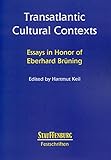
Hartmut Keil, ed. Transatlantic Cultural Contexts: Essays in Honor of Eberhard Brüning. Stauffenburg, 2005. 244 pp. EUR 58.00, ISBN 978-3-86057-634-2.
Reviewed by Peter Conolly-Smith (Dept. of History, CUNY-Queens College)
Published on H-TGS (May, 2010)
Commissioned by Anabel Aliaga-Buchenau (UNC Charlotte)
GDR American Studies and Other Tricky Matters
“A festschrift can be a tricky matter,” writes Catrin Gersdorf in one of fourteen essays dedicated to Eberhard Brüning on the occasion of his eightieth birthday (p. 49). She is right. Brüning, an eminent East German Americanist, retired from Leipzig University approximately twenty years ago, around the time of the fall of the Berlin Wall. Born in 1925, Brüning was an American prisoner of war during World War II, and it was under these circumstances that he developed a taste for American literature, in particular the works of left-leaning writers. His early interest in the “red decade” of the 1930s as well as writers blacklisted during the postwar Red Scare--“a field that in this time virtually no one would touch in the Federal Republic,” far less in “the USA in the wake of McCarthyism”--made of Brüning both an important literary historian in his own right and a “trailblazer,” in Rainer Schnoor’s taxonomy of East German Americanists, whose interests constituted an acceptable way to engage American culture without resorting to the West-baiting that was East Germany’s stock-in-trade (pp. 212, 213).
Brüning also helped bring about a thaw in academic relations between the two countries. Ideologically beyond reproach, he received permission to travel and research in the United States as early as the mid 1960s. He established particularly close ties with the faculty at Kent State University, which, according to Hartmut Keil, the editor of this volume, resulted in a cooperative agreement of scholarly exchange between Kent State and Leipzig universities. Several of Brüning’s erstwhile American colleagues have contributed to the book, published in 2005, as have former colleagues from Leipzig, a number of his doctoral students who now teach there and elsewhere, and members of the faculty who (like Keil) joined the American Studies Department at Leipzig only after Brüning’s retirement in 1990. By that time he had turned his scholarly attention to nineteenth- and early twentieth-century American-Saxon relations at the levels of tourism, diplomacy, and cultural and academic exchange, interests that gave rise to a spate of post-retirement publications on his end and that probably contributed to the title of this collection: Transatlantic Cultural Contexts: Essays in Honor of Eberhard Brüning.
Here, however, begins the tricky business of assembling a Festschrift. Having chosen a title that reflects the late-career interests of its honoree, editor Keil has also created the expectation that the collection’s essays will indeed address the transatlantic cultural contexts of, and exchanges between, European and American culture, politics, arts, and letters. This is however only partially the case. Indeed, approximately half of the collection’s essays do not address transatlantic issues at all--although they do engage Brüning’s first love, American literature--and several of the contributors to this volume seem not to have come up with much of an original contribution for the collection but, rather, to have revised or revisited former material, re-packaged here to somehow fit the bill. Keil himself--surely one of the most distinguished scholars of German-American history--at least admits freely that his contribution, “German Socialist Emigrants to the United States,” is but “a revised and updated version” of a 1991 essay. And to his credit, he has made a good-faith effort to add a specifically Saxon dimension to the article by “pay[ing] special attention ... to the distinct role which emigrants from Saxony played in the transfer of ideas and in the emerging German-American labor movement” (p. 187). This effort adds a new dimension to the article and brings it into accord with Brüning’s own prime interest, thus exemplifying how an old area of expertise can be rendered relevant to a new context.
Less of an effort along these lines is displayed by Sanford Marovitz, Yoshinobu Hakutani (both from Kent State), and Klaus Ensslen (formerly of Munich), who, during their distinguished careers, have worked on W. D. Howells, Richard Wright’s interest in the haiku format, and African American literature, respectively, and who, for this collection, offer essays on precisely these topics. While each of their essays has intrinsic merit, none has been tailored to the larger theme of the collection. More interesting in the realm of the purely literary essays included here are those by Anna Koenen on Sister Carrie (1900), Gabriele Pisarz-Ramírez on William Faulkner and the color line (both teach at Leipzig), and Catrin Gersdorf (who got her Ph.D. there, under Brüning) on Nathanael West and F. O. Matthiessen. While the previously listed scholars apply conventional modes of interpretation to their subjects, these three model approaches that helped define the periods during which they themselves came of age: Koenen examines her subject matter through the lens of feminism; Pisarz-Ramírez, through that of transnationalism; and Gersdorf, by applying the approach of ecocriticism, each to intriguing effect. Only one among this first group of essays, however, Wayne Kvam’s on a clandestine German-language radio address broadcast into Nazi Germany from civil war-torn Spain in 1938, credited to Ernest Hemingway, specifically engages the intersection of German and American culture and history. Though Kvam too traverses well-trod ground, like his Kent State colleagues, his short but meticulously annotated essay fits in well with the collection’s ostensible organizing theme.
This is generally true for the second half of the collection’s essays--including Keil’s--all seven of which address German-American relations in one way or another. Again, some essays rehash old material, such as Albrecht Neubert’s reflections on literary translation, a subject on which he is an acknowledged expert. Over one-third of the sources cited for his article are his own, yet his admittedly familiar central question--why Europeans consume reams of translated American literature, much of it of “less [than] noteworthy” literary merit, while Americans in turn consume comparatively few European literary works of any kind--takes on additional resonance in the context of George W. Bush’s then-recent reelection: “one is tempted to surmise,” Neubert muses, that this state of literary relations constitutes a “parallel [to] the unfortunate political climate of isolation from the ‘old Europe,’” and the United States’ “favouring [of] ‘go-it-alone’ policies over traditional ties” (pp. 80, 84). Reflecting on other trends in American conservatism, Crister S. Garrett, the first Leipzig-Fulbright Chair of American Studies, observes that cultural critic Samuel P. Huntington’s call for a strengthening of America’s Anglo-Protestant heritage shares common ground with German (and, more generally, European) conservatives’ demand that their immigrants too “assimilate into the dominant or leitkultur” of their respective host nations (p. 141). Garrett, picking up on the terminology of Huntington’s Who Are We (2004), instead argues that it is in fact the very “Ampersands” (mainly Hispanics) whom the book accuses of taking advantage of America’s wealth without committing to its culture, who embody the best hope for American values to endure in an increasingly multicultural world.
Garrett himself is a present-day incarnation of a species of transatlantic traveler to whom the collection devotes two essays: Americans in Germany. Thomas Adam explores the diaries of well-to-do American visitors to the early nineteenth-century royal Saxon court at Dresden, arguing convincingly that Boston Brahmins as well as other members of the American pseudo-aristocracy sought social validation in their interactions with European royalty. Anja Becker, in turn, surveys the experiences of nineteenth-century American students at Leipzig via their letters, diaries, and memoirs. While hers in particular would benefit from more rigorous copyediting--this is true of virtually all entries in the collection, to greater or lesser extent--both essays chime well with Brüning’s own interest in American-Saxon relations. In a variation on their theme, Berndt Ostendorf explores the life and times of one Julius Lips, a Weimar-era Africanist who fell into disfavor with the Nazis (despite well-documented efforts to ingratiate himself with the regime) and who subsequently found short-lived American employment, including at Howard University, whence he was fired after only three years. A “self-aggrandizing confidence man,” Lips returned to postwar Germany but failed to obtain a position in Cologne because of his earlier efforts to accommodate the Nazis. Instead he successfully applied for the rectorship at Leipzig University, where, “in the prevailing mood of quick restoration nobody [among the East German authorities] was able to contest nor inclined to question” Lips’s semi-fraudulent credentials (p. 119).
This, finally, returns us to the issue of the politics of the East German academy and, in particular, the politics of American studies in the GDR, a topic investigated in fascinating detail by Rainer Schnoor. Schnoor methodically surveys all aspects of teaching and being a student of American studies in East Germany, from the “dangerous fifties” through the “‘Wende’ [or] the Big Turn in 1989” and immediately beyond, when those who had reached retirement age, like Brüning, were perhaps among the fortunate; those who stayed on were subjected to a self-righteous West German-staffed “conduct commission” that probed them for Systemnähe, or coziness to the discredited system (pp. 212, 205). In fact, Schnoor argues, East German Americanists were neither Stalinist yes-men, nor bent on professional suicide via dissident teachings. Rather, people like Brüning (and Schnoor himself) performed a decades-long professional tightrope act. They produced impressive scholarship under difficult circumstances (Brüning’s appended bibliography is seventeen pages in length and includes sixteen monographs) and, in their teaching, strove for an objectivity that “le[ft] the interpretation to the discerning listener” (p. 221). While Schnoor writes eloquently on the chronic shortage of equipment and resources (one way of getting copies of Western books was to “steal [them] from the stalls of West German and British/American publishers” at the annual Leipzig bookfair), his essay is sufficiently nuanced to acknowledge both the presence of spies in the classroom (“at least one student Stasi informer per class”) yet also that, for all of the system’s failings, it did have its benefits: “quasi-egalitarian” aspects that are “sadly missed today,” for example, and “a holistic, comprehensive theory”--dialectical materialism--“that seemed to provide a tool for understanding history, society and culture” (pp. 216, 220, 209, 211). In the end, he admits, “most of us honestly believed (or believe) in the truly liberating function of the Marxist concept of history,” and one is left feeling that his and his peers’ conflicted relationship with the East German academy was perhaps not that different from the one they had with their notion of “America”--which was, he writes, a “love affair ... albeit [a] critical one” (pp. 221, 213).
It’s a good way to end this volume--Schnoor’s essay, followed by Brüning’s impressive bibliography--as it brings the reader back to the man being honored in its pages, his life’s work, and the conditions under which he achieved it. The fact that not all whose essays are included within the book’s pages have put the same level of effort into their contributions does not invalidate the collection by any means; there is something here for everyone, even among the less-than-original contributions. It does, however, make of this a Festschrift whose parts--some of them, anyway--are significantly greater than its whole.
If there is additional discussion of this review, you may access it through the network, at: https://networks.h-net.org/h-tgs.
Citation:
Peter Conolly-Smith. Review of Keil, Hartmut, ed., Transatlantic Cultural Contexts: Essays in Honor of Eberhard Brüning.
H-TGS, H-Net Reviews.
May, 2010.
URL: http://www.h-net.org/reviews/showrev.php?id=25416
 | This work is licensed under a Creative Commons Attribution-Noncommercial-No Derivative Works 3.0 United States License. |

