



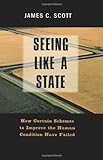
James C. Scott. Seeing Like a State: How Certain Schemes to Improve the Human Condition Have Failed. New Haven, Conn.: Yale University Press, 1998. xiv + 445 pp. $35.00 (cloth), ISBN 978-0-300-07016-3; $19.00 (paper), ISBN 978-0-300-07815-2.
Reviewed by Ulf Zimmermann (Department of Political Science and International Affairs, Kennesaw State University)
Published on H-PCAACA (December, 1998)
While originally trying to understand why governments seemed forever seeking to "sedentarize" people, Scott gradually came to see these efforts as "a state's attempt to make a society legible, to arrange the population in ways that simplified the classic state functions of taxation, conscription, and the prevention of rebellion" (p. 2). This made clear to him "processes as disparate as the creation of permanent last names, the standardization of weights and measures, the establishment of cadastral surveys and population registers ... the standardization of language and legal discourse, the design of cities ... as attempts at legibility and simplification" (p. 2). With this insight he believes to offer a better "optic" on fiascoes such as Third World development efforts and similar ones in Eastern Europe, including the "Great Leap Forward" in China, collectivization in Russia, and compulsory villagization in Tanzania, and why such (often well-intended) schemes too often proved disastrous.
Full-fledged disasters of social engineering like these require a combination of four elements. The first is the administrative ordering of nature and society; the second is "high-modernist" ideology," a hubris of scientific and technical progress that believes itself in mastery of nature and society as well. But these two only become pernicious when joined, third, by an authoritarian state willing to use all its coercive power to implement these schemes. That's easiest in times of war, depression, crises, or efforts at national liberation, when the fourth element is likeliest, a civil society too debilitated to resist. (He later reduces these four to three and, in the end, to two: "the combination [his emphasis] of the universalist pretensions of epistemic knowledge and authoritarian social engineering" [p. 34].)
Though schemes like this had been put into practice in Renaissance and Baroque city planning (and he discusses the later Haussmann's Paris and the modern Brasilia built along Le Corbusier lines), he uses the invention of scientific forestry in eighteenth-century Prussia to illustrate the sort of simplified perspective he is writing about. He starts out by showing how forest "science" pretty much overlooks everything that naturalists as well as anthropologists might see in favor of commercial/state value. "Nature" became "natural resources," forests "tree units," plants became either "crops" or "weeds," animals "livestock" or "varmints." Forestry science was a subfield of cameral science which seeks "to reduce the fiscal management of a kingdom to scientific principles that would allow systematic planning" (p. 14). This science replaced the real, diverse, and chaotic old-growth forest with a new uniform one that resembled the administrative grid of its technique. The resulting "monocropped" forest was, in the short term, great for "cameral" exploitation but terrible for peasants who could no longer get any food, firewood, medicines, and other raw materials they had previously extracted from it and, in the long term, ecologically disastrous. But these forests had become the "hegemonic" model for the world when Gifford Pinchot studied forestry in France.
Scott explores the same theme in measurement. Before the "state," people measured things through local practices based on human scale. In Malaysia, for example, if you ask how far it is to the next village you might be told "three rice-cookings." That explains how long it will take to get there; distance in miles would not tell you that because how long it takes to cover a mile depends entirely on the terrain. As he says, telling a farmer he has gotten twenty acres--but not where it is-- is about as helpful as telling a scholar he has received six kilograms of books.
What ultimately enabled the "metrical revolution" to begin in France were three things: market exchange was growing; popular sentiment and Enlightenment rationality both favored a single standard throughout the nation; and the Revolution, and especially Napoleon, actually enforced the metric system. What went hand-in-hand with it was another measurement- cum-political simplification: If meters were to be the same for everybody across the country, everybody across the country had to be the same in some measure, that is, a uniform concept of citizenship had to be instituted. This was thus a simplification with something of an emancipatory effect. Two other related and equally two-sided simplifications, preconditions for many others, were linguistic: the invention of permanent family names and the imposition of a single, official language. These can enhance property and commercial relations, often benefiting individuals--and always the state--but it is with these simplifications that the real trouble starts.
Much of twentieth-century social engineering has been implemented by progressives, often revolutionaries, because "it is typically progressives who have come to power with a comprehensive critique of existing society and a popular mandate (at least initially) to transform it" (p. 89), but of course these are always elites. Yet the hubris of these idealist elites who combine the faith that they know what's best for everyone with the power to implement it runs across the political spectrum--Taylorism and technocracy, for example, seemed to offer as much of a "fix" for the class struggle to Russians as it did to Americans. So we get implemented the plans of Lenin and Le Corbusier, Robert Moses and Robert McNamara, but not those of their opposite numbers such as Rosa Luxemburg, Jane Jacobs, Rachel Carson, et al. (not coincidentally often women) who truly represent the interests of the people.
Such state incursions can be limited. Some liberal societies have managed to preserve privacy (though, as Foucault has shown, even our sex and sanity have been "invaded") and a private sector economy. But the most important barrier is actually working representative institutions. These have been championed by the Luxemburgs and Jacobses and countless others who start from the "user" perspective.
The source of this is "metis," the practical skills and acquired intelligence that comes from having to deal with a constantly changing environment. Aristotle observed, Scott reminds us, that there are things like navigation and medicine in which practical experience often plays a more important role than universal rules. So this has been known for a good while.
In this sense the book does not offer much that is new to students of urban affairs, political science, and public administration--or of the Holocaust. We know of the failings of, say, city planning and housing projects, the evils of totalitarianism, and the abuses of bureaucracy. Perhaps Scott's chief contribution is to show that these evils can reach entirely unprecedented scopes under high modernism, though, as he acknowledges, it is chiefly high modernism as practiced by authoritarian states (not that we lack examples in the US such as the deleterious housing policies of the 1950s and 1960s which he also cites--or malignancies in the marketplace such as the Microsoft monopoly).
It is important to keep in mind, as Scott likewise notes, that many of these projects replaced even worse social orders and at least occasionally introduced somewhat more egalitarian principles, never mind improving public health and such. And, in the end, many of the worst were sufficiently resisted in their absurdity, as he had shown so well in his Weapons of the Weak and as best demonstrated by the utter collapse of the soviet system. "Metis" alone is not sufficient; we need to find a way to link it felicitously with--to stick with Scott's Aristotelian vocabulary--phronesis and praxis, or, in more ordinary terms, to produce theories more profoundly grounded in actual practice so that the state may see better in implementing policies.
This review is copyrighted (c) 1998 by H-Net and the Popular Culture and the American Culture Associations. It may be reproduced electronically for educational or scholarly use. The Associations reserve print rights and permissions. (Contact: P.C.Rollins at the following electronic address: Rollinspc@aol.com)
If there is additional discussion of this review, you may access it through the network, at: https://networks.h-net.org/h-pcaaca.
Citation:
Ulf Zimmermann. Review of Scott, James C., Seeing Like a State: How Certain Schemes to Improve the Human Condition Have Failed.
H-PCAACA, H-Net Reviews.
December, 1998.
URL: http://www.h-net.org/reviews/showrev.php?id=2533
Copyright © 1998 by H-Net and the Popular Culture and the American Culture Associations, all rights reserved. H-Net permits the redistribution and reprinting of this work for nonprofit, educational purposes, with full and accurate attribution to the author, web location, date of publication, originating list, and H-Net: Humanities & Social Sciences Online. For any other proposed use, contact P.C. Rollins at Rollins@osuunx.ucc.okstate.edu or the Reviews editorial staff at hbooks@mail.h-net.org.

