



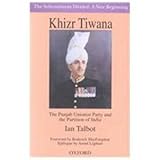
Ian Talbot. Khizr Tiwana: The Punjab Unionist Party and the Partition of India. Karachi: Oxford University Press, 2002. xvii + 259 pp. + 8 pp. of plates. $29.95 (cloth), ISBN 978-0-19-579551-6.
Reviewed by Brian Caton (University of Pennsylvania)
Published on H-Asia (June, 2003)
Commissioned by Sumit Guha (The University of Texas at Austin)
Biography, Partition, and Consociationalism
Ian Talbot. _Khizr Tiwana: The Punjab Unionist Party and the Partition of India._ With a Foreword by Roderick MacFarquhar and an Epilogue by Arend Lijphart. The Subcontinent Divided: A New Beginning Series. Karachi: Oxford University Press, 2002. xix + 259 pp. Glossary, select bibliography, and index. Rs. (P) 495.00 (cloth), ISBN 0-19-579551-2.
Biography, Partition, and Consociationalism
This book attempts to accomplish three seemingly unrelated tasks: to tell a story about the life of one of the foremost historical figures of colonial Punjab; to approach the history of the partition of British India from a fresh historiographical perspective; and to add to the theoretical literature on consociationalism, an idea less current among historians than perhaps among political scientists. For the first and second tasks, Talbot takes a reasonable middle ground between great men making history and the historical environment making men great. In addition, Talbot makes clear his desire to have his work read beside biographies of the greatest men of the era of Indian independence, namely Gandhi, Jinnah, and Nehru, to show
that some great men held visions of an independent subcontinent that would not inexorably lead to communal violence on a massive scale. For Talbot, Khizr Tiwana was _the_ tragic hero of India in the 1940s, a man whose intuitive political philosophy of consociationalism and compromise stands in stark contrast to the aggressive and unyielding tactics of politicians in both India and Pakistan today.
Those familiar with the historical literature on Punjab or with Talbot's publication history will know that this book is a second edition of Talbot's book (with the same title) originally published by Curzon Press in 1996. Little if any of the prose of the Curzon edition has been revised in the Oxford edition, and the really new prose consists of the contributions of MacFarquhar and Lijphart and Talbot's Series Editor's introduction. It is only fair, therefore, to draw the reader's attention to two reviews of the Curzon edition. In a brief review, Tan Tai Yong offered a general approval of the work but felt dissatisfied with Talbot's middle-ground position on Khizr's "position in history." [1] In a longer review, Clive Dewey identified Talbot's chief accomplishment as laying down, in clear and simple prose, an exposition that "makes a quintessential loyalist comprehensible." [2] Dewey also drew the reader's attention to the wide range of sources Talbot included in his research, and I must add that reliance on interviews with Khizr's son and grandson means that, barring the existence of any audio recording of these interviews, Talbot's book will remain for the foreseeable future the standard reading of Khizr's personal history. Talbot's access to written and printed matter is as comprehensive as imaginable. However, one is mildly disappointed with Talbot's unwillingness to revise the Curzon edition to account for relevant material published since 1996, in particular Raghuvendra Tanwar's account of the Unionist Party published in 1999. [3]
The three new sections of the book do not share equal importance. While MacFarquhar, as a personal acquaintance of the subject of the biography, is an appropriate choice for writing a foreword, his text adds little to what Talbot writes elsewhere. However, it does emphasize that the new edition "gives a Pakistani readership the chance to revisit the traumatic politics of partition and to meditate on the road not taken" (p. xiii); that is, the Oxford edition has a pointedly Pakistani audience in mind. At this point one should add that this volume is the first in the "A Subcontinent Divided" Series, and to my knowledge this is the first edited series of history monographs from OUP Karachi. The Series Editor's introduction
commendably draws attention away from marketing strategies that reinforce the twentieth-century limits of middle-class Pakistanis' historical imaginations and towards the methodological and theoretical innovations of the series in the field of partition studies. In terms of methodology, volumes in the series will explore a much wider variety of written and printed documentary sources than those used to construct the partition narratives currently available in Pakistan. Series volumes will also use oral material to pursue the "history from below" of partition, what Talbot calls its "new history" (pp. ix-x). While writing against nationalist metanarratives is certainly Talbot's main theoretical agendum for the series, the linkage of localized narratives of refugee resettlement and land redistribution to the violent political narratives of partition stands as the most promising theoretical innovation of the series. Learning how ordinary people cast their social and economic woes in religious terms is an intellectual key that could open doors in studies of historical episodes of violence in almost any part of the world.
Talbot has used Lijphart's ideas of consociationalism to make the Punjab case relevant to historical episodes of religious and ethnic violence around the world. Lijphart in fact provides a list of historical cases of consociational political life in his epilogue (p. 238). More importantly, Lijphart provides a definition of consociationalism that has suitable detail (p. 237), while Talbot seems satisfied with terse definitions and references--a fair move, in deference to Lijphart's expertise. However, at least two problems with consociational theory appear in this book. First, in footnote number twenty-six to the introductory chapter, Talbot writes, "According to consociational theory, the maintenance of stable democracy in societies riven by primordial divisions depends on elite accommodation" (p.12). Why should Talbot use a theory dependent upon the existence of "primordial divisions" when the notion of "primordial divisions" has been the object of intense scholarly criticism for at least the past twenty years and when Talbot himself (pp. 6-8) takes substantial measures to show religious divisions in Punjab to be of recent construction? In several other places in this book (pp. 149-50 for example), Talbot poses the crucial question for political, administrative, social, and cultural life in Punjab in the twentieth century: do Punjabis organize themselves on the basis of kinship (in the form of "caste," "tribe," or "clan") or of religion (in terms of "Hindu," "Muslim," and "Sikh")? Talbot recognizes, to an extent, the constructedness of kinship groups, so in the end one is
left with two equally malleable vocabularies of social organization, both claiming "primordial" origin. How did Punjabis choose between the parties of the landed and landless (the Unionists and the Communists) on one side and the parties of the religious (the Mahasabha, the Muslim League, and the Akali Dal) on the other side? Bill Clinton's 1992 campaign mantra seems to apply: it's the economy, stupid. In 1937, when Unionist leaders could convince their peers, _pirs_, and petty landowners that prosperity could flow from an outlet on a new canal and from keeping their land out of the hands of stereotyped moneylenders, the Unionists formed a hypermajority in the Legislative Assembly, or what Lijphart calls an "oversized cabinet" (p. 239). When wartime administrative policies decimated the supply side of the economy and offered military veterans little compensation in return for their service, religious party leaders found it easy to pin the blame on the sitting Unionist leadership, and the triumph of the religious parties in 1946 was a foregone conclusion before the polls opened. Talbot's book provides all the necessary detail for explaining this economy-centered historical argument. That religious party leaders could convert economic anxiety into religious violence was the key transformation of the war years, and consociationalism cannot tell the story of this transformation because of its assumptions about the stasis of political categories.
Second, and perhaps less significantly, consociational politics assumes that all parties agree upon the territorial unit in which that politics takes place. If Khizr's government between 1937 and 1945 was in fact consociational, which is a fair assumption following Lijphart's criteria on page 237, that consociationalism applied only to the territory of British Punjab. Once the religious parties and the Muslim League in particular began to float partition proposals, where exactly was the territory in which consociational politics occurred? Especially in the run-up to the 1946 elections, did consociational politics exist only in the imagination of Khizr himself? The useful comparison here might be Northern Ireland, in
which Catholic and Protestant ideologues have incorporated the _territory_ of Northern Ireland into the nationalist metanarratives of the Republic of Ireland and the United Kingdom, respectively. If religious party leaders and their footsoldiers imagined the territory of Punjab as part of a future Pakistan or India, how could Punjab escape the exclusivist narratives of those nations? Khizr's consociational answer, as Talbot reports (p. 219), was to leave Punjab independent of Pakistan and India. Khizr was not a powerless man, but his policies and agenda, crafted for the territory of Punjab, could not compete with nationalist agenda that sought to reshape
territory in the nation's image.
An argument about the consociational intuitions of a provincial minister hardly counts as "history from below," but Talbot's carefully researched and smoothly written book shows that in certain quarters, at least, grand narratives other than the imperialist and nationalist took political form. And in an historiographic climate dominated by Subaltern Studies claims about the revolutionary character of "peasant consciousness," it is refreshing to see a challenge to nationalist metanarratives take the form of what a politician, however unwilling, thought about himself. We look
forward to a successful series of such publications.
[1] Tan Tai Yong, review of _Khizr Tiwana, the Punjab Unionist Party and the Partition of India_, by Ian Talbot, _Journal of Imperial and
Commonwealth History_ 26, 3 (1998): 156-7.
[2] Clive Dewey, review of _Khizr Tiwana, the Punjab Unionist Party and the Partition of India_, by Ian Talbot, _International Journal of Punjab Studies_ 4, 2 (1997): 258-63.
[3] Raghuvendra Tanwar, _Politics of Sharing Power: The Punjab Unionist Party, 1923-1947_ (New Delhi: Manohar, 1999).
If there is additional discussion of this review, you may access it through the network, at: https://networks.h-net.org/h-asia.
Citation:
Brian Caton. Review of Talbot, Ian, Khizr Tiwana: The Punjab Unionist Party and the Partition of India.
H-Asia, H-Net Reviews.
June, 2003.
URL: http://www.h-net.org/reviews/showrev.php?id=25326
 | This work is licensed under a Creative Commons Attribution-Noncommercial-No Derivative Works 3.0 United States License. |

