



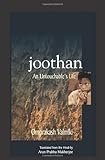
Omprakash Valmiki. Joothan: An Untouchable's Life. Translated by Arun Prabha Mukherjee. New York: Columbia University Press, 2008. 160 pp. $19.50 (paper), ISBN 978-0-231-12973-2.
Reviewed by Mohd. Asaduddin (Jamia Millia University)
Published on H-Asia (April, 2010)
Commissioned by Sumit Guha (The University of Texas at Austin)
Chronicle of an Outcast(e) from India
In that Country the laws of religion, the laws of the land, and the laws of honour, are all united and consolidated in one, and bind a man eternally to the rules of what is called his caste.--Edmund Burke[1]
“Dalit” is the term used to describe the nearly 180 million Indians who were placed at the bottom of the traditional caste system. In recent years, a vibrant field of Dalit literature has appeared in India, and some works are beginning to be translated into English. Autobiographical writings constitute a significant subgenre of Dalit literature, conveying the firsthand, raw experience of the writers who were, themselves, subjected to the scorn and contempt of the people who had no other qualities or distinctions in life except that they were born into upper-caste families. It is through the autobiographical writings of the first-generation Dalit writers that readers in Marathi, Tamil, and Hindi have become aware of what a Dalit’s life was/is really like in independent India. These works have been translated into other Indian languages and English to spread awareness across the country, and sometimes, build solidarities across languages and regions.
In Joothan, Omprakash Valmiki deals with the issue of humiliation meted out to the Dalits by Indian society, no matter where they lived. This humiliation stems from the fact that Dalit inferiority has gotten embedded in the psyche of the upper caste, the members of which have developed an extraordinary repertoire of idioms, symbols, and gestures of verbal and physical denigration of the Dalits over centuries. It is embedded in the literary and artistic imagination and sensibility of the upper caste. Even the Hindu epics, the Ramayana and the Mahabharata, are replete with examples of this denigration where the shudras and the chandalas are shown to be treated as less than human. Dalit writers feel that the mainstream literature in Sanskrit and many other Indian languages foster these built-in assumptions of Dalit inferiority and thus they need be critiqued, subverted, and deconstructed. In this context, one is reminded of other autobiographical works by Dalit writers, like Bama’s Karukku (2000) in Tamil and in Hindi Tiraskrit (vol. 1, 2002) by Suraj Paul Chauhan and Meri Safar aur Meri Manzi (2000) by B. R. Jatav. These books shocked the readers of mainstream literature into the realization of the inhuman and morally repugnant ways in which Indian people continued to treat segments of society. Before this body of literature came out, the Dalits were the proverbial invisible men and women of India who were compelled to live on the margins of society, never entering the vision of high-caste Hindus, the arbiters of art, literature, and good taste, in any significant or positive way.
Valmiki begins his chronicle from his childhood. He grew up in a village near Muzaffarnagar in Uttar Pradesh, in an untouchable caste named Chuhra (sweepers and cleaners), much before the self-assertive term “Dalit” was coined. With unmistakable directness untrammeled by any anxiety of literary embellishment, which is the usual style one finds in Dalit autobiographies, Valmiki says right in the second page: “Untouchability was so rampant that while it was considered quite all right to touch dogs and cats, or cows and buffaloes if one [a higher-caste person] happened to touch a Chuhra, one got contaminated or polluted. The Chuhras were not seen as human” (p. 2). The tenement clusters where they lived stood on the periphery of the village inhabited by the upper-caste Tyagis who felt that they had absolute power over them and their labor. If the Dalits dared to refuse unpaid labor, severe retribution would follow. Valmiki narrates one such incident where the Chuhras had refused to work without wages when a high official was visiting the village: “As usual a government employee came to the Bhangi basti [settlement]. The surveyors needed some people for clean up work, for which they would not be paid. As always, it would be unpaid labor. For days on end hungry and thirsty people would work to clean the kothi [big house]. In return they would be sworn at” (p. 44). When they refused this unpaid work, they were severely punished. Fifteen days after their refusal, two policemen came and arrested whoever they could lay their hands on and took them to the office of the village panchayat (council) where they were made to squat in a rooster position and beaten mercilessly. “The women and children of the basti were standing in the lane and crying loudly.... They could not think of what else they could do but cry” (p. 45). The writer reflects, “Why is it a crime to ask to be paid for one’s labor? Those who keep singing the glories of democracy use the government machinery to quell the blood flowing in our veins” (p. 46). In another similar incident, the boy Valmiki himself was forcibly dragged to work by Fauza Singh Tyagi in the field while he was preparing to appear in the math exam the following day, as though he was a bonded laborer. Joothan is filled with such incidents, each one of which left a deep scar in the writer’s mind. After witnessing the beating of his people in public for refusing unpaid labor, the writer reflects: “My mind was filled with a deep revulsion. I was then an adolescent and a scratch appeared on my mind like a line scratched on glass. It remains there still” (p. 45). Being humiliated by everybody, including his teachers, he says, “The scars that I have received in the name of caste--even eons won’t suffice to heal them” (p. 61). And being forced to work by Fauza in the field when he would have liked to study for his exams, he writes, “My mind was set aflame by his swearing. A fire engulfed my innards that day. The memories of these crimes of Tyagis continue to smolder deep inside me, emitting red-hot heat” (p. 66).
Probably the most painful aspect of this humiliation is the fact that his teachers were not only a party to it but also often aggravated it. These fellows who were sold to the idea of caste hierarchy were a blot to the fair name of teachers. Valmiki was admitted to the school with great difficulty, he was made to sit apart from Tyagi boys, he was made to squat on the floor while other students sat on the benches, he was not allowed to participate in extracurricular activities, and he was made to sweep and clean the school and adjoining field. During examinations he could not drink water from the glass when he was thirsty. Each day brought new torture and humiliation from his teachers. More than once, he was beaten mercilessly. Despite being one of the few good students in the class, he was given such low marks in the chemistry practical test that he failed the Board exam, which spelled doom for his promising career. With a pen dipped in acid, Valmiki writes: “Such were the model teachers I had to deal with. Moving from childhood to adolescence when my personality was being shaped, I had to live in this terror-filled environment.... At times I feel like I grew up in a cruel and barbaric civilization” (p. 57).
The latter part of the book describes Valmiki’s experiences as he moved from his native village to Dehra Dun, Roorkee, Jabalpur, Bombay, and Chandrapur. Caste followed him like an albatross around his neck. He was taken as a decent, educated, and respectable human being as long as people did not know about his caste. The moment they got to know about it they recoiled from him as though he were a lump of shit. The same happened with Savita who fell in love with him but dropped him shamelessly when Valmiki told her about his caste: “Suddenly, the distance between us has increased. The hatred of thousands of years had entered our hearts. What a lie culture and civilization are” (p. 113). These instances underline the fact that the sense of caste hierarchy is so ingrained in the Hindu mind that it cannot be erased overnight simply by formulating laws of affirmative action, but that a revolutionary change of mind and heart is required. Being repulsed thus, time and again, he developed an antipathy toward people who, he knew, had only contempt for him despite the masks they wore of outward decency. The fire smoldering within him found no outlet: “I too have felt inside me the flame of Ashwatthama’s revenge. They keep on burning inside me to this day. I have struggled for years on end to come out of the dark vaults of my life” (p. 27).
Valmiki recreates the period when Dalit literature was emerging as a radical and subversive, if controversial, genre that would gradually shape what is known today as Dalit aesthetics. The Dalit literary movement started in Maharashtra, the home state of Dr. Bhimrao Ambedkar, and then spread from Marathi to Tamil, Hindi, Telugu, and other Indian languages. Valmiki’s own life experiences propelled him toward the writings and activism of these first-generation pioneers whose lives had followed similar trajectories as his own: “During that period I was introduced to Marathi Dalit literature. The words of Daya Pawar, Namdev Dhasal, Raja Dhale, Gangadhar Pantavane, Baburao Bagul, Keshav Meshram, Narayan Surve, Vaman Nimbalkar, and Yashwant Manohar were igniting sparks in my veins. Their voices exhilarated me, filled me with new energy. My reading of Dalit literature was beginning to change my notions about what is literature” (p. 105). These writer-activists waged a valiant struggle against the deeply entrenched caste prejudices and oppression by creating awareness through art and literature. Reading their work reignited the literary spark in him that was already there. He began writing short plays and staging them. He also began to write poetry and fiction. However, even his considerable literary reputation did not change things much for him as far as his caste was concerned. With hindsight he seems to declare his final judgment in the opening lines of the preface to Joothan: “Dalit life is excruciatingly painful, charred by experiences. Experiences that did not manage to find room in literary creations. We have grown up in a social order that is extremely cruel and inhuman. And compassionless towards Dalits” (p. xiii).
Valmiki’s struggle described so graphically is symptomatic of the extent of challenges involved in the process of reclaiming dignity for himself and his community. It goes to his credit that he does not simply give a univocal account of the caste prejudices harbored by members of the upper caste, but also deals with the internal divisions within the depressed classes that point to the fault lines within the movement and draws attention to the ways in which the depressed classes themselves have internalized these prejudices against the castes they consider a notch below themselves. The movement must address this urgently.
It is undeniable that the rough and raw feelings/experiences narrated in the text with liberal sprinkling of the author’s animus against the high caste will raise the hackles of traditional critics who have their eyes glued on the so-called universals, and who, for that reason, will find it sensational and gross, lacking in objectivity. However, we should keep in mind the fact that Dalit literature has emerged out of specific historical and social circumstances, that protest and testimony are inalienable parts of it, and that it has to be judged by a different yardstick or literary aesthetics than we do in case of mainstream literature. Valmiki himself grapples with this question adequately in his nonfictional and critical writings.
Translating Dalit literature presents the translator with the stiffest challenges because of the linguistic nuances that seem almost untranslatable. Dalit writers make extensive use of the dialect or idiolect spoken by the particular caste group, and when the work is written in standard Hindi, Marathi, Tamil, or Telugu, it undergoes a process of normalization and standardization, if only to make the text accessible to mainstream readers. Translation into English involves a further, and often deeper, degree of normalization that flattens out the roughness, apparent sloppiness, and rawness of the text, all of which make up the flavor of the original and contribute to its appeal. When one compares Dalit texts with their English avatars, the result is often disappointing. Arun Prabha Mukherjee has done a commendable job in this regard. She has been able to retain some of the flavor of the original while attaining a good measure of readability in English. Moreover, her comprehensive introduction provides a good context for the study of the specific text under review, and also for Dalit literature in general. The book is a “must read” for courses in postcolonial, cultural, and South Asian studies.
Note
[1]. Cited in Nicholas B. Dirks, Castes of Mind: Colonialism and the Making of Modern India (Delhi: Permanent Black, 2002), 3.
If there is additional discussion of this review, you may access it through the network, at: https://networks.h-net.org/h-asia.
Citation:
Mohd. Asaduddin. Review of Valmiki, Omprakash, Joothan: An Untouchable's Life.
H-Asia, H-Net Reviews.
April, 2010.
URL: http://www.h-net.org/reviews/showrev.php?id=25316
 | This work is licensed under a Creative Commons Attribution-Noncommercial-No Derivative Works 3.0 United States License. |

