



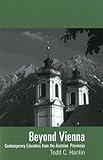
Todd C. Hanlin, ed. Beyond Vienna: Contemporary Literature from the Austrian Provinces. Riverside: Ariadne Press, 2008. 294 pp. $32.00 (paper), ISBN 978-1-57241-163-0.
Reviewed by Joseph W. Moser (German Program, Washington & Jefferson College)
Published on H-German (September, 2009)
Commissioned by Susan R. Boettcher
A Non-Vienna-centric View of Austrian Literature
Though both countries have been federal republics for more than six decades, Austria--in contrast to Germany--is often perceived as a centralized country whose capital, Vienna, dominates the country culturally and even politically. While no other town in Austria comes close to Vienna in geographic dimension and international significance, the country beyond Vienna is nonetheless culturally quite prolific. In fact, Thomas Bernhard--one of the country's most significant post-1945 writers--was throughout his life torn between the city of Vienna and the landscapes of Upper Austria and Salzburg, a struggle that is also present in his literature. This conflict between the city and country beyond the metropolis is a much stronger issue in Austrian than in German literature. An attempt to address this perceptive imbalance, this very useful volume edited by Todd C. Hanlin features nine articles on non-Viennese twentieth-century writers from all Austrian federal states except for Vorarlberg and Burgenland, including Friedrich Ch. Zauner, Alois Brandstetter, Anna Mitgutsch, Christine Lavant, Felix Mitterer, Gloria Kaiser, Elisabeth Reichart, Vladimir Vertlib, and Xaver Bayer.
The value of the volume can perhaps be best seen in a handful of particularly noteworthy articles whose insights and arguments typify the essays of the volume. One of these is Dagmar C. G. Lorenz's piece, "Vladimir Vertlib, a Global Intellectual: Exile, Migration, and Individualism in the Narratives of a Russian Jewish Author in Austria." Vertlib has now settled in Salzburg after having lived in Israel, Vienna, and the United States. Lorenz translates the following quote from his novel Zwischenstationen (1999): "I have truly become an Austrian, or more precisely, Viennese. I have to leave Vienna in order to understand that, over the years, I have assumed all the prejudices of this city--the smugness, arrogance, egocentricity, narcissistic love-hate, contempt for the 'provinces,' an inferiority complex toward foreign countries, and a nostalgic transfiguration of our former significance as a metropolis" (p. 232). Rural and small-town Austria stands for Vertlib in contrast to the big city of Vienna. In this sense, perhaps ironically given the project of the volume, he has started to adopt the Austrian perception of the country as caught up in an urban-rural dichotomy.
Another excellent piece is Felix W. Tweraser's article, "Elisabeth Reichart's Komm über den See: Upper Austria and the Excavation of Its History." Reichart's novel presents Ruth Berger, who leaves Vienna to return to Gmunden, where she uncovers her family's history during the Nazi period. Tweraser writes: "As Ruth achieves physical distance from the comforts of her life in Vienna, she begins to cast off the denial and rationalization that had prevented her from a more reflective engagement with the world around her" (p. 209). This need to distance oneself from Vienna, which Reichart's work shares with that of Vertlib, renders one important aspect of how non-Viennese authors see their country. At the same time, it also illustrates their dependence on Vienna as the country's grand metropolis.
A further useful contribution is "'Vienna is far away': Alois Brandstetter's Proclivity to the Provinces," by Paul F. Dvorak, who writes about a prolific but less-known Austrian scholar and writer who "has been firmly entrenched in Carinthia and Upper Austria and infrequently strays far beyond this comfort zone" (p. 62). Much like its author, Brandstetter's literature keeps a distance from Vienna. This stance is similar to that of Christine Lavant, whose oeuvre is covered in this volume by Geoffrey C. Howes in "Madness in the Landscape: Christine Lavant's Provincial Modernism."
This book presents a welcome selection of articles on non-Viennese Austrian literature. Perhaps one of its few weaknesses is the lack of a comprehensive bibliography or index. For scholars who may be less familiar with these writers, the book does include short biographies of the authors discussed in the essays.
If there is additional discussion of this review, you may access it through the network, at: https://networks.h-net.org/h-german.
Citation:
Joseph W. Moser. Review of Hanlin, Todd C., ed., Beyond Vienna: Contemporary Literature from the Austrian Provinces.
H-German, H-Net Reviews.
September, 2009.
URL: http://www.h-net.org/reviews/showrev.php?id=25276
 | This work is licensed under a Creative Commons Attribution-Noncommercial-No Derivative Works 3.0 United States License. |

