



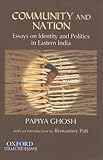
Papiya Ghosh. Community and Nation: Essays on Identity and Poltics in Eastern India. New Delhi: Oxford University Press, 2008. xxii + 218 pp. $29.95 (cloth), ISBN 978-0-19-569300-3.
Reviewed by Mahua Sarkar
Published on H-Asia (March, 2010)
Commissioned by Sumit Guha (The University of Texas at Austin)
Partition and Identity
Papiya Ghosh's Community and Nation combines the author's keen understanding of communal politics in twentieth-century Bihar and her commitment to distill for her readers the complexities and fissures underlying the apparent homogeneity of the identity location "Muslim" in the Indian subcontinent. Ghosh does this through extensive archival research and through critical engagements with existing scholarship on both the late colonial period, and the post-1947 (independence of India and the creation of Pakistan) and post-1971 (Bangladeshi independence from Pakistan) eras. The result is a thoroughly researched book that offers fresh insights into an old problem--the Partition--by approaching it through a dense study of communal politics in a crucial aqliat subah (minority province), Bihar, in the decades leading up to 1946-47.
Community and Nation was not written as a book. Published posthumously, it is a collection of ten essays that Ghosh wrote over the course of a decade and a half. However, a number of themes recur throughout the book connecting the essays. What follows is an attempt to highlight some of these concerns that seem to have animated much of what Ghosh wrote in these years.
The first such theme or concern centers on the question of whether Muslim identity in the subcontinent can be seen as homogenous with Islam as its main, or sole, point of reference. Ghosh seems to side with recent critical scholarship that foregrounds differences--of class, region, language, or ideological orientation--among Muslims in the subcontinent, in explicit opposition to the tendency to define Muslims in terms of an "absolute" Islamic consciousness.[1]
Ghosh does acknowledge that, by the early twentieth century, there was enough of an ijma or consensus among the ulama and the liberal intelligentsia to forge something of a corporate "Islamicate identity" which could then be "thrust on Muslims" (pp. 6-7).[2] She also accepts that this ijma among Muslim elites played an important role in the eventual success of the Muslim League in its anti-Congress politics and demand for Pakistan. But, as she painstakingly establishes through her research, such "homogenizing attempts" around a religious identity, divorced from all other specificities, were successful only in part. For, in Bihar, significant numbers of Muslims remained unconvinced of the Muslim League's self-professed mandate to speak for all Muslims in the subcontinent throughout its period of ascendency in the 1930s and 1940s. In this context, Ghosh presents her research on the spirited resistance to the Pakistan movement mounted by two distinct groups of Muslims in Bihar--an influential section of the ulama, which established the first political party of the ulama, the Jamiyat-al-ulama-i-Hind (JUH); and the razil (working people) biradaris (communities), represented most forcefully by the Abdul Qaiyum Ansari-led Momin Conference from 1938. As she writes, both organizations "were ranged against the separatist politics of the Muslim League" (p. 1).
The JUH, founded in 1919, consisted of an important segment of the ulama, which decided to actively intervene in politics by forging alliances with other groups, including non-Muslims. The JUH "worked out a theory of composite nationalism, grounded in the basic tenets of Islam that ... [was] deployed against imperialism and subsequently the Muslim League's communalism" (p. 3). As Ghosh points out, this theory of composite nationalism or muttahidah qaumiyat was in fact supposed to represent the "very core" of all the differences between what the Muslim League and the JUH stood for (p. 82).
Muttahidah qaumiyat was based on two sets of ideas. One was associated with Maulana Abul Kalam Azad, who insisted that "the prophet's covenant with the people of Medina [AD 628], which included the Jews and pagans, was valid as a precedent ... and was, in particular, pertinent in India" (p. 3). The other, was developed by JUH president Hussain Ahmad Madani, who held that "To the extent that contemporary nations were ... defined by reference to land, Muslims [in India] were not a nation.... However, as a millat (religious community) they could co-exist with other religious communities not as a qaum (nation) in the modern sense, but as a qaum in the Quranic sense, that is, as a part of a confederation of religious communities" (p. 4). In short, in the JUH's "federal scheme of things ... all who lived in Hindustan belonged to one nation" (p. 5). For these politically engaged members of the ulama what was perhaps most unacceptable about the Muslim League's position was the obvious "disjuncture between the League's litany about the fate of Muslims in provinces such as Bihar where they were the aqliat (minority...)" and the demand for Pakistan which would ensure "liberation" only for Muslims in provinces where they were in the majority (aksariat) (pp. 82-83).
A second body of Muslims who fought the "denominational politics" of the Muslim League was the Momin Conference, which "situated its political intervention [on] the razil-sharif [or working vs. high-born] differentiation within the putative community." As far as the Momin Conference was concerned, the Muslim League was a party of "nawabs, capitalists and zamindars" and, as such, did not represent the more numerous working and poor Muslims, who numbered over eight crores in the late 1930s (pp. 142-143). The Momin Conference also shared some of the JUH's objections to the Pakistan movement on the grounds that it would mean that Muslims would have to leave their masjids (mosques) and kabristans (graveyards) in the hands of the Kafirs; and that it would provide no protection to Muslims in the aqliat (minority) provinces. There was, therefore, no logic in supporting Pakistan (pp. 142-146). Indeed, as Ghosh describes it, the self image of the Momin Conference continues to underline that while "it stolidly opposed the Partition, it was the Congress that yielded to the Muslim League's demand" (p. 6). It also contrasted the "son of the soil roots" of the Momins or weavers to the image of the sharif Muslims "who traced their ancestry to foreign lineages, saw themselves as aliens and therefore could not but support separatist politics" (p. 6). It is worth noting that as part of its critique of the sharif politics of the Muslim League, the Momin Conference attempted to form "a transformative razil collective" by reaching out to other peshaewar (occupational) Muslim groups, such as the Rayeen (vegetable sellers and growers), the Mansoor (cotton carders), Idrisi (tailors), and Quraish (butchers) communities (p. 149).
Not surprisingly, both the JUH and the Momin Conference supported the Congress' anti-imperialist efforts. However, as Ghosh points out, contrary to what the Muslim League claimed (see chapter 3), in matters of the cultural autonomy of Muslims and anti-imperialist partnership, the JUH and the Congress did not see eye to eye. The difference resulted to a large extent from two very different notions of composite nationalism--"one Quranic and the other ... additive of religious communities"--and also because the Congress seems to have been blatantly unequal in its appointment of Hindu and Muslim leaders to positions of power in Bihar, leading to the resignation of a number of key Congress Muslims (p. 93).
What is perhaps most damning in the evidence that Ghosh musters is the dual membership of some Hindu Congressmen in the utterly communal and anti-Muslim Hindu Mahasabha, and worse yet, their direct involvement in the violent riots of 1946 in Bihar, in which almost thirty thousand Muslims were killed (pp. 121-125). This latter issue of the majoritarian and communal politics of not just the Hindu Mahasabha but also the Congress in Bihar marks a third theme that recurs throughout Community and Nation. It seems that such were the "acts of omission and commission" of the Congress, that already in 1939 the Bihar JUH felt compelled to conclude that the Congress was "communalist to the core" (p. 89).
Ghosh's research shows that while the Hindu Right continues to blame Muslims for the division of India in 1947, they were just as, if not more, culpable for making that division a reality. Instead of supporting the considerable opposition that segments among the Muslims mounted against the Partition movement of the Muslim League, the chauvinism, intolerance, and violence of the Hindu Mahasabha, heady with the idea of "Hindu Raj" in Bihar (pp. 108-113), and the inadequate and opportunistic politics of the Congress, made it impossible for these critical Muslim initiatives to succeed. The result is a continued vulnerability of Muslims from the province of Bihar--as the last few chapters on the Muhajir (refugee) problem in Ghosh's book poignantly argue.
Throughout the book, Ghosh returns to these concerns regarding the anti-Partition mobilization among sections of the Bihari Muslim community, and their sense of betrayal let down by the Congress, as well as the attendant discussions of the polarizing communal politics of the Hindu Mahasabha and the Muslim League. Together they represent, in my reading, the most significant contribution of this collection of essays. For, as I have argued elsewhere, the automatic equation of Muslims with separatist politics and the Partition in both popular perceptions and, unfortunately, in scholarly work, even if only through omissions, feeds a simple and guilt-free narrative of "loss"--the Muslims wanted Partition, the Hindus suffered it.[3] Ghosh's work ought to put a stop to this particular simplification that underlies so much of the politics of bad faith in contemporary India. But will it?
Finally, a word of constructive criticism for future attempts at compiling Ghosh's work. Community and Nation is not always an easy book to read, especially for nonexperts. Since Ghosh did not have a chance to write either an introduction, or a concluding chapter highlighting the central themes and concerns running through the book, the reader is sometimes left with the task of looking for her own observations amid the densely presented empirical core of the book. For the same reason, there is also considerable repetition in the arguments presented in the chapters. Biswamoy Pati's introduction of course provides a valuable summary of the book. But a work such as this, which both exemplifies the rigor and breadth of archival research, and speaks to larger questions regarding the politics of community and nation formation in the subcontinent, needs a more critical introduction that both places it within the existing literature and boldly foregrounds the various themes that otherwise remain all too submerged in the text.
Notes
[1]. Mushirul Hasan, "Muslim Intellectuals, Institutions and the Post-Colonial Predicament," Economic and Political Weekly 30, no. 47 (November 25, 1995); Zoya Hasan and Ritu Menon, Unequal Citizens: A Study of Muslim Women in India (Delhi: Oxford University Press, 2004); and Shahida Lateef, Muslim Women in India: Political and Private Realities (New Delhi: Kali for Women, 1990).
[2]. See also Rafiuddin Ahmed, The Bengal Muslims, 1870-1906: The Quest for Identity (Delhi: Oxford University Press, 1988) for a discussion of similar processes of consensus formation in Bengal in the late nineteenth century.
[3]. Mahua Sarkar, Visible Histories, Disappearing Women: Producing Muslim Womanhood in Late Colonial Bengal (Durham: Duke University Press, 2008).
If there is additional discussion of this review, you may access it through the network, at: https://networks.h-net.org/h-asia.
Citation:
Mahua Sarkar. Review of Ghosh, Papiya, Community and Nation: Essays on Identity and Poltics in Eastern India.
H-Asia, H-Net Reviews.
March, 2010.
URL: http://www.h-net.org/reviews/showrev.php?id=25235
 | This work is licensed under a Creative Commons Attribution-Noncommercial-No Derivative Works 3.0 United States License. |

