



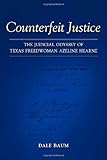
Dale Baum. Counterfeit Justice: The Judicial Odyssey of Texas Freedwoman Azeline Hearne. Baton Rouge: Louisiana State University Press, 2009. xvi + 310 pp. $45.00 (cloth), ISBN 978-0-8071-3405-4.
Reviewed by Heidi Giusto
Published on H-SAWH (November, 2009)
Commissioned by Antoinette G. van Zelm (TN Civil War Nat. Heritage Area Center for Historic Preservation)
Ex-Slaves and the Failures of Reconstruction
In Counterfeit Justice, Dale Baum uses one woman’s story to illuminate the plight of ex-slaves in the former Confederacy. Baum deftly demonstrates how circumstance led to Azeline Hearne’s name appearing in record books and legal documents from the 1860s through the 1880s. Sam Hearne, a wealthy cotton plantation owner who lived in Robertson County, Texas, held Azeline Hearne in slavery. Azeline and Sam had a sexual relationship, which resulted in Azeline bearing four children, one of which, Doctor Samuel Jones Hearne, reached adulthood. Sam willed his entire estate to his son, with requirements for Doctor to care for his mother, Azeline. In the event of Doctor’s death, Azeline would be the sole heir to Sam’s vast landholdings. Sam and Doctor’s deaths came to pass in 1866 and 1868 respectively, which made Azeline Hearne, for a short time, one of the wealthiest ex-slaves in Texas. Unsurprisingly, countless local white residents--too many to recount in this review--preyed on her, with the intent of claiming the estate for themselves. Through meticulous research, Baum pieces together Azeline’s story and explains in great detail the trials and tribulations that Azeline endured after she inherited Sam’s estate.
The author’s clearly stated goal is to “bring back to life the heretofore untold story of how calculating and devious attorneys and the wealthy collateral kin of Azeline Hearne’s former master cheated her out of her considerable lawful inheritance” (p. 6). Baum not only unearths Azeline’s struggles to maintain her property rights in Reconstruction-era Texas but also places her life in a broader, national perspective. Relying largely on Texas legal documents, Baum argues that Azeline Hearne’s life “revealed as much about the period of Reconstruction after the American Civil War as the lives of many who attained distinction through their fame or extraordinary achievements” and “demonstrated the limits to what could have been achieved in the way of securing legal equality and fair treatment for the former slaves throughout the postwar South” (p. 2). Baum maintains that the postwar judicial system was inherently biased against African Americans and could only provide Azeline Hearne with what he calls “counterfeit justice” (p. 6). Although Azeline did not triumph over the challenges that she faced, Baum notes that eventually she took a stand against conniving and manipulative whites when she sued those who defrauded her.
Counterfeit Justice is organized chronologically and divided into nine chapters. Baum’s first chapter contextualizes the area and people around which Azeline Hearne’s story unfolded by tracing the history and significance of Robertson County and the wealthy Hearne family. The author goes into great detail explaining the genealogy of the family (a genealogical tree would have been helpful). At times, the family relations are difficult for the reader to keep straight but that may reflect more on the prevalent inbreeding among the Hearnes than on the author’s explanatory skills. Baum carefully establishes that Sam, Azeline’s master, was different than the rest of his family members for several reasons, including his lack of public service, his decision not to marry, and his choice to acknowledge openly his relationship with Azeline and their son.
The second chapter covers a lot of ground by discussing Sam Hearne’s will, placing Robertson County and its slave system in the context of the Civil War and Reconstruction, and attempting to establish what life may have been like for slaves who lived on the Hearne family plantations. Baum might have provided more concrete evidence for his claims about Sam falling out of good graces with his family. Although he provides examples where Sam acted differently from his relatives, there seems to be less evidence of actual dissent between family members. For example, Baum argues that Sam’s “white relatives feared and anticipated” that he would leave his estate to his mulatto son, and that Sam had “concerns that his brothers and cousins would almost certainly contest his will,” yet Baum does not explicitly share the data that leads him to those conclusions (pp. 63, 64). These assertions are logical, but it seems particularly important to reveal where such evidence can be found, especially because Baum discusses the deficiency of the historical record. Was it in the language of Sam Hearne’s will? Or was it perhaps found in court testimony?
Chapters 3 through 8 discuss the legal fiasco that ensued over Sam Hearne’s estate. The third chapter shows how a variety of people wanted to profit from Sam’s death at the expense of Azeline and her son, including attorneys, Freedmen’s Bureau agents, neighbors, and family members. In this chapter, Baum does a particularly good job at putting the legal battle in the larger framework of Reconstruction and explaining how Reconstruction affected Robertson County and the county’s politics. Local whites felt threatened by ex-slaves and did everything in their power to keep African Americans disenfranchised and fearful. Chapter 4 discusses events that occurred in 1867 and 1868 in Robertson County and the surrounding areas, including the numerous ways in which crooked legal proceedings enabled people to challenge Azeline Hearne’s rightful inheritance after her son died.
The fifth and sixth chapters continue to chronicle the legal battles that Azeline encountered because of her inheritance. Baum also discusses the 1869 gubernatorial election and how the attendant political turmoil affected Robertson County. These chapters highlight how Azeline Hearne’s inexperience with legal matters devastated her chances of keeping her inheritance. According to Baum, Azeline was often unaware she was being sued. This situation resulted in Azeline losing her inheritance a piece at a time.
Baum focuses his attention in the seventh chapter on Harvey Prendergast, the man who served as an executor and administrator of Sam Hearne’s estate and worked as Azeline Hearne’s attorney. Although Prendergast was supposed to advocate for Azeline, Baum details how Prendergast ruthlessly used his trusted role to swindle her. In one of the strangest incidences of Azeline’s judicial odyssey, Prendergast sued Azeline in 1876 when she was still his client. Unsurprisingly, he won the lawsuit, which was about money for his legal services. Perhaps demonstrating Azeline’s enhanced understanding of law and legal matters, in 1881 she hired “one of the state’s most successful and capable attorneys,” William Hamman, to be her legal counsel in a lawsuit against Prendergast and H. L. Lewis, another man who had interests in Azeline’s estate (p. 211). Interestingly, Hamman happened to be the lawyer who represented many of the plaintiffs in other lawsuits against Azeline.
One of the most compelling sections, chapter 8, reviews the depositions made for Azeline Hearne’s suit against Prendergast and Lewis. Baum argues that Azeline’s decision to sue the men, and the result of the lawsuit, reveal “the gap between justice and the law in Robertson County” (p. 235). Despite assembling a strong case for his client, Hamman’s efforts did not prove fruitful. The judge ruled in favor of the defendants because a statute of limitations applied to Prendergast and Lewis’s alleged wrongdoings. Azeline appealed the case, but the Texas Supreme Court disposed of it because of a legal technicality.
Azeline Hearne’s story ends in the ninth chapter with Baum’s discussion of the termination of Prendergast’s administration of the Hearne estate, the sale of the estate’s final lots of land, and the deaths of Prendergast, Hamman, Lewis, and Hearne. Information is known about the men’s deaths, yet virtually nothing is known about Azeline’s demise, a situation that speaks to the continued racist patriarchal conditions that existed in late nineteenth-century Texas.
Baum concludes by focusing on the larger implications of Azeline Hearne’s case and how it reflects the predicament of nearly all ex-slaves in the former Confederacy. Although in theory African Americans were granted equality before the law, reality dictated that most still lived in a society that discriminated against them within and outside the courtroom. Baum could have extrapolated on that point more and would have done well to analyze how Azeline’s gender may have affected her treatment before the law. Azeline’s tale of hardship and inequity ends with a cautionary warning, when Baum writes: “If the mockeries of justice and agonizing hardships brought about by years of omnipresent and unyielding persecution and oppression are left unacknowledged, then the ability to see racism in the future will remain obstructed and whites will continue to scapegoat blacks” (p. 270).
The author achieves his goal of resurrecting Azeline Hearne from the forgotten past, yet somehow she often gets lost in the legal battles that Baum recounts. Amid Baum’s exhaustive discussions of the people, area, and lawsuits, he sometimes lets Azeline disappear from the scene almost entirely, making his story seem more like a tale of an estate than a narrative focusing on one freedwoman’s journey through the legal system. Perhaps this situation could have been avoided had the author made the chapters more argument driven and more coherently united around central themes. At times, it is unclear how parts of the chapters relate or why each topic that Baum discusses is important to his overarching goal of telling Azeline Hearne’s story. Nevertheless, Baum’s ability to reconstruct the judicial proceedings surrounding Sam Hearne’s estate is nothing short of remarkable, given the constraints of the extant evidence. Baum also does a commendable job of placing the events surrounding Azeline Hearne’s life and tribulations within the larger framework of Reconstruction. Scholars interested in legal history, African American history, slavery and freedom, and Reconstruction will find this book useful.
If there is additional discussion of this review, you may access it through the network, at: https://networks.h-net.org/h-sawh.
Citation:
Heidi Giusto. Review of Baum, Dale, Counterfeit Justice: The Judicial Odyssey of Texas Freedwoman Azeline Hearne.
H-SAWH, H-Net Reviews.
November, 2009.
URL: http://www.h-net.org/reviews/showrev.php?id=25162
 | This work is licensed under a Creative Commons Attribution-Noncommercial-No Derivative Works 3.0 United States License. |

