



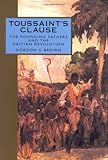
Gordon S. Brown. Toussaint's Clause: The Founding Fathers and the Haitian Revolution. Jackson: University Press of Mississippi, 2005. xi + 321 pp. $35.00 (cloth), ISBN 978-1-57806-711-4.
Reviewed by Karen Racine (University of Guelph)
Published on H-LatAm (November, 2010)
Commissioned by Kenneth Kincaid (Purdue University North Central)
Everything Old Is New Again
The past twenty years have brought about a resurgence of academic interest in the Haitian Revolution, a development that has been mirrored by a broader political and humanitarian concern with conditions in the struggling nation itself. There is a thriving Haitian Studies Association that holds a yearly academic conference and sponsors the Journal of Haitian Studies, and a Haitian Kreyòl summer language institute at the University of Massachusetts-Boston. The bicentennial of Haitian independence in 1804 prompted several high-profile conferences in France, the United States, the United Kingdom, and the Caribbean. In the past decade, there has been a boom of excellent research being produced in diverse fields, such as anthropology, linguistics, history, sociology, political science, folk religion, and public health. The devastating 2010 earthquake raised unprecedented levels of donations for disaster relief and reconstruction. High-profile celebrities like Sean Penn, Wyclef Jean, and Angelina Jolie travel regularly to Haiti. Film producer Jonathan Demme has had a longstanding interest in Haitian folk art; recently, he teamed with Canadian rock band Arcade Fire to produce a documentary on the island’s rich musical traditions. Literary works by Haitian-American novelist Edwidge Danticat and Haitian-Canadian Dany Laferrière are both popular and acclaimed. There can be no doubt, people are interested in Haiti.
Yet interest is not always enough. Furthermore, interest can take many forms, including self-interest. In Toussaint’s Clause, retired career diplomat Gordon S. Brown revisits the convoluted early years of the revolution and argues that it was mainly U.S. politicians’ economic interests that shaped their attitudes and actions. He downplays any significant racialized motivations for their failure to embrace an independent Haiti as a neighbor republic or to treat them on equal terms as with other legitimately constituted states. The title itself refers to a 1798 law passed by Congress that was intended to punish France for an attempt to extort wartime loans the year before; the law banned all trade with France “or elsewhere under thee acknowledged authority of France” (p. 129). Brown sees this particular clause as a deliberate invitation to Toussaint Louverture to declare St. Domingue liberated from French authority and thereby to throw it open to legal trade with U.S. merchants. He does a good job setting out thee multinational machinations of the era for the general reader, and strikes a decent balance between the minutiae of diplomatic negotiations and the larger strategic goals.
Unfortunately, the Haitians themselves seem oddly absent from this account. Instead, John Adams, Timothy Pickering, Charles Pinckney, James Madison, and especially Thomas Jefferson dominate the story from the U.S. side, and André Pichon and Charles Maurice de Talleyrand Périgord from the French. References to Haitians and their culture tend toward the sensational. Although Brown considers economic conditions to be the most important, he never misses a chance to used race-based adjectives to describe the actual events. For example, the “black prisoners rose up,” the “slave leaders had no ambition” but were animated by their “voodoo” practices, and a “black insurgency” sent the “panicked white colonists” fleeing for their lives (pp. 48, 49, 64, 79). Indeed, Brown often uses language and concepts that would be more typical of early to mid-twentieth-century writing about the Haitian Revolution than would be common (or even considered accurate) today. By emphasizing the lurid, leering aspects of a slave-based and racialized revolution in the narrative, but then dismissing those elements as a major motivating force in the events themselves, Brown weakens the overall message of the book. The author is occasionally too uncritical of the Americans and their motives, often relying on an idealized notion of “the American people’s respect for property and industry” (p. 100).
As one would expect of a book that is part of the ADST-DACOR Diplomats and Diplomacy series, Brown’s main interest is the machinations of political actors at the state (and aspiring state) level. The book is intended for a general audience rather than academic scholars, which may explain why the back cover blurb could make the astonishing claim that Haiti’s was a “little-known revolution.” In the preface, Brown recalls his own surprise when he first discovered this “often-overlooked story” (p. ix). He does not offer any new arguments, insights, or methodological approaches but rather sets out to tell the tale of events from the perspective of the U.S. Founding Fathers in a readable, accessible way. His research appears to have been conducted entirely among printed or microfilmed sources in the United States, the great majority of which are pre-1990 English-language works. As such, the book tends toward a simplistic, straightforward narrative of events from a mainly U.S. perspective, with little attention paid to the interrelated issues of class, language, culture, and religion that have been expertly fleshed out by recent researchers across disciplines. It is not a book distinguished by its academic quality or one suited for serious students of Haitian history.
In an unintended way, the author’s sources and approach reveal another stubborn feature about the writing of Haitian history, namely, the tendency for it to be done over the heads of the Haitians themselves. In a similar vein, Brown’s story also reveals the longstanding interrelationship between politics and international commerce and the ways in which moneyed citizens can influence state policy for their own benefit. He notes ironically that in the early nineteenth century, war was good for business. It seems that for both Haitians and Americans, everything old really is new again.
If there is additional discussion of this review, you may access it through the network, at: https://networks.h-net.org/h-latam.
Citation:
Karen Racine. Review of Brown, Gordon S., Toussaint's Clause: The Founding Fathers and the Haitian Revolution.
H-LatAm, H-Net Reviews.
November, 2010.
URL: http://www.h-net.org/reviews/showrev.php?id=25141
 | This work is licensed under a Creative Commons Attribution-Noncommercial-No Derivative Works 3.0 United States License. |

