



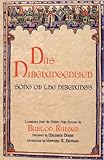
Burton Raffel, trans. Das Nibelungenlied: Song of the Nibelungs. New Haven: Yale University Press, 2008. xxiv + 351 pp. $20.00 (paper), ISBN 978-0-300-12598-6.
Reviewed by William C. Crossgrove (Departments of German Studies and Comparative Literatures, Brown University)
Published on H-German (February, 2010)
Commissioned by Susan R. Boettcher
It All Goes So Very Wrong
From 1962 to 1965, no less than four English translations of the Middle High German Nibelungenlied (NL) appeared: three in prose, by D. G. Mowatt,[1] Helen M. Mustard,[2] and A. T. Hatto,[3] and one in verse, by Frank G. Ryder.[4] Nonetheless, the opening comment on the back cover of Das Nibelungenlied--Song of the Nibelungs asserts that "Burton Raffel brings to life for the first time the great German epic poem that inspired Richard Wagner's opera tetralogy Der Ring des Nibelungen and J. R. R. Tolkien's The Lord of the Rings." As for the claims about Wagner and Tolkien, Michael Dirda, the Pulitzer Prize-winning critic and Washington Post editor who provides a brief foreword to the Raffel translation, is at least marginally more circumspect when he notes that Tolkien drew from poems "like the Nibelungenlied" (p. ix) and refers to Wagner's "quite different conception" of the main characters (p. xii). Dirda also reports the NL to be "in a memorable sentence by scholar A. T. Hatto, 'the world's best heroic epic, bar one'" (p. x). It is perhaps a bit ironic that Hatto makes this observation as the opening sentence in the introduction to his own Penguin Books translation. The more detailed introduction to the Raffel translation by Edward R. Haymes, by contrast, provides a reliable overview of NL scholarship and accurately portrays its minimal connection to Wagner and Tolkien. Still, as Dirda says: "What matters most in the following pages is surely the crisp, clear English translation of the epic itself" (p. xii), and this should be our primary focus in evaluating the work, as well.
Perhaps the best way to proceed is to examine a few typical strophes from the original. The Hatto prose translation has been widely used in American courses in translation, both because it is readily available in an inexpensive edition and because its "Introduction to a Second Reading" and accompanying appendices provide detailed background information. I will therefore use it along with the Ryder verse translation for comparison. The sequence I follow in the comparison is: NL (Middle High German text),[5] Hatto prose, Ryder verse, Raffel verse.
For example, for strophe 71:
The original text (NL):
An dem sibenden morgen / ze Wormez uf den sant
riten die viel küenen. / allez ir gewant
was von rotem golde, / ir gereite wol getan.
ir ross in giengen ebene, / des küenen Sivrides man.
Hatto:"A week later, in the morning, Siegfried's valiant company rode on to the sandy river-bank at Worms. All their equipment shone red with gold, their chargers went with even pace, their harness was good to see;"
Ryder:
The seventh morning, the heroes reached the shore
Of the Rhine at Worms. All the clothes they wore
Were red with gold, their harness skillfully wrought,
Smooth the gait of the steeds that Sigfrid's men had brought.
Raffel:
Seven mornings later / Sifried and his men rode
on the sands outside Wurms. / Their clothes were splendid, gold
glistening in sunlight, on garments / and warriors' gear. Their steeds
stepped smoothly ahead, bearing / on their backs warriors who numbered thirteen.
Here, the prose translation skips over the mention of the clothes worn by the riders and uses a more general "equipment." Raffel's translation appropriately renders a typical NL construction in assuming that the phrase "von rotem golde" can apply both to the garments and the gear, while Ryder chooses to connect that phrase only to the clothes. Both decisions are defensible. Raffel interprets "red gold" as "glistening in sunlight," an interpretation that goes beyond the text. He uses the odd spelling "Wurms" for reasons that are unclear. Also, he adds the phrase "warriors who numbered thirteen" based on his earlier reading that Sivrid chose to ride "selbe zwelfte" (strophe 59). This phrase normally is interpreted to mean that Sivrid wanted to go as the twelfth man, that is, with eleven companions. It is a minor point, to be sure, but it is in any case not mentioned at all in the original text at this point and is presumably added by Raffel to fill out the metrical requirements of the line.
Turning to strophes 1003-4, we find the following translations:
NL:
Von grozer übermüete / muget ir hoeren sagen,
und von eislicher rache. / do hiez Hagene tragen
Sivrit also toten / von Nibelungen lant
für einen kemenaten / da man Kriemhilde vant,
Er hiez in tougenlichen / legen an die tür,
daz si in da solde vinden / so si gienge darfür
hin zer mettine / e daz ez wurde tac,
der diu frouwe Kriemhilt / vil selten deheine verlac.
Hatto: "Now learn of a deed of overweening pride and grisly vengeance. Hagen ordered the corpse of Siegfried of Nibelungenland to be carried in secret to Kriemhild's apartment and set down on the threshold, so that she should find him there before daybreak when she went out to matins, an office she never overslept."
Ryder:
Of overweening pride you hear me sing,
And awful vengeance. Hagen had them bring
The murdered lord of the Nibelungs, had him laid
Before the woman's hall where Lady Kriemhild stayed--
In secret, by the door where she would pass
And find him as she left for matin mass,
Before the day had dawned. (And rare indeed
The call to such a mass that Kriemhild failed to heed).
Raffel:
Now you'll have to hear / a tale of arrogance
and horrible revenge. / Sifried was carried back
to Wurms, and then, on Hagen's / orders, his corpse was dropped
in front of Lady Kriemhild's / rooms. They left the body propped
against the door, so she / would have to find it, bright
and early next morning, when she left / for matin prayers, a rite
she never missed, attending / every single day
of her life. Matin bells / were rung in the morning, in the usual way,
By examining two strophes together, we can see that the translators do not always literally follow the strophic structure. It is apparent from the way in which the two are intermingled in the quite accurate prose translation that a single sentence is involved. Both verse translators also intermingle the two strophes, and Raffel even includes the first line of the next strophe in his translation.
Turning to strophe 2308:
NL:
Da was nieman lebende / al der degene,
niwan die einen zwene, / Günther und Hagene.
mit bluote gie berunnen / der alte Hildebrant.
er brahte leidiu maere / da er Dietrichen vant.
Hatto: "Of all the Burgundian warriors none was now left alive save that solitary pair: Gunther and Hagen. And now with blood running down all over him, old Hildebrand went to Dietrich and brought him terrible news."
Ryder:
Not one was living of all the warriors there
Except for Gunther and Hagen, this one pair.
Covered with blood, Hildebrand fled, to bring
Most painful tidings to Theoderich the king.
Raffel:
And then the only living / warriors left, standing
alone, were two Rhineland men / Gunter the king, and Hagen.
Bloodied all over but running / fast, old Hildebrand
hurried to bring the terrible / news to Dietrich, his lord and master.
We are now nearing the grisly finale, when Kriemhild is about to kill her brother and Hagen, only to be struck down by Hildebrand as the bloodbath finally ends. The prose translation is accurate and felicitous in its phrasing. The choice Ryder makes of using Theoderich for Dietrich seems unnecessarily "historical," while the insertion of "Rhineland men" by Raffel reflects a choice that he frequently makes to insert "Rhinemen" or similar terms instead of unspecified "degene" (warriors).
In two of the three instances discussed above, Hatto's prose translation follows the text more closely than either of the verse translations. It would probably be preferable for anyone wanting an aid in reading the Middle High German text. Ryder's decision to use a five-foot line without caesura requires him to make some compromises in literal translation. He manages to reproduce the rhyme structure remarkably well, and by adding an extra foot in the fourth line, he also preserves at least something of the feel of the original NL strophe. Nonetheless, his translation inevitably acquires a sing-song-like rhythm in modern English that does not seem quite to capture the alternately stately, rambunctious, repetitious, comic, prefigurational, or judgmental strophes of the NL.
But this is supposed to be a review of Raffel, not of his earlier competitors. Raffel is an accomplished critic, poet, and translator who has worked at his craft for more than forty years. In addition to three books about translation,[6] he has translated from languages as diverse as Old English and Indonesian, to name just two. His translation of Beowulf (1963) set a new standard for the poetic translation of a difficult epic masterpiece, despite its controversial aspects. Following the translation of the NL, twenty-one pages of "Translator's Notes" present Raffel's discussion of his understanding of the place of the text in world literature and his decisions about rhyme and meter in comparison with other medieval works. These notes deserve to be read and pondered while reading the translation.
A few of Raffel's decisions seem questionable to me nonetheless. I have already mentioned the frequent insertion of "Rhinemen" or "Rhineland men," terms usually with no parallel in the original. The spelling "Wurms," for "Worms" is inexplicable to me, and the repeated assertion that Sivrid had twelve companions when he went to the Rhine to woo Kriemhild is contrary to the usual reading of the text. In strophe 1721, Hagen supposedly identifies Dietrich and his companions as "a clan that hails from Switzerland." Yet, Dietrich of Bern is nearly universally recognized as Dietrich of Verona, and nothing in the original text connects him to Switzerland. Indeed, Bern in Switzerland is not attested in written records until the end of the twelfth century, and its name is thought to derive from its founders' relatives in Verona. But these are minor quibbles. Overall, the translation is quite successful at capturing the poetry of the Middle High German text.
It is ultimately impossible to do full justice to a translation without examining the text in great detail, yet no reviewer will want to spend the time to do this, and no reader will have the patience to read such a review. The very fact that Raffel has chosen to tackle the NL is in itself newsworthy, and one can only hope that the paperback edition will introduce this majestic and somewhat enigmatic description of the downfall of an entire clan to new readers. The translation conveys about as good a sense of the original as it seems possible to do in modern English. It thus makes a welcome addition to world literature, one that will certainly be of great benefit to individuals engaged in the comparative study of the epic literature of the Middle Ages.
Notes
[1]. D. G. Mowatt, The Nibelungenlied: Translated with an Introduction and Notes (London: J. M. Dent, 1962). This translation was reprinted in 2001 as a Dover Thrift Edition.
[2]. The volume Medieval Epics (New York: Random House, 1963) contains an introduction to, and translation of The Nibelungenlied by Helen M. Mustard. It also contains Beowulf (William Alfred), The Song of Roland (W. S. Merwin), and The Poem of the Cid (W. S. Merwin).
[3]. A.T. Hatto, The Nibelungenlied: A New Translation (New York: Penguin Books, 1965).
[4]. Frank G. Ryder, "The Song of the Nibelungs": A Verse translation from the Middle High German "Nibelungenlied" (Detroit: Wayne State University Press, 1962). This translation was reprinted in German Epic Poetry, edited by Francis G. Gentry and James K. Walter as the first volume of The German Library (New York: Continuum, 1995).
[5]. The Middle High German text is cited from Helmut de Boor, ed. Das Nibelungenlied (Wiesbaden: F. A. Brockhaus, 1963).
[6]. Burton Raffel, The Forked Tongue: A Study of the Translation Process (The Hague and Paris: Mouton, 1971); Burton Raffel, The Art of Translating Poetry (University Park: Penn State University Press, 1988); and Burton Raffel, The Art of Translating Prose (University Park: Penn State University Press, 1994).
If there is additional discussion of this review, you may access it through the network, at: https://networks.h-net.org/h-german.
Citation:
William C. Crossgrove. Review of Raffel, Burton, trans., Das Nibelungenlied: Song of the Nibelungs.
H-German, H-Net Reviews.
February, 2010.
URL: http://www.h-net.org/reviews/showrev.php?id=25084
 | This work is licensed under a Creative Commons Attribution-Noncommercial-No Derivative Works 3.0 United States License. |

