



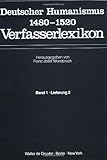
Franz Josef Worstbrock, ed. Deutscher Humanismus 1480-1520. Verfasserlexikon, Band I, Lieferung 2: Buschius, Hermann - Engel, Johannes. Berlin: De Gruyter, 2006. 160 pp. EUR 68.00 (paper), ISBN 978-3-11-019064-9.
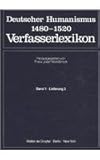
Franz Josef Worstbrock, ed. Deutscher Humanismus 1480-1520. Verfasserlexikon, Band I, Lieferung 3: Engelbrecht, Philipp - Gratius, Ortwinus. Berlin: De Gruyter, 2008. 160 pp. EUR 74.00 (paper), ISBN 978-3-11-019275-9.
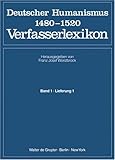
Franz Josef Worstbrock, ed. Deutscher Humanismus 1480-1520. Verfasserlexikon, Band I, Lieferung 1: Adelmann von Adelmannfelden, Bernhard - Burkhard von Andwil. Berlin: De Gruyter, 2005. xxiii +156 pp. EUR 68.00 (paper), ISBN 978-3-11-017572-1.
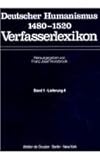
Franz Josef Worstbrock, ed. Deutscher Humanismus 1480-1520. Verfasserlexikon, Band I, Lieferung 4: Gresemund, Dietrich - Kruyshaer, Johannes. Berlin: De Gruyter, 2008. iv + 193 pp. EUR 79.95 (paper), ISBN 978-3-11-020638-8.
Reviewed by Patrick Hayden-Roy (Nebraska Wesleyan University)
Published on H-German (November, 2009)
Commissioned by Susan R. Boettcher
The Lexicon of German Humanist Literature
Das Verfasserlexikon: Die deutsche Literatur des Mittelalters is one of the most important reference works for scholars working on medieval German literature. It was recently brought to completion when the last parts of the twelve-volume work were published in 2006. It is now being supplemented with two additional volumes that will extend the lexicon to cover German humanist authors from the late fifteenth into the early sixteenth centuries. As with the main work, the supplement is being published in pieces over a period of a few years. The current sections under review contain figures of wide reputation, such as Konrad Celtis, Johannes Cochlaeus, Johannes Eck, and especially Erasmus of Rotterdam, as well as other figures familiar to only a vary narrow circle of scholars, and an occasional individual work, such as the Epistolae obscurorum virorum (1514), which does not fit under a specific author and has wide significance.
The virtue of the Verfasserlexikon lies in the systematic way each biographic/bibliographic entry is arranged. The basic entry revolves around a treatment of the life and works of the individual that packs in a highly abbreviated yet precisely rendered overview of the important elements of the biography and oeuvre, with copious references to works from which the details are derived, as well as cross references to names, places, and other relevant contextual background. While this organization does not make for particularly stylish prose, one can quickly gain an orientation to the figure, find key details, and collect references for further research. The bulk of the entry concerns the literary activity of the subject. To take Celtis as a representative example, the entry (pp. 375-427) covers his work as editor as well as his published works, divided into numerous sub-categories, as well as his correspondence. Each work is described with background on the context of its publication, its substance, and its publication history, including references to more recent publications in anthologies or other hard-to-identify places. Again, the detail provided by the entries is remarkable and makes this reference work unusually useful. Each entry ends with a brief overview of the wider influence of the author on later literature, plus a bibliography of publications since 1975, with reference to previously published complete bibliographies. Entries are generous in length, with the entry on Erasmus, for instance, allotted almost half of the space in Lieferung 3. Given the multiple authorship of the various entries, some idiosyncrasies are visible in the presentation of each article, but all of them provide a similar overview, and even less well-known figures are given thorough treatment.
Some limitations of the work are determined by the format. Perhaps the most significant is the time boundaries set for the work: 1480-1520. For a figure such as Johannes Cochlaeus, for example, this choice raises some problems, since much of what makes him a figure of broader significance is his polemical work, which ensued in 1517 with the outbreak of the "Luther affair." Though some of this work is acknowledged in the entry, it is not given a complete listing, and especially his later work in the 1530s is incompletely identified. No doubt the decision to set 1520 as the terminal date of the lexicon involves a calculation that German humanism was fundamentally altered by the religious strife of the 1520s and 1530s, and that what came after devolved from the pristine cause of reviving true learning when it became entangled with the cause of true religion. While the choice of this boundary is understandable, it is unfortunate that the editors did not extend the time line further, since much material of interest remains to be excavated from the careers of the figures whose lives bridged the divide. The transmutation of humanism under the pressure of religious strife provides a fascinating example of what happens to ideas when the stakes are not only truth, but power, wealth, or even survival. And humanist impulses in Germany, while deflected, remained influential. Still, despite this limitation, scholars of early modern Germany-in-the-making will benefit from the availability of this new reference, and we may hope that it might be made available in an online version sometime in the not too distant future.
If there is additional discussion of this review, you may access it through the network, at: https://networks.h-net.org/h-german.
Citation:
Patrick Hayden-Roy. Review of Worstbrock, Franz Josef, ed., Deutscher Humanismus 1480-1520. Verfasserlexikon, Band I, Lieferung 2: Buschius, Hermann - Engel, Johannes and
Worstbrock, Franz Josef, ed., Deutscher Humanismus 1480-1520. Verfasserlexikon, Band I, Lieferung 3: Engelbrecht, Philipp - Gratius, Ortwinus and
Worstbrock, Franz Josef, ed., Deutscher Humanismus 1480-1520. Verfasserlexikon, Band I, Lieferung 1: Adelmann von Adelmannfelden, Bernhard - Burkhard von Andwil and
Worstbrock, Franz Josef, ed., Deutscher Humanismus 1480-1520. Verfasserlexikon, Band I, Lieferung 4: Gresemund, Dietrich - Kruyshaer, Johannes.
H-German, H-Net Reviews.
November, 2009.
URL: http://www.h-net.org/reviews/showrev.php?id=25074
 | This work is licensed under a Creative Commons Attribution-Noncommercial-No Derivative Works 3.0 United States License. |

