



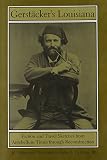
Irene S. Di Maio, ed. and trans. Gerstacker's Louisiana: Fiction and Travel Sketches from Antebellum Times through Reconstruction. Baton Rouge: Louisiana State University Press, 2006. 360 pp. $49.95 (cloth), ISBN 978-0-8071-3146-6.
Reviewed by Frank Mehring (Free University of Berlin)
Published on H-TGS (December, 2010)
Commissioned by Alexander Freund (The University of Winnipeg)
Multiethnic and Multicultural Compositions on Louisiana from a German American Perspective
Friedrich Gerstäcker is widely considered an important figure in German American literature and the history of transatlantic encounters. However, despite his high profile and the impressively large and comprehensive oeuvre he produced, many of his writings have not yet been translated into English. With the recent new emphasis on transcultural confrontations and the transnational dimension of American culture, Gerstäcker’s writings on ethnic and racial diversity, slavery, and multilingual America are re-emerging from the archives of German Americana. While some of Gerstäcker’s most popular books are still in print in Germany, reprints of his works are often based on the edition of selected works by Dietrich Theden (1889-91) and later in a forty-five-volume edition entitled Reiseromane und Schriften (1903-10). Unfortunately, these editions bear the sign of extensive editorial changes and cuts. Gerstäcker is among the noted writers who have been included in the Projekt Gutenberg-DE full text database with forty-five novels and travel reports. In addition, Wikisource lists a selection of his writings for the magazine Gartenlaube. Despite the continuing archival efforts of professionals and organizations such as the Friedrich-Gerstäcker-Gesellschaft, gaining “complete bibliographical control over the hundreds of publications in periodicals or the pirated editions and translations” continues to be an unresolved challenge, as the esteemed Gerstäcker scholar Jeffrey L. Sammons explains.[1] The new critical edition of a selection of Gerstäcker’s works translated and edited by Irene S. Di Maio is a fascinating effort to make this author better known and more accessible to an international, English-speaking community of scholars.[2]
The life of Friedrich Gerstäcker is worth recounting. Gerstäcker had become a writer more or less by accident during his trips through the United States. Born in Hamburg on May 10, 1816, to an actress and an opera tenor, his early life was marked by unsteadiness as he moved with his parents between the cities of Dresden, Kassel, Leipzig, and Braunschweig. At the age of 21, he set sail for the country which, for an extended period of time, had instilled a longing in his imagination. He traveled through New York State, Ontario, the upper Midwest, Illinois, Arkansas, Louisiana, and Texas. As legend has it, he realized that he was a published writer when he returned to Germany in 1843: His mother had given excerpts of his diary to the journal Rosen. In order to support himself financially, Gerstäcker decided to teach English. In his free time, he translated Charles Fenno Hoffman’s Wilde Szenen im Wald und Prairie mit Skizzen amerikanischen Lebens (two vols.,1845), Charles Rowcroft’s Die Abenteuer eines Auswanderers: Erzählungen aus den Colonien von Van Diemens-Land (three vols.,1845), Seba Smith’s Der Indianer-Häuptling und die Gefangene des Westens (two vols., 1847) and Herman Melville’s Omoo oder Abenteuer im Stillen Ocean (two vols., 1847). He also published his autobiographical Streif- und Jagdzüge durch die Vereinigten Staaten Nord-Amerikas (1844), thus embarking on a prolific literary career. His travels through America provided the basis for books such as Mississippi-Bilder (1847-48) or Amerikanische Wald- und Strombilder (1849). Particularly successful were his Wild West stories of crime and adventure such as Die Regulatoren in Arkansas (1846) or Die Flusspiraten des Mississippi (1848).
These commercially highly successful writings proved to be harmful to Gerstäcker’s literary reputation, however, and overshadowed his efforts to establish himself as an author beyond the realm of popular entertainment or children’s literature. Today, his large and complex oeuvre remains a challenge to scholars. In his fiction, essays, poetry, dramas, and memoirs we encounter a “great qualitative range,” as Jeffrey Sammons explains.[3] Editor and translator Di Maio has developed a constructive approach to provide the reader with both synchronic and diachronic insights into his comprehensive oeuvre. She rightly argues that Gerstäcker was particularly sensitive to the tensions and struggles in the United States due to his German background, his familiarity with the democratic aspirations of the political Vormärz, the failed democratic revolution of 1848/49, and the aristocratic reconstitution of political powers in its aftermath. Di Maio’s selection is based on the following premise: “[A]s a sojourner and traveler from abroad, who experienced Louisiana in both the antebellum and Reconstruction periods, Gerstäcker may have been unique. Gerstäcker’s writings have much to offer concerning the historical, geographical, social, political, and economic dynamics of Louisiana, a state whose culture is both singular and increasingly representative in its multiethnic and multicultural composition” (p. 16). Whether Gerstäcker was indeed “unique” remains to be discussed. What seems clear, however, is the importance of not just rediscovering texts simply because they have been forgotten or inaccessible due to a foreign language but evaluating their significance within a certain sociocultural and political context. The selection Di Maio has chosen offers English-speaking scholars and students a glimpse of the different genres of Gerstäcker’s repertoire and points to the complexity of his oeuvre. Hence, the volume might serve as a basis to compare and contextualize Gerstäcker’s observations in a larger intellectual field.
Translating German texts on nineteenth-century American culture and history into English can be challenging. Di Maio has wisely decided to keep in place all the italics and references to American expressions, which are a staple of immigrant literature in a language other than English, in order to emphasize the multilingual dimension of the original texts. Unfortunately, one of the shortcomings of translations of this kind is that the visual difference between German and English words, which both appear in italics in the original texts, is lost. On the other hand, translations can make the original more accessible. For example, Gerstäcker’s prose often features unnecessarily long-winded sentences. Di Maio’s translation serves the reading experience well by resting from time to time on a full stop, thereby creating several shorter sentences. The following quotation from Gerstäcker’s fourth chapter “Streifzug westlich vom Mississippi” (Roving expedition west of the Mississippi, in Di Maio’s translation) from his first travel book Adventures and Hunting Expeditions in the United States of North America (1844), documents Gerstäcker’s style, his early reactions to slavery in the South, and his empathy with abolitionism: “The southern slaveholders, unfortunately, have been granted--even by the laws of the land--far too much power over their slaves, who are, after all human beings. The law, to be sure protects the slave from too great a tyranny or cruelty. But this must be proved in the courts, and how should this happen?--According to the law, a black man cannot bear witness against a white man. Only in very rare cases is a white man a witness, and even then he will not come forward unless he lives independent of these people or is, perhaps, a stranger. Most such cruel deeds are well known even to the judge, but often no one steps in because there is no plaintiff or because the plaintiff cannot testify” (p. 27).[4] In her apparatus, Di Maio evaluates reports such as this one and provides bibliographical information for scholars to contextualize Gerstäcker’s descriptions and claims.
In addition, the text shows how Gerstäcker frames German American encounters and conflicts. While he is often critical of German immigrants (or what he calls “blockheaded German ‘scholars’”), other examples document how he carefully constructs an enlightened German protagonist in nineteenth-century America in order to contrast racial hatred with alternative international perspectives. A good example can be found in Di Maio’s selection of a chapter from In America: A Picture of American Life in Recent Times (1872). After an American citizen shot, in cold blood, an African American who refused to get off a streetcar on Canal Street in New Orleans, a man who described himself as a “foreigner” offered his services to the young family relative to have the body taken away and accompany her to the police office. Later, he revealed his German identity:
“Don’t be afraid, Miss, I am not a southerner, not even an American. I come from far across the sea, where we have condemned slavery for a long time and even fought bravely to banish it from this beautiful and otherwise free country. You can trust me to accompany you home”
“I am a nigger, sir,” said the poor creature in a severely bitter tone. “Leave me. From now on I must find my way alone, in any case.”
“You won’t impress me whether you call yourself a nigger or not,” the foreigner said good-naturedly. “I won’t leave you now until I know that you are back home safely--where is it?” (p. 271).
As far as the descriptions of Louisiana and the special focus on New Orleans are concerned, Gerstäcker emerges both as a cultural insider and outsider due to this status of a transatlantic traveler. The selection Di Maio has made is a highly revealing example of how to successfully approach the complex and extremely comprehensive oeuvre of Gerstäcker. It allows the reader not only to explore Louisiana’s landscapes, urban environments, people, and institutions from a German American perspective;it also offers the opportunity to learn alongside with the author how to slowly come to terms with the multiethnic diversity, democratic aspirations, and the challenges of transcultural confrontations over several decades, in Gerstäcker’s case from the 1830s to the 1870s.
Di Maio’s edition and translations in Gerstäcker’s Louisiana. Fiction and Travel Sketches from Antebellum Times through Reconstruction are an inspiring example of how to create a new pathway to the rich sources of German American literature. The knowledgeable selection and the instructive critical apparatus make the book a valuable contribution to the analysis of nineteenth-century American culture and history from an international perspective.
Notes
[1]. Jeffrey L. Sammons, Ideology, Mimesis, Fantasy: Charles Sealsfield, Friedrich Gerstäcker, Karl May, and Other German Novelists of America (Chapel Hill: University of North Carolina Press, 1998), 127. Also see the bibliography edited by Manfred Garzmann, Thomas Ostwald, and Wolf-Dieter Schuegraf, Gerstäcker-Verzeichnis: Erstausgaben, Gesammelte Werke und Sekundärliteratur mit Nachweis im Stadtarchiv, in der Stadtbibliothek Braunschweig, und in der Friedrich-Gerstäcker-Gesellschaft Braunschweig (Braunschweig: Stadtarchiv, 1986); and the bibliography prepared by Jeffrey L. Sammons, “Friedrich Gerstäcker (10 May 1816 - 31 May 1872),” in Dictionary of Literary Biography, vol. 129: Nineteenth-Century German Writers, 1841-1900, ed. James Hardin and Siegfried Mews (Detroit: Gale Research, 1993), 110-119.
[2]. To a certain degree, Di Maio follows James William Miller, who edited and translated fifteen of Gerstäcker’s stories in his book In the Arkansas Backwoods: Tales and Sketches by Friedrich Gerstäcker (Columbia: University of Missouri Press, 1991).
[3]. Sammons, Ideology, Mimesis, Fantasy, 127.
[4]. Gerstäcker’s original text reads: “Den südlichen Sklavenbesitzern ist leider eine viel zu grosse Gewalt über ihre Sklaven, die doch nun einmal Menschen sind, eingeräumt und selbst von den Gesetzen des Landes zugestanden. Das Gesetz schützt die Sklaven allerdings gegen zu grosse Willkür oder Grausamkeit; solche muss aber vor dem Gesetz bewiesen werden können, und wie soll das geschehen?--Ein Schwarzer kann, diesem Gesetze nach, nicht gegen einen Weissen zeugen, und ein Weisser ist nur in sehr seltenen Fällen Zeuge, und tritt selbst dann nicht, wenn er nicht unabhängig zwischen diesen Leuten lebt, oder vielleicht ein Fremder ist, gegen sie vor Gericht. So geschieht es denn, dass die meisten solcher Grausamkeiten selbst den Richtern vollkommen gut bekannt sind, niemand aber dagegen einschreitet, weil eben der Kläger fehlt oder nicht gestellt werden kann.” Friedrich Gerstäcker, Streif- und Jagdzüge durch die Vereinigten Staaten Nordamerikas (Weimar: Gustav Kiepenheuer Verlag, 1966), 167-168.
If there is additional discussion of this review, you may access it through the network, at: https://networks.h-net.org/h-tgs.
Citation:
Frank Mehring. Review of Di Maio, Irene S., ed. and trans., Gerstacker's Louisiana: Fiction and Travel Sketches from Antebellum Times through Reconstruction.
H-TGS, H-Net Reviews.
December, 2010.
URL: http://www.h-net.org/reviews/showrev.php?id=25062
 | This work is licensed under a Creative Commons Attribution-Noncommercial-No Derivative Works 3.0 United States License. |

