



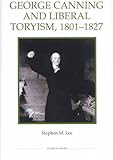
Stephen M. Lee. George Canning and Liberal Toryism, 1801-1827. Woodbridge: Boydell & Brewer, 2008. 212 S. $95.00 (cloth), ISBN 978-0-86193-294-8.
Reviewed by Philip Harling
Published on H-Albion (September, 2009)
Commissioned by Mark Hampton (Lingnan University)
The Quintessence of Canningism
Stephen M. Lee’s worthy goals are to explain George Canning as a politician of his own time and not a mere precursor of Victorian liberalism, and to promote Canning as a major figure on the domestic political scene and not merely a foreign secretary of exceptional skill and influence. In pursuing these goals Lee makes several arguments that are reasonably compelling. The first is that by the 1820s, "liberal Toryism" was a concept that meant something. More than anything else it meant “piecemeal reform of obvious abuses as an antidote to calls for organic restructuring of the constitution” (p. 2). Canning, according to Lee, was a particularly influential exponent of piecemeal reform at home--a quintessential liberal Tory in his commitment to “a balancing act between unthinking reaction (which risked provoking revolution by its resistance to change) and heedless radicalism (which also, almost by definition, risked ushering in revolutionary change” (p. 144). A related argument is that it’s a mistake to read Canning’s accession to the Foreign Office after Castlereagh’s suicide in 1822 as marking a pivotal change of ideological direction for the Liverpool administration. There were several ministers in the cabinet who were no less committed than Canning to this "balancing act"--notably Liverpool himself, Peel, and even Wellington--but who simply differed among themselves about what sort of piecemeal reforms to promote or at least to acquiesce in, as often as not for practical reasons that reflected different habits of mind as for clashing philosophical reasons.
Another of Lee’s arguments is that Canning did represent a new style of Toryism in his eagerness to expound his beliefs and justify his actions to a widening political audience. In 1812 Canning took a self-consciously “outward turn” from aristocratic to popular politics by contesting and winning a parliamentary seat for Liverpool, one of the largest electorates in the country, whose largely affluent but socially middling voters embodied the growing influence of “public opinion.” In his stump speeches in Liverpool and in a great many public utterances over the rest of his career, Canning sought to harness public opinion as a means of legitimizing the unreformed system, arguing that his own rise from humble origins to the House of Commons was testament to the efficacy with which the political status quo promoted stability by recognizing and rewarding merit and hard work. Canning was quite alone among Tories in his insistence on appealing to a political nation beyond Westminster. Lee convincingly argues, however, that his was but an extreme example of the tendency among the disciples of Pitt as well as the disciples of Fox to move away from the old-style politics of factional connection to the new-style politics of constituency organization, a politics in which the notion of a well-organized opposition to the “king’s ministers” became quite acceptable even to Pittites thanks in large part to Canning’s words and deeds when out of office. While in this sense Canning made a significant contribution to the development of the party system, Lee hastens to acknowledge that he played a no less instrumental role in splitting the Tory party itself through his adherence to Catholic relief, which provoked an open schism when he took the premiership in 1827.
As Lee contends, Canning’s influence on the domestic political scene over the first three decades of the nineteenth century probably hasn't received as much attention as it deserves. His dutiful account certainly helps to redress the balance. But this account is so much about the domestic political context and so little about anything else that it makes Canning seem dull. This is not an easy thing to do, as Canning was a fascinating creature. The son of a provincial actress, he was the closest thing to a self-made man that late-Georgian high politics had to offer. Exceptional student, formidable satirist, superb orator, incurable wag--for pure talent he had everybody beat. And he didn’t hesitate to let everybody know it. Many in the highest circles resented him not only for being a parvenu, but a parvenu who didn’t bother to hide his vaulting ambition or his intellectual superiority. Lee is of course right to assume that all this about Canning is already well known. It would nonetheless have served him well to dwell on these matters at greater length, because they are relevant to the story he has to tell. The grudges held against Canning clearly did serve to limit his political influence, at least before he took over at the Foreign Office. Many of those grudges were rooted in snobbery. Some who had a hard time forgiving Canning his modest beginnings could not forgive his self-conscious appeals to a middling “public opinion” beyond Westminster. Lee does not ignore the social tensions that marked Canning’s career and played themselves out in the broader political sphere that he helped to shape, but more diligent attention to them would have been a good thing.
Finally, while one can understand Lee’s decision to focus almost exclusively on Canning’s influence on domestic politics, the result is a bit like Hamlet without the prince. Because everyone knows that Canning’s chief influence was on foreign policy, just about everyone before Lee has focused on Canning the world statesman rather than Canning the English politician. But the ways in which those two Cannings relate to each other is surely an interesting question, one that in the wake of Lee’s account still needs to be explored. The point here is not to fault Lee for choosing to write one sort of book over another. It’s just that some reasonably detailed account of Canning’s work at the Foreign Office would likely have strengthened his claims for Canning’s contribution to the making of liberal Toryism. For the balancing act between unthinking reaction and heedless radicalism that Lee rightly associates with liberal Toryism (which is of course just as easily associated with moderate Whiggism or even the “nascent liberalism” from which Lee is at pains to dissociate Canning) was carried out on an international stage as well as a domestic one. Canning arguably did more than any other British statesman of his time to legitimate the notion that in some places a republic was a better guarantor of stability than a monarchy was. This was a major contribution to the international balancing act that doubtless had its roots in Canning’s commitment to achieving a rational balance of political forces closer to home--the commitment that Lee takes as his subject.
If there is additional discussion of this review, you may access it through the network, at: https://networks.h-net.org/h-albion.
Citation:
Philip Harling. Review of Lee, Stephen M., George Canning and Liberal Toryism, 1801-1827.
H-Albion, H-Net Reviews.
September, 2009.
URL: http://www.h-net.org/reviews/showrev.php?id=25020
 | This work is licensed under a Creative Commons Attribution-Noncommercial-No Derivative Works 3.0 United States License. |

