



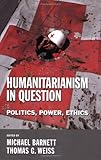
Michael N. Barnett, Thomas George Weiss, eds. Humanitarianism in Question: Politics, Power, Ethics. Ithaca: Cornell University Press, 2008. x + 303 pp. $55.00 (cloth), ISBN 978-0-8014-4486-9; $19.95 (paper), ISBN 978-0-8014-7301-2.
Reviewed by Daryl Mundis (Office of the Prosecutor, International Criminal Tribunal for the former Yugoslavia )
Published on H-Genocide (August, 2012)
Commissioned by Elisa G. von Joeden-Forgey (University of Pennsylvania)
The Shifting Nature of Humanitarianism
[Disclaimer: The views expressed herein are those of the reviewer alone and do not necessarily reflect the views of the International Tribunal or the United Nations in general.]
What is humanitarianism? Are we to use the traditional definition, that it is aid to the victims of armed conflict or natural and man-made disasters? Or is it more properly defined more broadly to include not only the provision of food and medical supplies but also longer-term objectives such as peace-building, nation-building, economic development, and the promotion of human rights and democracy? This volume explores these fundamental questions with the goals of furthering scholarly research to assist practitioners, thereby “enhancing the welfare, improving the protection, and strengthening the voice of affected populations” (p. viii).
Organizations engaged in humanitarian assistance routinely portray themselves as neutral, impartial, independent and non-political (think International Committee of the Red Cross). Such claims may (or may not) have been true in the past. Given the changing nature of what the broad term “humanitarianism” encompasses, however, such claims merit close inspection. After introductory chapters setting forth a brief history of humanitarianism and the rise of emergency relief aid, the essays in this book take a critical look at these self-portrayals from the angles of politics, power and ethics. A number of the essays in the collection deal with more than one of these topics.
Turning first to the politics of modern humanitarianism, the chapter by Janice Gross Stein, “Humanitarian Organizations: Accountable--Why, to Whom, for What, and How?” is particularly interesting. Stein’s focus on accountability is well placed in light of the substantial growth in the “humanitarian industry” over the past two decades. Compared with the situation in the past, states have virtually divested themselves of the delivery of humanitarian assistance, leaving these logistical functions to nongovernmental organizations (NGOs).Nevertheless, because states remain important sources of funding for the work that is actually carried out by the NGOs, they rightfully demand transparency and accountability from the NGOs.
Because humanitarian NGOs consider themselves bound by the principles of neutrality and impartiality, however, Stein notes that they tend to chafe at the concept of accountability to donor states, since donor states are often not neutral or impartial with respect to the parties to the conflict in question. “There is almost a sense of moral outrage among some humanitarians when the subject is raised,” she writes (p. 129).
Of course, humanitarian organizations are not accountable solely to the states that fund them. As active members of international civil society, they are typically accountable to many entities and persons, including, most importantly, victims and others in dire need of aid. This further compounds the situation: what should a conscientious humanitarian do when there are clashes between competing accountability relationships?
Other issues arise when one confronts how to integrate accountability principles into the hierarchy of humanitarian organizations. A number of humanitarian NGOs (such as Oxfam) have put considerable efforts into developing standards to promote accountability. Stein contends that there are paradoxes inherent in attempts to foster greater accountability, since most donors forbid NGOs to conduct research, including research into better governance practices. At the same time, the NGOs are encouraged by donors to cut overhead costs and to deliver aid at the lowest possible price. Without diverting resources into examining and implementing best governance practices, this problem may not be solved easily.
Stein notes that the Active Learning Network for Accountability and Performance in Humanitarian Action (ALNAP) spends $3 million annually to improve humanitarian accountability, quality, and performance, which is a drop in the bucket when compared with the estimated $10 billion spent annually on humanitarian activity. While increased accountability is likely to increase donor confidence--thus making more resources available to those who truly need them--Stein rightly notes that too much of a good thing can “cripple the initiative” of humanitarianism and when that happens, “accountability extracts a price that is exorbitantly high” (p. 142).
Power is the focus of several chapters in this collection and “Saying ‘No’ to Wal-Mart? Money and Morality in Professional Humanitarianism” by Stephen Hopgood contains a number of fascinating--and provocative--ideas. As the title of his essay suggests, he examines the question, “Can Wal-Mart be a humanitarian organization?” His question is rooted in the fact that in the increasingly globalized economy, “the idea of the market as the most efficient mechanism for meeting public needs is ascendant” (p. 99). The United Nations Global Compact initiative recognizes this ascendancy and encourages business, labor, and civil society to work together to promote environmental and social principles. While these goals may be laudable, Hopgood asks whether they are manageable or even desirable.
Wal-Mart’s immense capital, purchase-power, and logistical operations potentially place it in a unique position to be a major player in humanitarian action if it chose to do so (and was able to sell the idea to its corporate owners). Hopgood argues forcefully that even if Wal-Mart were to try to enter the humanitarian field, we should reject such encroachment. Simply put, despite Wal-Mart’s substantial economic power and market domination, its “self-interested utilitarianism” lacks the essential virtues required for humanitarianism (p. 122). Hopgood concludes that “[t]he logic of capital is to make us see one another as partners in a variety of instrumental changes. The very logic of humanitarianism is to reject this idea precisely by helping those with whom no exchange is possible, whatever the Global Compact may say" (p. 123).
“The Grand Strategies of Humanitarianism,” co-authored by editor Barnett and Jack Snyder, poses a number of ethical issues facing humanitarianism in this millennium. This essay, one of the strongest in the book, deals with consequences: the language of moral duties, obligations, and responsibilities vis-à-vis humanitarianism. These concepts are particularly important since “one of the striking features of humanitarian actions over the last several decades is the increase in both their number and kind” (p. 145). What is humanitarianism today? The authors discuss four models: “Bed for the Night” (unqualified short-term relief for those in life-threatening circumstances), “Do No Harm” (provision of relief while minimizing negative side effects), “Comprehensive Peace Building” (elimination of the causes of conflict, while promoting stable and peaceful economic and political systems), and “Back a Decent Winner” (deployment of resources to halt human rights violations in the framework of a political bargain).
The authors argue that strategic thinking is required in order to promote and understand what humanitarianism can accomplish. Employing case studies from humanitarian actions in Kosovo and Afghanistan to draw lessons on how strategy can be tailored to the circumstances on the ground, they conclude that it is “imperative to avoid a ‘one size fits all’ mentality” (pp. 169-170). This requires humanitarian organizations to use a “menu of strategies” based on the situation on the ground and the prevailing political, military, and economic conditions. Moreover, different approaches are required during the conflict than in the post-conflict period.
The editors have done a superb job in bringing together academics to address these complex issues. The essays are well written and interesting and undoubtedly the topics discussed will be familiar to anyone who has field experience with humanitarian assistance. The reviewer is mindful of the notion that in reviewing a book, one should always strive to review the book at hand, rather than the book the reviewer might have produced. Having acknowledged that, however, I am left wondering about the voices of the practitioners. Have these thoughtful scholars adequately framed the issues? Are there other looming problems that merit our attention? Are the conclusions applicable to those in the field? Perhaps the editors would consider building upon this excellent book by engaging in a similar exercise with contributions written by the brave and compassionate people who place their lives on the line in order to improve the lives of others.
If there is additional discussion of this review, you may access it through the network, at: https://networks.h-net.org/h-genocide.
Citation:
Daryl Mundis. Review of Barnett, Michael N.; Weiss, Thomas George, eds., Humanitarianism in Question: Politics, Power, Ethics.
H-Genocide, H-Net Reviews.
August, 2012.
URL: http://www.h-net.org/reviews/showrev.php?id=24943
 | This work is licensed under a Creative Commons Attribution-Noncommercial-No Derivative Works 3.0 United States License. |

