



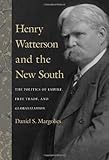
Daniel S. Margolies. Henry Watterson and the New South: The Politics of Empire, Free Trade, and Globalization. Lexington: University Press of Kentucky, 2006. xii + 340 pp. $50.00 (cloth), ISBN 978-0-8131-2417-9.
Reviewed by Steven G. Collins (St. Louis Community College at Meramec)
Published on H-SHGAPE (July, 2009)
Commissioned by James Ivy
A New South for a New World?
Daniel Margolies prefaces his book on southern newspaper editor Henry Watterson with this striking sentence: “America was dynamic, productive, striving, eager, calculating, and industrious, but it was also prickly, racist, self-interested, tumultuous, violent, and expansionist” (p. ix). This statement, in many ways, describes Henry Watterson himself. Watterson watched the South undergo war, the wrenching transition from slavery to free labor, and industrialization. From his perch as the nationally known editor of the Louisville Courier-Journal, he tried to reconcile the unique history and views of the South with the nation’s international aspirations during the Gilded Age. He did not always accomplish his goal of unifying his disparate ideas; indeed, many scholars will find Watterson’s intellectual gymnastics exasperating. Nevertheless, Margolies makes clear that, at his prime, Watterson’s views carried great weight with both public opinion and Washington politicians.
Watterson embraced the “New South Creed” of industrialization, low tariffs, and market expansion. In his views, he mirrored many southern leaders. Watterson also understood and explained why many southerners remained reluctant to support imperialism--Reconstruction jaded many Southerners toward government power and occupation. Thus, Watterson went to great lengths in his editorials to explain the difference between the positives of market expansion and the evils of imperialism. Although this argument may have been lost on northern readers as simple semantics, southerners understood the difference in a very personal way. Moreover, Watterson believed that the South’s struggle with race relations gave it unique insight and offered lessons as to why the United States. should not become an occupier of foreign nations.
Margolies argues that Watterson focused much more on foreign policy than most editors because he linked the South’s economic modernization and social stability to foreign markets and free trade. In other words, Watterson believed that what happened in Asia also affected local institutions, social relations, and business opportunities. Nonetheless, he had to sell this view to an often skeptical southern reader. To do this, Watterson used bombastic language and turned to southern nationalism. He always framed his argument from the southern, regional perspective. Because of the tenor of his editorials and his status as the South’s most important newspaperman, other major newspapers often carried Watterson’s words, and he became a caricature in many editorial cartoons. Few editors ignored Watterson, and more often than not, fireworks broke out in his editorials when other newspapermen disagreed with his assessments. Margolies makes it clear that Watterson enjoyed these verbal jousts with other editors.
When William McKinley became president, Watterson became worried about the link between imperialism and national politics. As a southern Democrat, he feared Republican power tied to imperial designs. He continued to preach free trade and market expansion, but warned against empire. He therefore came out against the annexation of Hawaii in 1897 by tapping into racist and class ideology that appealed to many whites in both the North and the South. He told his readers that the trade system already benefited the United States and that annexation would bringno advantages but would threaten American labor with a “riff-raff population” (p. 153). As well, he argued that annexation would “violate our national policy since our national existence, will reject with contempt the teachings and warnings of the founders and conservators of our institutions, and open the way for untold burdens and entanglements in the future” (p. 149).
Margolies explains how Watterson’s relatively consistent views against imperialism broke down as war approached in 1898. Margolies states that “it is striking how, in times of war and political expediency, logic can reverse course” (p. 161). Margolies avers that Watterson “recognized in early 1898 that only war could supply the South and the Union with the means of realizing the nation's promise and dominance. Only imperialism served the twin goals of America’s expansionist tradition and newer economic objectives” (pp. 156-157). Watterson’s sudden change of view, in hindsight, appears jarring. But, Margolies argues, Watterson saw no contradiction (other editors did!) in his arguments and simply perceived war as an expedient way to meet the South’s goals of economic growth and social order. Moreover, Watterson had become quite troubled about strikes and labor violence and embraced imperialism as a salve to social problems at home. Margolies asserts that in radically changing positions on war and imperialism, Watterson embraced the idea that a new war would forge reunion and sectional reconciliation. Indeed, Watterson toned down his anti-Republican rhetoric before and during the war.
As the war progressed, Watterson reverted to earlier arguments for market expansion and free trade, but attacked imperialism with bromides against the annexation the Philippines. But, as the war came to a climax, he again reversed position to accept annexation of Hawaii and imperialism. He began to use humanitarian and Social Darwinist arguments to rationalize imperialism and compared the Filipinos to emancipated slaves. Eventually, Watterson broke with both the Republicans and Democrats on foreign policy. He hated the Republicans’ high tariff policy and was outraged by the dangers of populist ideology. Margolies concludes that Watterson never was able to reconcile his views: “His intransigence on the limits of authority in the political and economic realm, like his support for free trade, remained consistent throughout his life. He did not readily recognize the incoherency of attempting to reconcile limited government, liberty, and empire” (p. 211). In the end, the professionalism of journalism and Watterson’s grumpy editorials led to his increasing irrelevance as America entered the twentieth century.
Margolies has written an important book for southern historians and those interested in the evolution of American foreign policy. It is well written and extremely well researched. It is also well grounded in southern historiography. Unfortunately, like most academic books, it will probably not find a wider audience. The narrow focus on Watterson’s views often limits its insight. It would have been a much stronger book if more historical context and larger events had been given more explanation. Margolies takes it for granted that readers will know the larger events that Watterson is reacting to in his editorials. As well, the book can get a bit tedious as Margolies analyzes Watterson’s evolving views, thus making the book seem repetitive. Nevertheless, as the United States enters the twenty-first century with overwhelming foreign policy demands, Margolies shows us--through the eyes of Henry Watterson--that we entered the twentieth century in the same, often intellectually contradictory, manner.
If there is additional discussion of this review, you may access it through the network, at: https://networks.h-net.org/h-shgape.
Citation:
Steven G. Collins. Review of Margolies, Daniel S., Henry Watterson and the New South: The Politics of Empire, Free Trade, and Globalization.
H-SHGAPE, H-Net Reviews.
July, 2009.
URL: http://www.h-net.org/reviews/showrev.php?id=24929
 | This work is licensed under a Creative Commons Attribution-Noncommercial-No Derivative Works 3.0 United States License. |

