



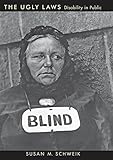
Susan M. Schweik. The Ugly Laws: Disability in Public. New York: New York University, 2009. xii + 431 pp. $35.00 (cloth), ISBN 978-0-8147-4057-6.
Reviewed by Julie Passanante Elman (Department of Social and Cultural Analysis, New York University)
Published on H-Human-Rights (September, 2009)
Commissioned by Rebecca K. Root (Ramapo College of New Jersey)
Unsightly Evictions
The “ugly laws,” a series of municipal laws generated in the late nineteenth century, were designed to limit the access of “unsightly” persons, defined as “[a]ny person who is diseased, maimed, mutilated or in any way deformed so as to be an unsightly or disgusting object,” to urban public spaces (p. 1). Although these laws have been entrenched within the cultural memory of the disability rights movement (as late as the 1970s, many city codes still had such laws on the books), it is surprising that no book-length treatment of the history of disability in the legal and cultural construction of the “unsightly beggar” has emerged. Susan Schweik’s The Ugly Laws: Disability in Public fills this gap in scholarship, not only by uncovering the untold story of the interaction of the ugly laws, urban space, and the body but also by productively reevaluating how a mythology of ugly laws has been claimed as part of a collective past by disability historians and activists. Unearthing a labyrinthine network of city streets, discourses of the ugly and unsightly, and the municipal laws attempting to contain the public movement of (ab)normal bodies, Schweik’s exhaustively researched text combines a dense and variegated archive with provocative theoretical work in disability studies, performativity, and aesthetics.
In Evictions, Roslyn Deutsch has argued that both defenses of and attacks on public space share “a democratic rhetoric of ‘openness’ and ‘accessibility’” while showing how public spaces, both real and imagined, are constituted as much through their “evictions” of conflict and heterogeneity as by images of their all-inclusiveness.[1] By historicizing the blurring together of disability and poverty that has facilitated the exclusion of the disabled and nondisabled poor from public space, Schweik reframes the ugly laws as “unsightly beggar ordinances” and insists on the centrality of disability to urban eviction (pp. 15-16). She also productively critiques the limitations of disability histories that treat the marginalization and oppression of the disabled discretely from that of the poor (whether disabled or nondisabled). Foregrounding issues of class and space as well as bodily variation, Schweik asserts that “unsightliness was a status offense, illegal only for people without means” (p. 16). Her excavation of persistent individual and collective resistance to ugly law enforcement reveals that the laws shared more in their failure to ever fully evict the indigent and disabled than in their success. Finally, Schweik demonstrates that the ugly laws, whether enforced or evaded, operated to control the public movement, presence, and behavior of non-beggars and the nondisabled as well as those of the unsightly beggar.
The book operates at multiple levels of history--individual, social, and cultural; local and national--to map a coordinated set of assumptions whose application and enforcement was varied and uneven. Part 1 discusses the emergence of ugly laws in multiple U.S. cities, beginning in 1867 in San Francisco. Between 1867 and 1905, laws surfaced at the city and state levels throughout the United States, and Schweik deftly telescopes between the local and national contexts of their emergence. For example, in her account of the San Francisco ugly law, she traces the collision of Chinese immigration, a “Gold Rush ideology that emphasized the ability of any man, whatever his prior economic situation, to make good,” and national discourses of rugged individualism and what Max Weber named the "Protestant ethic” (p. 25).
The first two chapters trace the rise of scientific Charity Organization Societies, whose leaders framed the ugly laws not as discriminatory surveillance but as a state tool for ensuring compassionate “care.” Articulating histories of begging and disability to labor history, these chapters discuss class conflicts surrounding factory injuries and the emergent middle-class ideology of conspicuous consumption, which cast begging as resultant from individual failing rather than structural inequalities in working conditions and access to health care. Schweik shows how ugly laws not only were imagined to police public space but also to limit labor mobility, suppress labor reform agitation, and increase medical and state surveillance over injured workers seeking reparations within ascendant contractual wage-labor systems. Finally, Schweik depicts the laws’ specific limiting of disabled people’s control over their own self-representation in their prohibition of public exhibition of “deformity” for the purposes of eliciting charity. Her analysis of contemporaneous modes of “deformance,” a term she coins to examine the paternalistic cultural use and public display of the disabled body by legal, medical, cultural, and social reform institutions, reveals that it was permissible for the disabled body to appear in public “even as a central object, but only as an adjunct to someone else’s subject”--as an othered object of cure, reform, or spectacle, orchestrated by and for “someone else” (p. 47).
Part 2 foregrounds trenchant analysis of the “unsightly intersection” of race, class, gender, sexuality, and disability within the ugly laws (p. 139). Many gems can be found here: extraordinary analyses of the highly sexualized legal history of indecency and its linkage to the (problematically desexualized) history of disability and the unsightly; of the mutually impacted histories of immigration, ethnicity, disability, and manifest destiny; and of the relationships among white privilege, class conflict, segregation, eugenics, and the racialization of begging. However, this reader longed for a more fluid engagement with these critical valences throughout the book rather than the limitation of the discussion of intersectionality to discrete single-issue chapters.
The book’s final section examines how those deemed unsightly navigated and resisted the dominant cultural and legal meanings attached to their non-normative bodies and movement through public space. Here, Schweik analyzes court cases, the Cleveland Cripple Survey (1913), and mendicant disability literature. Unearthing the counterdiscourse offered by everyday resistance and cultural production, Schweik not only crucially uncovers one unsung set of the disability rights movement’s ancestral voices but also presents a compelling alternative to the privileged able-bodied figure of urban histories, the flaneur. Schweik examines how an aesthetically pleasing discourse of unimpeded movement through the city--both historically and historiographically--occludes the ways in which “the body of the city comes to life when it actively and deliberately copes with the resistance of impairment and of disability activism” (p. 109). While a demand for “accessibility” has been central to and naturalized within disability politics, finding interdisciplinary disability studies scholarship that situates this political investment within scholarship in architectural history, urban studies, and the built environment still presents a formidable challenge. Thus, The Ugly Laws not only fills a significant gap in disability studies but also effectively critiques analyses of public space that do not consider issues of accessibility, movement, and aesthetics in terms of dis/ability.
By far, the book’s greatest strength is its textured archive, the most fascinating portion of which revealed the presence of an elaborate outlawed beggar subculture within early twentieth-century New York’s Bowery. Describing a thriving network of bars, such as The Cripples’ Home and The Doctor’s, which purposefully catered to disabled beggars and so-called Bowery bums (beggars who feigned disability by using props, physical performance, and suggestion), Schweik weaves a fascinating story of real disabled beggars and “fakers” rubbing elbows at the bar, undercover agents “tricked up in a sling” to determine the real from the faking, and the press obsession with cautionary tales of the manipulative power of “sham cripples” (pp. 112-137).
Much as the ugly laws were an unruly assemblage lacking in predictable and coherent structure, Schweik’s text often struggles with cohesiveness amid the girth of her archive and the depth of her secondary-literature review. The inclusion of countless archival examples and innumerable in-text references to and long quotations from secondary scholarship persistently distracts from her unique analysis. In light of the book’s already complex chronology, individual chapters seem riddled with references to material in upcoming chapters (especially when questions of intersectionality creep into part 1 rather than patiently remaining in part 2) and promises of future elaboration--signs of organizational unwieldiness. A more judicious use of in-text references to secondary scholars and fewer (but well-chosen) examples to illustrate trends would have enhanced the readability of this important work and spotlighted Schweik’s substantial interventions rather than simply her materials themselves. The book’s significant organizational issues likely stemmed from its staggering breadth of material, interdisciplinary scholarly engagements, and multiple historical horizons, all of which combined to make it an extraordinary (if a bit challenging) read.
A noteworthy addition to disability studies and urban history, Susan Schweik’s The Ugly Laws is not only a remarkable compendium of rigorous research, theoretical daring, and recovered subaltern voices, but it also raises important questions about the contemporary cultural memory of the ugly laws. Out of the bigotry sedimented within these laws, disability activists forged a social movement and collective memory from a space of eviction. Out of a fuller account of their history, Schweik has resisted the eviction of disability from cultural histories of class antagonisms, sexuality, racism, built environments, American imperialism, and social justice.
Note
[1]. Roslyn Deutsch, Evictions: Art and Spatial Politics (Cambridge, MA: MIT Press, 1998), xiii.
If there is additional discussion of this review, you may access it through the network, at: https://networks.h-net.org/h-human-rights.
Citation:
Julie Passanante Elman. Review of Schweik, Susan M., The Ugly Laws: Disability in Public.
H-Human-Rights, H-Net Reviews.
September, 2009.
URL: http://www.h-net.org/reviews/showrev.php?id=24905
 | This work is licensed under a Creative Commons Attribution-Noncommercial-No Derivative Works 3.0 United States License. |

