



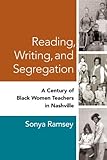
Sonya Yvette Ramsey. Reading, Writing, and Segregation: A Century of Black Women Teachers in Nashville. Champaign: University of Illinois Press, 2007. 208 pp. $35.00 (cloth), ISBN 978-0-252-03229-5.
Reviewed by Laura Atkins
Published on H-SAWH (July, 2009)
Commissioned by Antoinette G. van Zelm (TN Civil War Nat. Heritage Area Center for Historic Preservation)
Education and Segregation in the Microcosm of Nashville, Tennessee
Reading, Writing, and Segregation is a groundbreaking work on black education that focuses on black women teachers and their role in the educational system and in their communities. Sonya Yvette Ramsey is one of the first historians to examine the civil rights movement from the perspective of the teachers in charge of implementing desegregation in the aftermath of the Supreme Court’s landmark decision in Brown v. Board of Education (1954). Much has been written about the civil rights movement, but relatively few books have been written about the role women teachers played.
Ramsey structures her book chronologically from Reconstruction through the 1980s and builds her discussion by using Nashville as a microcosm of the history of black education, from elementary to postsecondary schools, in the South. For each time period, she includes court cases and firsthand accounts of teachers and students, as well as statistics on pay scales and money spent per student and school. Ramsey also analyzes the effect that black women teachers had on their profession, their influence within their communities, and their contribution to the rising black middle class.
Ramsey’s narrative begins in the post-Civil War period with the inception of formal black education in the South. She notes that originally teachers for black children were primarily white missionaries from the North, who many black parents felt were not racially or culturally attuned to their children. These parents pushed for black teachers--male and female--for their children. As the nineteenth century progressed, the education of black students in the South increasingly took place under the tutelage of black teachers in all-black schools.
Ramsey then introduces several problems that would plague black schools and teachers for decades: unequal pay for black and white teachers and disparate funding for black schools. Black women teachers made significantly less than their white counterparts and taught their students with fewer resources, usually in ramshackle, dilapidated buildings.
Ramsey also discusses the black college system in Nashville, which began with the founding of Fisk University during Reconstruction. Supported by both Booker T. Washington and W. E. B. Dubois, Fisk University had many graduates who became teachers and were well-educated role models and middle-class members of their communities. According to Ramsey, black women teachers contributed to the rising black middle class and were acutely conscious of their role within their communities. They saw themselves as positive role models for their students and comported themselves accordingly through their behavior and their appearance.
As Ramsey moves in time through World War I and World War II, she shows that teachers saw their roles change as they became involved with the National Association for the Advancement of Colored People (NAACP). They also saw their position in their communities strengthen as they attempted to raise the self-esteem of their students and in many ways became extensions of their students’ families. This time period encompasses the beginning of the NAACP and the nascent civil rights movement. The vast differences in pay of black and white teachers, based on skin color and not the level of education or experience, was fertile ground for lawsuits geared toward equal rights for blacks.
The lack of funding for black schools, as well as the low income of many of their students’ families, often meant black teachers spent their own money on their students for such things as lunches, shoes, and school supplies. Ramsey does an excellent job of tracing these trends through oral histories, statistics, and recorded court cases. Teachers fought for equal pay and funding for schools, formed women’s clubs, and raised money to support soldiers overseas. They also found themselves in the position of promoting democracy and patriotism to their students while living in a society that denied them the basic freedoms that Americans were fighting for overseas. Black women teachers overcame this irony by incorporating the idea that true democracy and patriotism crossed color lines and belonged to all people. It is this idea that provided the ideology for the civil rights movement.
Ramsey then follows these themes through the civil rights movement and moves on to additional consequences of desegregation. With education being one of the many fronts of the movement, Ramsey brings out teachers’ roles not only in the courts but also within their communities. As the movement expanded into promoting desegregation, teachers’ roles also expanded. Although many teachers were not willing to participate in sit-ins because they feared job loss as retribution, they contributed behind the scenes by posting bail and providing students with car rides to sit-ins. Teachers often put aside their own personal welfare to aid desegregation by giving up teaching positions where they had attained professional respect and by volunteering for positions where they had to “prove” that they were as competent as their white counterparts. This caused many black women teachers to redefine themselves professionally.
Ramsey discusses not only the impact desegregation has had on the teaching profession but also its influence on the black community. She notes that when experienced black women teachers left neighborhood schools, the stabilizing influence these teachers provided for their students was also removed. The extension of the family into the school system evaporated to the detriment of black students.
Ramsey’s seminal work illuminates the role black teachers played in their communities, the development of the American school system, and the place of education within the civil rights movement. However, Ramsey’s research and conclusions leave readers to grapple with several controversial questions, such as whether desegregation was a success or failure, and what its final influence will be on public education in the United States. Certainly, desegregation was a vital step toward equal rights for blacks and all minorities, but Ramsey notes that many black teachers have lamented the loss of neighborhood schools and the resulting disconnection between black parents and their children’s teachers. She suggests that although most black women teachers would not want to revert to a segregated school system, many are disappointed with the way desegregation has been implemented and believe that the burden of desegregation has fallen unduly on black teachers, black students, and their families. Finally, Ramsey analyzes black women teachers’ loss of power and prestige within their communities and suggests this is as much a consequence of the women’s rights movement as it is of desegregation. Women, both black and white, now have vast opportunities for careers that are more prestigious and pay substantially more than teaching.
In light of the No Child Left Behind Act, our country’s first black president, and the various problems in our public education system, Ramsey’s Reading, Writing, and Segregation provides a jumping-off point for future discussion.
If there is additional discussion of this review, you may access it through the network, at: https://networks.h-net.org/h-sawh.
Citation:
Laura Atkins. Review of Ramsey, Sonya Yvette, Reading, Writing, and Segregation: A Century of Black Women Teachers in Nashville.
H-SAWH, H-Net Reviews.
July, 2009.
URL: http://www.h-net.org/reviews/showrev.php?id=24860
 | This work is licensed under a Creative Commons Attribution-Noncommercial-No Derivative Works 3.0 United States License. |

