



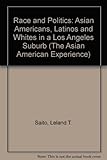
Leland Saito. Race and Politics: Asian Americans, Latinos and Whites in a Los Angeles Suburb. Urbana: University of Illinois Press, 1998. xiii + 250 pp. $24.00 (paper), ISBN 978-0-252-06720-4; $52.00 (cloth), ISBN 978-0-252-02413-9.
Reviewed by Roger Guy (Texas Lutheran University)
Published on H-Urban (November, 1998)
This is one of a number of new works on contested territories in ethnic suburbia. In this case Monterey Park near Los Angeles is the setting for this ambitious monograph on contemporary local politics that focuses on pan-ethnic and inter-racial political alliances. It is a book that crosses academic disciplines--political science, ethnic studies and sociology. Unlike earlier works on urban politics such as Ira Katznelson's City Trenches, issues of class are conspicuously absent from this work. Instead, Saito focuses on race and ethnicity to understand the events that unfolded in Monterey Park, a community facing what sociologist Joe Feagan termed the "coming white minority." Saito correctly points out that race and ethnicity have evolved as a central point of political mobilization in the United States. Changing racial and ethnic populations in America have led to the need to define someone as the "other." In this process, the concept of who is more white has served as the primary division in society. Saito argues that Asians and Latinos became somewhat "reluctant ethnics" in light of this process of racial construction and white privilege.
One of the strengths of this work is the research methodology Saito employed. By and large, he relies on ethnographic fieldwork he performed during a four year period. He also uses case studies, data from exit polls, and local election results. These techniques offer a rich and complex picture of the experiences for the researcher as well as the subjects of the study. From the interviews Saito is able to explore issues such as inter-racial conflict between Asians, Latinos and whites, and intra-racial conflict between Chinese and Japanese-Americans in Monterey Park.
The book is divided into six primary chapters. Chapter One introduces the reader to the historic process of racial exclusion in the development of Monterey Park. Chapter Two discusses issues of racial politics and white privilege in the neighborhood redevelopment. Chapter Three traces the emergence of Asian-Americans political power in Monterey Park. Chapter Four shows that despite the heterogeneity of the Asian population, its members are able to form pan-ethnic political coalitions. Chapter Five demonstrates how this pan-ethnic Asian coalition shares common experiences of racial exclusion with Latinos. This forms the basis of multi-racial coalitions. Chapter Six follows the process of these multi-racial coalitions in the effort to gain legitimate political power though voting redistricting.
Saito does a commendable job of linking the seemingly mundane artifacts of American culture to show how whiteness is equated with "American." In doing so, he begins to subtly untangle the machinations that lead to this racial preeminence and how it remains unnoticed by whites. During a neighborhood redevelopment meeting, for example, whites in Monterey Park supported architectural styles and restaurant types that mixed patriotic rhetoric and nationalism to challenge the influx of Chinese. Saito illustrates how what is "white" is also invisible in that it is taken for granted to be American until others challenge it. What Saito does not address, however, is the question of the inevitability of whiteness as a product of assimilation. This privileging of white culture has its roots in the historic process that has become synonymous with nationalism or what Tom Englehardt has referred to as the "victory culture."
The action of white residents causes a backlash among Asians. Whereas earlier groups such as Japanese-Americans held sway with organizations like the Japanese American Citizen League (JACL), newer immigrants from Taiwan have exerted their influence with groups like the Taiwanese American Citizens League (TACL). As was the case with earlier groups in urban America, a group consciousness emerges among Asian Americans based on common experiences with discrimination. The result is a more dynamic identity that changes to reflect the influx of new residents. White discrimination unites Asian-Americans and leads to their political mobilization. Moreover, the experience of collective action further solidifies this group identity. Saito correctly points out that class will ultimately influence this coalition of Asian Americans after "basic goals" are met. The real challenge facing those in Monterey Park is how to extend this pan-ethnic mobilization to an inter-racial coalition.
Asians and Latinos have had differential access to rewards of citizenship. United by common experiences of restrictive housing covenants, employment discrimination and racism, Asians and Latinos have, on occasion, formed multi racial coalitions. These included cooperative efforts in the agricultural fields to political support for people like Ed Roybal. These alliances stemmed in part form the realization that Asians and Latinos occupied a similar position in the United States racial hierarchy. Moreover, these alliances have emerged in spite of the divisive policies and differential treatment that the Chinese-Americans suffered before and after the Chinese Exclusion Act, or the incarceration of Japanese-Americans during World War II, and issues confronting Latinos after the War regarding unionization, immigration, and language. White race baiting at times resulted in intra-ethnic antagonism. However, Saito demonstrates how white and non-white categories emerged as a primary cleavage in American society. Thus these "racialized" minorities came to understand that it was often in their collective interest to unite. This undercut the divide and conquer strategy that whites hoped would succeed.
This book is as much about a process of realization for the reader as it is for the social actors in Monterey Park. Much of what the participants in Saito's study realize is that their position on the ladder of privilege in America is wrapped in the veil of race. While it is in the interest of whites to fragment racial groups by pitting them against one another, Saito shows how issues of immigration, and language are important not only to immigrants from Asia and Mexico but also to American citizens of Asian or Hispanic descent. In the end, race matters.
Commissioned for H-Urban by Clay McShane
Copyright (c) 1998 by H-Net, all rights reserved. This work may be copied for non-profit educational use if proper credit is given to the author and the list. For other permission, please contact H-Net@H-Net.MSU.EDU.
If there is additional discussion of this review, you may access it through the network, at: https://networks.h-net.org/h-urban.
Citation:
Roger Guy. Review of Saito, Leland, Race and Politics: Asian Americans, Latinos and Whites in a Los Angeles Suburb.
H-Urban, H-Net Reviews.
November, 1998.
URL: http://www.h-net.org/reviews/showrev.php?id=2485
Copyright © 1998 by H-Net, all rights reserved. H-Net permits the redistribution and reprinting of this work for nonprofit, educational purposes, with full and accurate attribution to the author, web location, date of publication, originating list, and H-Net: Humanities & Social Sciences Online. For any other proposed use, contact the Reviews editorial staff at hbooks@mail.h-net.org.

