



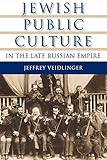
Jeffrey Veidlinger. Jewish Public Culture in the Late Russian Empire. Bloomington: Indiana University Press, 2009. xiii, 382 S. $65.00 (cloth), ISBN 978-0-253-35287-3; $24.95 (paper), ISBN 978-0-253-22058-5.
Reviewed by Brian Horowitz (Tulane University)
Published on H-Judaic (September, 2009)
Commissioned by Jason Kalman (Hebrew Union College - Jewish Institute of Religion)
Neither Religion, Nor Heroism: Russian Imperial Jews and Their Secular Drive
In this new and important book Professor Jeffrey Veidlinger, the Alvin H.Rosenfeld Professor of Jewish History at Indiana University, sets forth the claim that Jews were engaged in building a public sphere in late tsarist Russia. Providing overwhelming evidence with statistics about libraries, readers, and publishing ventures, theaters and performances, lectures, and also literary, music, drama, and historical societies that Jews founded and cultivated in the waning years of the empire, Veidlinger conclusively shows that there were a large number of individuals who established cultural institutions and promoted secular culture in localities beyond the main capitals. These Jews, sometimes "russified," sometimes inspired by nationalism, were responsible for the renaissance in Jewish culture characterized by the appearance of a world-class Yiddish and Hebrew literature, the proliferation of Jewish historical study, and the development of Jewish theater.
In his first chapter, “Jews of this World,” Veidlinger claims that besides the elite culture, another sphere of cultural creation was shaped by non-elites--workers, the growing bourgeoisie, students, and civic activists. In contrast to religious individuals, secular Jews sought meaning for their lives in the here and now and not sub specie aeternitatis. This new kind of Jew had abandoned Judaism and also the Haskalah (the Jewish Enlightenment) and its struggle against religion. He/she was interested in bourgeois life--leisure and self-realization through reading, lectures, plays, concerts, and education. Not only did these individuals “share a desire to stimulate public engagement with culture and to elevate the status of secular culture within the Jewish community,” but they also “claimed to be acting as modern citizens as well” (p. 7). According to Veidlinger, many Jews in both the main Russian capitals and regional urban centers of the Pale were subordinating political goals to an individualistic struggle for intellectual and creative development.
To prove his point, the author provides refreshingly new material. A significant example is his portrait of a fire brigade in Nesvizh (Minsk Province) in which the firefighters learn to play musical instruments. Many members of this fire brigade hoped to use the musical training, experience, and pay they received as a stepping-stone to a career in the performing arts. The prominence fire brigade orchestras have in numerous memorial books is striking, as is the degree to which they were regarded as cultural actors rather than public safety officials. Rarely can a photograph be found of a fire brigade posing in front of its hoses, kegs, or wagons. Instead, photographs of the fire brigade typically show a group of young men holding French horns, coronets, and tubas, as though these were naturally the instruments and tools of fire-fighting rather than of music-making.
This amazing description epitomizes a new attitude; a generation of Jews looked to culture as a way of life. Libraries were not only places to get books, but also hot spots to meet the opposite sex; lectures by major writers provided opportunities for intellectual stimulation; local theater groups furthered the professional development of Jewish culture. Jews, whom one often pictures as cowering in basements to avoid pogromists or on the front lines of the revolution, were also busy putting on amateur plays. This book adds an important layer to a history that has been dominated for too long by “heroic” narratives about political fighters and martyrs.
The book’s central thesis appears to be inspired by Jürgen Habermas’s ideas about the character of civil society. Nonetheless, it is worth asking if these ideas can migrate eastwards and whether they make sense in the context of Jewish culture. Although Viedlinger is entirely aware of the political context of the time in which different kinds of Zionists, Bundists, liberals, and acculturated Jewish members of Russian parties interacted, he seems to submerge politics as irrelevant to the cultural practices in which Jews were engaged. But can politics really be put aside in a conversation about tsarist Russia, where culture had long served as a means for political expression? Furthermore, one is curious about the relevance of popular culture in the shtetls. In several instances the author notes that the poorer classes were excluded from libraries and also that certain journals, Evreiskaia starina, for example, felt financial pain because of a lack of subscribers. Such evidence points to a more limited number of cultural consumers and to their class affiliation than is generally argued in the book.
Although extensively treating the issue of language choice--Russian, Yiddish, Hebrew, or Polish--Veidlinger shies away from making distinctions between national culture and secular culture generally. In what way does a Jew who borrows Russian books from a public library have “Jewish” meaning and how does this event differ “Jewishly” from events that are intended to produce national significance (for example, meetings of Zionists or lectures on Jewish nationalism)? Significantly, Veidlinger avoids identity questions to make a different point: that there were in Russia, and many more than you think, Jewish individuals who acted as creators and consumers of secular culture and in their attitudes these individuals formed the building blocks of an emerging Jewish civil society. While I agree generally with his “integration” thesis, I would still point to unmistakable resistance in the Jews’ overall predicament, their tough economic situation, government persecution, their interest in post-liberal nationalist politics, and the massive emigration that took place during this time. Nonetheless, by posing questions that have never been debated previously about Jews in the Russian Empire, Professor Veidlinger has produced a book that transforms our perspective on Jewish civil society in the critical moments at the end of tsarism.
If there is additional discussion of this review, you may access it through the network, at: https://networks.h-net.org/h-judaic.
Citation:
Brian Horowitz. Review of Veidlinger, Jeffrey, Jewish Public Culture in the Late Russian Empire.
H-Judaic, H-Net Reviews.
September, 2009.
URL: http://www.h-net.org/reviews/showrev.php?id=24809
 | This work is licensed under a Creative Commons Attribution-Noncommercial-No Derivative Works 3.0 United States License. |

