

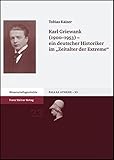
Tobias Kaiser. Karl Griewank (1900-1953): Ein deutscher Historiker im "Zeitalter der Extreme". Stuttgart: Franz Steiner Verlag, 2007. 528 pp. EUR 60.00 (cloth), ISBN 978-3-515-08653-0.
Reviewed by Matthew Stibbe (Department of History, Sheffield Hallam University)
Published on H-German (June, 2009)
Commissioned by Susan R. Boettcher
A Historian of the "Superfluous Generation"
Karl Griewank, the subject of this new and highly engaging study by Tobias Kaiser, was a German scholar, university teacher, and academic administrator best remembered for his works on Queen Luise of Prussia, the Congress of Vienna, and the 1789 and 1848 revolutions. He was also one of the few non-Marxist, "bourgeois" professors to make a decisive contribution to the re-establishment of history as a taught discipline in East German universities after 1945, before his suicide on October 26, 1953, at the age of fifty-three.
Griewank's postwar activities included his editorship of the Deutsche Literaturzeitung (to which he also contributed many reviews); his election to a seat on the committee of the West German-dominated Verband der Historiker Deutschlands (VHD) in 1949; and his membership in the academic advisory body to the Museum für Deutsche Geschichte, founded in East Berlin in 1952. However, he made his main impact in Jena, where he took up a position as professor of history and dean of the faculty of philosophy in 1947. One SED official in October 1951 described him as "zwar kein bedeutender, aber doch sehr kenntnisreicher und in der bürgerlichen Welt angesehener Fachhistoriker" (p. 437). In spite of clashes with university authorities and SED activists among the students, especially over a controversial lecture he gave in October 1950, in which he referred in passing to the nineteenth-century nationalist historian Heinrich von Treitschke, and in spite of persistent rumors that he intended to leave the GDR for an academic post in Munich, Griewank remained in Jena and refused to abandon his students. It now seems likely that his suicide, which was politicized by both sides during the Cold War, was owed largely to personal factors (he had suffered from bouts of depression and insomnia throughout his life). However, the professional strains and stresses of carrying out his self-appointed role as "mediator" between historians in the East and the West, and the evident collapse of his hopes for the maintenance of some kind of unified German scholarly community beyond the ideological divisions of the Cold War, may nonetheless have played a part.
Kaiser addresses this period in Griewank's life with a great deal of expert knowledge, contextual background, and empathy, as well as discussing significant aspects of his earlier career during the Weimar and Nazi eras. Yet, beyond these techniques he uses the tool of a biographical study to challenge what he sees as the Betriebsblindheit of twentieth-century German historiography more generally: its reluctance to engage in a critical examination of its own values, methods, and assumptions. In his view, which I find entirely convincing, "Historiographiegeschichte sollte immer auch kritische Selbstreflexion sein: Reflexion über das eigene Fach, die Methoden, das Verhältnis von Historiker und Fakten, die Frage von Objektivität und Wahrheit. Sie eröffnet Chancen und Vergleichsmöglichkeiten, fordert jedoch vor allem zu methodischem Nachdenken auf" (p. 12).
For further inspiration and guidance, Kaiser looks beyond Germany to the ideas of two British historians, E. H. Carr and Eric Hobsbawm, and shows how both of these authors are relevant to the critical study of historiography within a biographical--or even autobiographical--framework. Carr's What is History? (1961) is of course famous for the dictum "study the historian before you begin to study the facts," a recommendation based on the self-evident notion that "[t]he historian, before he begins to write history, is [himself] the product of history."[1] As an example, Carr used the German liberal scholar Friedrich Meinecke, asserting that "in effect there were three (or even four) different Meineckes," reflecting the different historical epochs he had lived through: the Kaiserreich, the Weimar Republic, the Nazi dictatorship, and the immediate post-1945 period.[2]
In many ways, Griewank's intellectual development followed a similar trajectory, even though he belonged to a different generation from Meinecke, namely the "superfluous generation" born around the year 1900 (pp. 49-50).[3] His childhood and education were entirely conventional, shaped first and foremost by the Protestant nationalism of small-town Mecklenburg and later by the methodology and scholarly idealism of the nineteenth-century German historian Leopold von Ranke, including the latter's attachment to critical analysis of sources (Quellenkritik) as the only true basis of historical knowledge. Although a democrat during the Weimar years, he developed a more authoritarian attitude in the early 1930s that allowed him to cooperate with the National Socialist authorities as a paid advisor to the Deutsche Forschungsgemeinschaft. Even so, he steadfastly refused to join the Nazi Party and instead nurtured his Christian faith as a member of the confessing church. Through discretion, diplomacy, and a fair amount of political reserve he managed to achieve his habilitation in 1942, and to obtain a chair at the Friedrich-Wilhelms-Universität (the future Humboldt Universität) in Berlin in 1943.
After 1945 he rediscovered his earlier democratic values and devoted himself to the study of the 1789 and 1848 revolutions, the concept of revolution more generally, the origins of modern political parties, and human rights within a European setting. This was the Griewank who wished to reconcile liberalism, Christian democracy, and Marxism as the joint heirs of German progressive traditions. It was also the Griewank who refused to believe that the division of Germany after 1945 was permanent. It thus greatly pained him when some of his non-Marxist students at Jena were persecuted for their beliefs, including a wave of arrests and expulsions from the university in the early 1950s. In particular, his past experience as a member of the confessing church led him to fight continuously on behalf of Christian students targeted during the SED campaign against the Junge Gemeinde and associated Protestant groups in 1952-53. On the other hand, he was equally pained by the refusal of most West Germans to recognize the validity of Marxist interpretations, or to engage in serious debate with Marxist scholars, and by the tendency of some of his pro-SED East German colleagues to offer nothing better than crude communist propaganda in response. As a frequent visitor to the West, he had ample opportunity to witness such tensions, most notably at the German historians' congress in Bremen in the autumn of 1953, which he attended shortly before his death.
Something of the Rankean tradition also remained in Griewank's commitment to an absolute vision of historical "truth" above political dogma, a stance dismissed by SED education officials and students as "bourgeois" objectivism. At the end of the so-called Treitschke debate, a public discussion on historical methodology staged at Jena in January 1951, he addressed his Stalinist critics in the SED as follows: "Ich möchte Sie bitten, denjenigen, die aus Wahrheitsgründen nicht auf dem Boden des historischen Materialismus treten können, zuzubilligen, daß sie aus echter Überzeugung so handeln" (pp. 259-260). Above all, however, Griewank was an experienced political operator who managed to avoid a direct clash with the SED, without denying--or even moderating--his own beliefs. It was no accident, in Kaiser's view, that Griewank chose the Congress of Vienna as the topic for his habilitation thesis in 1942, a theme that allowed him to explore the art of diplomacy in a specific historical period.
Eric Hobsbawm's notion of the "short twentieth century" as the "age of extremes" also features in the title of this study and is referred to on several occasions; not least in relation to understanding why, since the beginning of that era, even individual life stories can only be narrated in a fragmented, incomplete, distorted, or contested way. Yet, it is a concept that is probably best used in the global sense intended by Hobsbawm, the two extremes being capitalism and communism, rather than in the narrower German sense, as deployed by Hans-Ulrich Wehler, where the two extremes are represented by the two German dictatorships, the Third Reich and the GDR. Equating the Nazis and the GDR in this way simply takes us straight back into the Cold War polemics that Griewank was so anxious to dismantle.[4]
Griewank was a beneficiary and supporter of what Hobsbawm describes as the "temporary and bizarre alliance of liberal capitalism and communism" that saved the world from fascism in the 1940s.[5] His best work was produced during this short period of democratic, anti-fascist renewal, coinciding with his move to Jena in 1947 and his contribution to scholarship marking the one hundredth anniversary of the revolutions of 1848-49. His choice of topic did not indicate a conversion to Marxist ideas; indeed, he made efforts to reject the doctrine of historical materialism and even published a book on a distinctly Rankean theme: Das Problem des christlichen Staatsmannes bei Bismarck (1953). Yet he also disliked West German historian Gerhard Ritter's extreme conservatism and stressed the positive sides of the German--and European--revolutionary tradition, including contributions made by the workers' movement. In his predominantly "historist" view, the type of history written by Ritter and by his Stalinist antipodes in the GDR threatened to relativize the meaning of past struggles for universal human rights and liberties. This tendency became even more evident after anti-fascism gave way to renewed East-West antagonism and a much harsher climate of political repression in the years 1948-53.[6]
Finally, as an individual who lived through and personally experienced the "age of extremes," Griewank was passionate in his advocacy of a pluralism of scholarly approaches, a pluralism that necessarily included respect for Marxist positions. This attitude explains his continued efforts to act as a "mediator" between East and West Germany in the late 1940s and early 1950s, and his reluctance to choose sides irrevocably through an illegal defection to the West. As he told Gerhard Ritter in a letter in January 1950: "Ich muß nach alledem nun doch bedacht darauf sein, meine Zelte hier [in the GDR, M.S.] in absehbarer Zeit abzubrechen--wenn es irgend sein kann, nicht als politischer Flüchtling, sondern in legitimer Weise, wenn eine lohnende Wirksamkeit im freieren Westen sich auftut" (p. 441). It should also be pointed out that any unauthorized move to the West would have irrevocably destroyed Griewank's ability to act as a character witness on behalf of those of his non-Marxist research students threatened with political interference in their work, or even worse, with the possibility of a premature end to their academic careers through exclusion from the East German university system.
Had Griewank lived into the late Honecker era or even further, into the period of German reunification after 1989, he would most probably have been horrified at the distortions contained in attempts by communist historians to reclaim him as a "co-founder of GDR science" or as an advocate of a putative East German pluralism against the "anti-Marxist" West. For one thing, he saw himself as representing German science, not GDR science. For another, he knew from his own experiences, and from the experiences of some of his students, how determined the SED regime was at that time (and indeed thereafter) to place barriers in the way of genuine dialogue between Marxist and non-Marxist scholars. Undoubtedly he would have agreed with Carr that the acquisition of historical knowledge is "a social process, in which individuals are engaged as social beings."[7] SED officials, even the more dogmatic ones, indeed praised his openness to new social science methodologies, even if he did not apply them systematically in his own work, and his willingness to tackle historical issues of contemporary social and political relevance, including revolutions. But beyond this, he had an old-fashioned (or in Marxist-Leninist terminology, "reactionary") commitment to nineteenth-century standards of truth and historical objectivity, a commitment that brought him into severe personal and professional conflict with the values of the time and place in which he lived.
Overall, Kaiser's book is strongly recommended. At 528 pages, including extensive footnotes and several appendices, it is too long and too detailed to be of direct use in undergraduate teaching. But as a contribution to the study of twentieth-century historiography it is outstanding, and it deserves to be read far more widely than its apparent focus on one rather obscure, if oddly heroic and appealing, German scholar would suggest.
Notes
[1]. E. H. Carr, What is History? (Basingstoke: Palgrave, 2001), 17, 34.
[2]. Ibid., 34-35.
[3]. On political generations see also Detlev J. K. Peukert, The Weimar Republic: The Crisis of Classical Modernity, trans. Richard Deveson (London: Penguin Books, 1991), 14-18. Using Peukert's four categories, Meinecke (1862-1954) belonged to the "Wilhelmine generation" ("contemporaries of Wilhelm II"), while Griewank (1900-53) belonged to the "superfluous generation" ("those born after 1900").
[4]. Hans-Ulrich Wehler, Deutsche Gesellschaftsgeschichte: Vom Beginn des Ersten Weltkriegs bis zur Gründung der beiden deutschen Staaten 1914-1949 (Munich: C. H. Beck, 2003), 985-986. For a useful critique of Wehler and other writers in this context see Wolfgang Wippermann, Dämonisierung durch Vergleich: DDR und Drittes Reich (Berlin: Rotbuch Verlag, 2009).
[5]. Eric Hobsbawm, Age of Extremes: The Short Twentieth Century, 1914-1991 (London: Michael Joseph, 1994), 7.
[6]. Here I borrow from Stefan Berger's definition of a "historist" as somebody who "understands all political order within its own historical context" as opposed to a "historicist," who believes that "history develops towards a particular end according to predetermined laws." See Berger, The Search for Normality: National Identity and Historical Consciousness in Germany since 1800 (New York and Oxford, 1997), 3.
[7]. Carr, What is History?, 49.
If there is additional discussion of this review, you may access it through the network, at: https://networks.h-net.org/h-german.
Citation:
Matthew Stibbe. Review of Kaiser, Tobias, Karl Griewank (1900-1953): Ein deutscher Historiker im "Zeitalter der Extreme".
H-German, H-Net Reviews.
June, 2009.
URL: http://www.h-net.org/reviews/showrev.php?id=24802
 | This work is licensed under a Creative Commons Attribution-Noncommercial-No Derivative Works 3.0 United States License. |

