



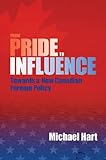
Michael Hart. From Pride to Influence: Towards a New Canadian Foreign Policy. Vancouver: University of British Columbia Press, 2008. xii + 436 pp. $98.00 (cloth), ISBN 978-0-7748-1587-1.
Reviewed by Daniel Heidt (The University of Western Ontario)
Published on H-Canada (August, 2009)
Commissioned by Stephanie Bangarth (King's University College, UWO)
Mistaken Identity
Since the end of the Cold War, Canada’s place and role in world affairs has been increasingly debated. Michael Hart’s From Pride to Influence makes an energetic neoconservative case for a Canadian foreign policy centered on interests that will catch the attention of political scientists and policy makers. According to Hart, Canada can best safeguard its two most important interests, security and prosperity, via closer relations with the United States. All other interests or values either flow from, or should be subordinated to, this relationship.
According to Hart, recent Liberal foreign policy has been based on “liberal international” values rather than Canadian interests. Associating himself with the realist tradition, Hart insists that Canadian and American values are increasingly similar and that Canadians are no longer troubled by American cultural and economic hegemony. Instead of reflecting this, Liberal Party foreign policy has been based on “liberal internationalism,” and focuses on how Canadians “feel about themselves and how they want others to perceive them” (p. 3). Recent Liberal prime ministers, therefore, differentiated Canadian and American conduct by not participating in such initiatives as the U.S. Missile Defense network or the recent operations in Iraq. Similarly, both prime ministers Jean Chrétien and Paul Martin sometimes vocalized anti-American messages to boost their domestic popularity. Such choices did not modify American actions and instead limited Canadian influence in Washington until both prime ministers took corrective measures. In short, Hart believes that Canadians need and desire a foreign policy that “projects a less self-conscious emphasis on pride and pays more attention to gaining and maintaining influence” via a closer working relationship with the United States (p. 17). The current prime minister, Stephen Harper, has begun to move in this direction, but Hart argues that the federal Conservative party is hampered by a minority government as well as the continued influence of bureaucrats who still have no replacement for the Liberal government’s 2005 International Policy Statement.
Canadian foreign policy, therefore, needs to move away from a value driven foreign policy and focus on interests. Foreign aid has “suffered from political correctness” because it is diluted among a plethora of countries for projects that often fail to produce prosperity (p. 302). Hart argues that poverty and disease “are the historical norm” and that the market and democracy rather than aid are the best methods for creating wealth because they instill responsibility (p. 308). Alarmingly, he asserts that, as a result, sweatshops are a means of economic mobility rather than something to be discouraged. Although Hart does admit that emergency aid is sometimes necessary, he argues that when Canada donates aid, it should focus on a few countries where results are likely, and where it serves Canadian “political interest” (p. 304). Thus, because Canada has relatively few economic interests or immigrants from Africa, Canadians should “be content to let Europeans take the lead” (p. 317). Similarly, Canada should open embassies and consulates where Canadian interests are strongest rather than refraining from closing large facilities where few Canadian interests remain. Perhaps Hart has a point regarding embassies and consulates; however, his discussion of poverty and aid is deeply troubling. Surely Canada’s aid allocation should be determined by more than interests.
Canada has drifted further and further into the U.S. orbit since the end of the Second World War. Despite the efforts of several previous Canadian governments, American trade continues to dominate Canadian markets. Hart contends that further efforts to tear down trade barriers at the Doha Development Round will have little impact on Canada since most of its trade is already sheltered under the North American Free Trade Agreement. Moreover, he argues that Canada is already producing at full capacity and therefore could not benefit from new trade opportunities. Consequently, Canada’s economic future lies with the United States. Trading with other countries should be encouraged, but within “American-based global value chains” rather than to redirect Canadian-American trade (p. 290). To ensure the continuity of this bilateral relationship, Canada will require a “seamless border with our neighbour, embraced within a new agreement implementing rules, procedures, and institutions consonant with the reality of ever-deepening mutually beneficial cross-border integration and of new threats to security” (p. 165). Hart is at his best when discussing the Canada-United States border. The United States continues to watch its borders closely, and continued collaboration in the spirit of the 2005 Security and Prosperity Partnership will be necessary to ensure the free flow of goods and services.
Unfortunately, Hart undervalues the relevance of other states or regions that rival American influence. According to Hart, the European Union’s “efforts to compete with the United States are hobbled by debilitating debates between the advocates and opponents of ever-closer political union, by its generally anemic economic performance, by its lack of military will and muscle, and by its postmodern approach to foreign policy” (p. 117). Russia and Japan have both faded from their former Cold War glories. China may compete with the United States eventually, but its phenomenal growth during “the next two decades will be harder” as it will require reforms. Multilateralism’s utility is also declining according to Hart. For instance, the United Nations was “marginalized” by Iraq when the United States demonstrated that it could act with or without the body’s approval (p. 129). Moreover, the United Nations “reflects the world as it existed in 1945” and is hopelessly divided by new rivalries among lesser powers (p. 133). To join this body’s initiatives at the expense of Canadian-American relations would be “a further step down the road to irrelevance” (p. 140). This interpretation exaggerates American hegemony: although the United States will continue to dominate Canadian trade and heavily influence Canadian foreign policy, other states and regions remain relevant.
Hart also avoids variables that would complicate his strategies. For instance, he sometimes emphasizes how Canadian support and participation in American plans would increase Ottawa’s influence in Washington rather than explaining how that action satisfies Canadian interests. This oversight is particularly noticeable when he discusses Iraq. Focusing almost exclusively on the implications of Canada’s desistance on Washington-Ottawa relations, Hart only briefly mentions regime change and the lack of new terrorist attacks on U.S. soil as Canadian interests. A book emphasizing Canadian interests must detail Canadian interests beyond influence in Washington before advising the deployment of Canadian soldiers.
Lastly, Hart researched and wrote Pride to Influence before the current global economic recession. While the United States continues to maintain a dominant global position, Hart’s contention that “Canadians now live in a unipolar world dominated by the United States, in a global economy in which trans-national corporations have become major contributors to citizens’ long-term prosperity” is less convincing than it may have been a short year ago (p. 323). Similarly, Hart wrote prior to the 2008 election of now President Barack Obama and the full repudiation of George W. Bush’s foreign policy. Regardless, this book provides an encompassing argument from the far political right that will surely provoke debate which will hopefully spur increased public awareness of and direction for Canadian foreign policy.
If there is additional discussion of this review, you may access it through the network, at: https://networks.h-net.org/h-canada.
Citation:
Daniel Heidt. Review of Hart, Michael, From Pride to Influence: Towards a New Canadian Foreign Policy.
H-Canada, H-Net Reviews.
August, 2009.
URL: http://www.h-net.org/reviews/showrev.php?id=24778
 | This work is licensed under a Creative Commons Attribution-Noncommercial-No Derivative Works 3.0 United States License. |

