



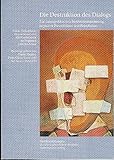
Dieter Bingen, Peter Oliver Loew, Kazimierz Wóycicky, eds. Die Destruktion des Dialogs: Zur innenpolitischen Instrumentalisierung negativer Fremd- und Feindbilder. Polen, Tschechien, Deutschland und die Niederlande im Vergleich, 1900 bis heute. Veröffentlichungen des Deutschen Polen-Instituts Darmstadt. Wiesbaden: Harrassowitz Verlag, 2007. 428 pp. EUR 24.00 (paper), ISBN 978-3-447-05488-1.
Reviewed by Timothy Dowling (Department of History, Virginia Military Institute)
Published on H-German (June, 2009)
Commissioned by Susan R. Boettcher
Less Could be More
Conference collections are uneven, both internally and as a whole. Good presentations do not always translate into good papers, and vice versa. Sometimes the presentation is too short to convey adequately the nuances of a paper; more frequently, a panelist rambles on, spelling out the entire thirty- or even fifty-page paper when a fifteen-minute summary was the goal. In Die Destruktion des Dialogs, however, the problem--if it is a problem--is reversed. The authors have scrupulously adhered to a twenty-page limit, a decision that often leaves the reader wanting more. And while the editors include snippets of their discussions at the end of the book, this inclusion hardly fills the gap. The collection raises questions that go unanswered, and makes points that are never pursued. As a conference, it was probably fascinating and fruitful; as a collection of papers, it is both tantalizing and frustrating.
The volume is, for the most part, well and clearly organized. The first two papers ("Feindbilder aus der Sicht der politischen Psychologie" by Josef Berghold and "Spuren des Anderen: Eine philosophische Antwort auf eine politische Frage" by Małgorzata Bogaczyk) present an overview of the topic. While some of the points made in them seem obvious, it is useful to get an introduction to the nuances of the field, and definitions for the jargon that, inevitably, follows. Skipping right to the heart of the matter would hardly have created a significant disadvantage, though, and the sensitive (or cynical) reader would have been spared exposure to tropes like "it is impossible to define ourselves without a definition of others" (p. 19) and "what separates also connects" (p. 26).
The core papers, thankfully, provide more intellectual meat. Szymon Rudnicki's case study of Roman Dmowski's writings and attitudes toward Germany and Germans neatly demonstrates the dilemma many Poles faced in the late nineteenth century. Caught between Germany, Russia, and Austria-Hungary, they longed for independence but saw little hope of achieving this status on their own. Thus Dmowski, and Poles in general, had to choose between "others" as a means of realizing "self." Ingo Loose's paper follows logically by examining the ways in which Poles then (re)constructed and used the concepts of "others" to bind their new nation together in the years after the First World War. He shows, for instance, how Poles moved from Dmowski's idea of the "political other" to one of a cultural and racial German "other," even as trade and politics still bound them to Germany. And where Loose's paper ends, Andrzej Michalczyk picks up. While Rudnicki and Loose (frustratingly) drew no significant conclusions, Michalczyk convincingly places the micro-developments they elucidated in a broader context. These papers work well as a unit, providing a detailed glimpse into the subject of German-Polish relations on several levels.
The next group of four papers builds on this foundation by comparing the Czech-German case to the Polish-German one. The contributions range over nearly a century, with each providing a detailed case study. Markus Krzoska looks at Germans and Czechs in Bohemia between 1897 and 1920, while Kristina Kaiserová examines the images Germans and Czechs had of each other in the confessional arena between 1900 and 1938. Finally, Miroslav Kunštát demonstrates the ways in which Czechs used images of Germans internally after 1989 as part of their national renewal. In between, Martin J. Klein offers a thoughtful and challenging study of "memory transfer" between Jews and Czechs as affected by Germany and Poland. All of these papers are brief--Kaiserová's is only six pages--and give the impression that the authors have more to say. The gaps are not as large as they appear because the previous section provides an excellent foundation and comparison, but these contributions cry out for further development.
The next two sections repeat the pattern, with four papers on German-Polish (and Jewish) images in the Second World War and its aftermath, followed by two papers comparing the images of Germans in the Netherlands following the war. Again, they work well together, with ideas from one paper supporting those found in others. Piotr Madajczyk's work is the broadest and it lays the foundation for the rest, demonstrating how the Soviets deliberately used anti-German images to further their policy in Poland, and how the Poles used this to their advantage between 1944 and 1989. Christian Lotz follows by showing how negative images were manipulated in Poland, Bulgaria, and the divided Germany immediately after the war. Joanna Wawrzyniak discusses how Jews became Germans in Poland during 1967-68, and Klaus-Pieter Friedrich looks at how the politics of memory legitimized Poles' and Germans' conceptions of themselves as "victims" during the Second World War. As comparative, transnational history, this section is (and these panels must have been) outstanding.
The two contributions on the Netherlands, while not as broad, are nonetheless fascinating and interrelated. Both focus on East Germany as it was perceived in the Netherlands. The recognition of the GDR, Jacco Pekelder shows, was a perfect example of how nebulous perceptions can be. The renewal of anti-National Socialist sentiment in the 1960s and 1970s, he argues, was simultaneously used against West Germany and as an argument for the recognition of East Germany. Beatrice de Graaf's paper explores similar paradoxes in the Dutch image of the GDR, and demonstrates how these contributed to the politics of détente in the 1970s and 1980s. Taken together, these papers present a topic usually overlooked (Dutch-East German relations) in a thought-provoking way that easily translates to other areas.
The final two sections, unfortunately, do not fit together so well. Both deal with the period after 1989, and though the first is subtitled "Aufbruch in neue Zeiten?" and the second "Politische und Gesellschaftliche Entwicklungen," the delineation is not so clear. Neither rubric is really appropriate, in fact.
The first four papers return to the theme of Poland and its neighbors. Anna Wolff-Powęska discusses what is old and new in the images Poles hold of Germans and others, while Agnieszka Stępińska shows how these concepts have been used in Polish elections. Piotr H. Kosicki's paper is even more specific, looking at how what he calls the "aggressor-victim" dynamic (as opposed to "us-them") played out in the elections that occurred within a week of each other in Germany and Poland during September 2005.
The next three papers, however, depart from the (apparent) theme. Artur Lipiński discusses the construction of a Feindbild of communists and communism within Poland after 1989, while Stefan Garsztecki and Piotr Forecki examine how Poles have used negative images (of Germany and others) as part of an anti-European Union discussion. Peter Oliver Loew closes by asking whether the German Right has developed a specific image of Poland (the answer is yes), and how that image is used. While the first two contributions might have formed an interesting panel or section, Loew's paper does not seem to belong. His concepts are not particularly difficult, but they are left hanging in space. To this point, each paper reinforced the one before or after, lending context and contour. Loew's seventeen pages stand alone, and his thesis that the German image of Poles as the enemies of 1900 has been revived appears too simple and unsupported.
Fortunately, the next contribution provides some depth. Despite being separated by the editors, Bernadette Jonda's work on how young Germans and Poles perceive each other in the new "age of media" does in fact build upon Loew's paper. (Though, to be fair, it could just as well be put the other way around; either way, it seems this would have made a good panel and a good section). Using polling data, Jonda demonstrates how Poles' and Germans' perceptions and opinions of each other have shifted after German unification--not always for the better.
The last three papers also appear to be anomalies of a sort, though they are not. Klaus Bachmann and Anna Skwarek's examination of how populist Dutch and Polish political parties use (negative) images of "those guys in Brussels" seems like it would work well juxtaposed with Garsztecki's and Forecki's contributions. The same is true for Peter Gostmann's explanation of how Poles are developing representations of "Europe" and European nations in their historical memory, and Justyna Woźna's discussion of the process of developing negative images of foreign capitals in the Polish press. All together, they create a diverse, yet connected, picture of a new "European" image under formation in central Europe, and these five pieces probably should be read together. Indeed, although this comment might be seen as nitpicking, the editors might have organized the whole second half of the book better.
In sum, the papers in Die Destruktion des Dialogs provide a multifaceted look at an intriguing area of comparative history. Each paper provides at least a kernel of a further investigation, and the sections (panels) suggest profitable avenues for broader development. Because the papers are so short and specialized, this volume might not find a wide audience. It should, however, attract at least a passing glance from anyone interested in the cultural side of German-Polish relations or the interplay between culture and politics in central Europe. Surely what is presented here can and must lead to more substantial publications on these topics.
If there is additional discussion of this review, you may access it through the network, at: https://networks.h-net.org/h-german.
Citation:
Timothy Dowling. Review of Bingen, Dieter; Loew, Peter Oliver; Wóycicky, Kazimierz, eds., Die Destruktion des Dialogs: Zur innenpolitischen Instrumentalisierung negativer Fremd- und Feindbilder. Polen, Tschechien, Deutschland und die Niederlande im Vergleich, 1900 bis heute.
H-German, H-Net Reviews.
June, 2009.
URL: http://www.h-net.org/reviews/showrev.php?id=24690
 | This work is licensed under a Creative Commons Attribution-Noncommercial-No Derivative Works 3.0 United States License. |

