



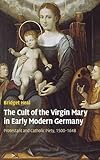
Bridget Heal. The Cult of the Virgin Mary in Early Modern Germany: Protestant and Catholic Piety, 1500-1648. Cambridge: Cambridge University Press, 2007. xvi + 338 pp. $99.00 (cloth), ISBN 978-0-521-87103-7.
Reviewed by Richard J. Ninness (Department of History, Touro College)
Published on H-German (May, 2009)
Commissioned by Susan R. Boettcher
Mary in the German Reformations
In this recent monograph, Bridget Heal presents a nuanced account of Mary's significance for Lutheran and Catholic circles in the Holy Roman Empire during the Reformation. Given the evangelical reformers' condemnation of Mary's cult, we might have expected to find the elimination of images and liturgy honoring the Virgin, but in the cases of both Nuremberg and Augsburg, Heal demonstrates that the reality was much more complex, with both art and practices surviving to varying extents in churches that converted to Protestantism. On the Catholic side, Heal examines the assumption that the militant Virgin venerated by the Wittelsbachs and the Habsburgs typifies early modern Marianism. Heal does this by looking at Augsburg, where the Marian cult had nearly disappeared, only to be resurrected by a new Tridentine Catholicism, and at Cologne, which remained Catholic throughout the Reformation while preserving the old late-medieval traditions. According to Heal, an examination of theology alone is insufficient for understanding the Marian cult. One must also examine cultural factors on the ground.
As is well known, Protestant theologians condemned the medieval cult of saints. In their view, saints conflicted with their central theological tenet of justification by faith alone and distracted attention from the worship of Christ. Unlike other saints, however, for evangelical reformers, Mary could never be entirely eliminated from evangelical piety, since her veneration was closely tied to that of Christ. Though reformers had no desire to dishonor Mary, her veneration had to be altered to accommodate their interpretation of scripture. The Virgin continued to be important in Protestant circles, but was to be assimilated into Lutheran devotional life, even as images were reinterpreted in accordance with the evangelical understanding of Mary as Hausmutter rather than as a divine intercessor. But Mary continued to play a role in Protestantism. Indeed, Martin Luther had an image of the Virgin and the Child hanging in his study. Ambiguity in the Protestant position on Mary arose when reformers condemned her cult but did not seek to eliminate it entirely. In fact, this unclarity facilitated the preservation of Marian images and devotion in parts of Protestant Germany. Even so, although Augsburg and Nuremberg were both Protestant, a visitor to Augsburg would have seen few if any Marian images, while in Nuremberg, a visitor would have encountered numerous Marian remnants. In order to account for the extensive survival of Marian imagery and liturgy in Nuremberg and in other Lutheran territories, Heal considers the ways in which theology interacted with local political and cultural circumstances.
In 1525, Nuremberg became the first imperial city to adopt the Lutheran faith. Yet, in the early modern period, Nuremberg's churches still contained paintings and statues of the Virgin of Mercy, of Mary's assumption and coronation, of the Madonna of the Rosary and other non-scriptural subjects. Various Marian festivals were still celebrated. The city council's reluctance to follow the recommendations on this subject of the city's leading theologian, Andreas Osiander, indicates that its decisions with regard to Marian art and liturgy were influenced by something other than straightforward religious ideology. (Similarly, on the political level, Nuremberg did not join the Schmalkaldic League.) According to Heal, the fate of ecclesiastical art in Nuremberg was shaped by the council's determination to preserve order and by the desire of influential citizens to protect objects that they and their families had donated to the church. Patricians on the city council or with close connections to it orchestrated Nuremberg's Reformation, and they might have seen existing art as monuments to their families as civic patrons. Furthermore, Nuremberg had a close relationship with the emperor based on the Golden Bull. Beginning in 1424, it housed the imperial regalia. Elite preferences notwithstanding, evangelical reformers appear to have transformed popular belief with regard to Marian devotion in Nuremburg. In 1530, about half of the householders still owned rosaries. But, by the middle of the sixteenth century, a sample of seventy inventories revealed only one rosary.
In contrast, in Augsburg, most manifestations of Mary's cult were eliminated during the early stages of the Reformation. Though Augsburg went over to the Reformation later than Nuremberg, it would later surpass the Franconian imperial city in the radical nature of its religious and political affiliations. The different attitudes towards Marian images and devotion owed a good deal to the theological divisions within Protestantism. Augsburg's initial Reformation owed more to the theology of the Swiss reformers than to Wittenberg, and was much less tolerant of remnants of pre-Reformation devotion. As a result of the officially sponsored iconoclasm in 1537, much less Marian imagery survived in Augsburg than in Nuremberg. However, shortly thereafter, after the evangelicals' defeat in the Schmalkaldic War, the city's devotional life underwent an abrupt change when Charles V demanded the reintroduction of Catholicism in Augsburg. Even though Augsburg adopted Lutheranism after the Peace of Augsburg in 1555, the renewal of Catholicism, heralded by the arrival of the Jesuits, led to a gradual hardening of confessional boundaries from the sixteenth century onwards. In Nuremberg, in contrast, where adherents to the Augsburg Confession were never under immediate threat from militant Counter-Reformation Catholicism, Marian images and feast days were assimilated into post-Reformation devotional life. Augsburg felt an ever-present threat of re-catholization, and Protestants there were confronted with the militant Counter-Reformation on a daily basis in a way that Nurembergers were not. Heal argues that once Augsburg's burghers perceived Mary as a weapon in the campaign for Catholic reconquest, little chance remained that she would be welcomed back into evangelical devotion there.
In the second half of the book, Heal discusses the Marian cult in Catholic circles. For Catholics, the Marian cult transcended all gender boundaries but was in no way uniform throughout the Holy Roman Empire. When Catholicism was forcibly restored in 1548 in Augsburg, its chief proponents were faced with a difficult task. Although a number of the city's wealthy patricians had remained loyal, Catholicism enjoyed little support. Authorities could not rely on coercion because the peace treaty recognized Augsburg as a biconfessional city. Each confession had to attract new followers through positive incentives, and so Mary became a key figure in the exciting new Catholicism led by the Jesuits, as seen in the renewal of festivals, processions, and pilgrimages and the foundation of sodalities. The confessional struggle in this biconfessional city made Marian venerations more rigorous there. In 1570, the Jesuit Peter Canisius carried out a dramatic exorcism in Altötting in which Mary figured prominently. The strong support Mary enjoyed in neighboring Bavaria, where the Wittelsbach court actively sponsored the Counter-Reformation, led to an intensification of her cult in Augsburg under the Jesuits. In Counter-Reformation Bavaria, Mary assumed a new importance as a symbol of the church militant and triumphant. The Virgin was the victor of Battle of Lepanto and the Battle of White Mountain, patroness of Bavaria and Austria, and the Jesuits promoted her as the personification of their campaign against heresy, too.
Cologne's Marian cult survived the Reformation intact but without the same sharp edge as in Augsburg. The imperial city remained for the most part Catholic, and its local devotional traditions were never fully destroyed. As a result, Counter-Reformation influences never established a monopoly over Marian imagery and devotion. With its vitality of traditional forms, Cologne's religious culture reflected the imperial city's medieval heritage and proved more resistant to the forces of the Counter-Reformation than the other cities Heal studies. In one church, for example, statues were clothed in rich robes, adorned with crowns and other precious objects. Cologne's artists continued to produce an older style of emotional art in which Mary's bare breast was shown, which contrasted with the Counter-Reformation concept of a triumphal Mary. Because Cologne's religious practices continued uninterrupted and because many of the city's patrons remained steeped in local devotional traditions, the imperial city did not witness a significant transformation in the cult of the Virgin in the sixteenth century. However, beginning in 1583, Cologne's elector was a Wittelsbach, inaugurating a long dominance of the electorate by the dynasty. The Wittelsbachs brought the new Marian cult to Cologne and built the Mariä Himmelfahrt church in 1618 for the Jesuits. But in Cologne, the Jesuits' militant Marian piety was never the only devotional form. Older local institutions and religious traditions continued to shape Cologne's Marian cult.
Heal's analysis points out differences between Lutheran and Reformed attitudes towards the saints and their images. Other than an emphasis on justification by faith, a reliance on scripture, and a rejection of Rome's authority, little consensus on how to treat Mary emerged among the Protestant reformers. Furthermore, her work shows how the fate of Marian images and liturgy sheds light on the interaction between religion and society. Her book demonstrates that attitudes towards the Virgin Mary owed as much to local political and ecclesiastical circumstances as to doctrinal norms. Her conclusion that understanding Protestant devotional practice requires historians to consider the establishment of the Reformation and Counter-Reformation on the ground is important, because it underlines how religion accommodated itself to local political, social, and cultural concerns. In a work on the Marian cult, this approach might profitably have been extended beyond the realm of the imperial cities, whose populations were only a small fraction of the Holy Roman Empire. Heal's focus on imperial cities is frankly hard to justify for the Counter-Reformation. Late-sixteenth-century innovations in the Marian cult in Augsburg and Cologne clearly came from Bavaria. Although she mentions the importance of the Jesuits in Augsburg and Cologne, she deals with Bavaria only indirectly.
In sum, however, Heal's study offers a subtle consideration of Germany's confessional landscape. Mary did not disappear from Protestant devotional life, and the Jesuits did not succeed in imposing their own form of the cult of the Virgin throughout Catholic Germany. Heal abandons the crude interpretations of the past and looks beyond generalized theology and polemics to the realities of daily life and worship within specific historical contexts.
If there is additional discussion of this review, you may access it through the network, at: https://networks.h-net.org/h-german.
Citation:
Richard J. Ninness. Review of Heal, Bridget, The Cult of the Virgin Mary in Early Modern Germany: Protestant and Catholic Piety, 1500-1648.
H-German, H-Net Reviews.
May, 2009.
URL: http://www.h-net.org/reviews/showrev.php?id=24645
 | This work is licensed under a Creative Commons Attribution-Noncommercial-No Derivative Works 3.0 United States License. |

