



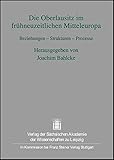
Joachim Bahlcke, ed. Die Oberlausitz im frühneuzeitlichen Mitteleuropa. Quellen und Forschungen zur sächsischen Geschichte. Stuttgart: Franz Steiner Verlag, 2007. 500 pp. $84.00 (cloth), ISBN 978-3-515-08983-8.
Reviewed by James Palmitessa (Department of History, Western Michigan University)
Published on H-German (June, 2009)
Commissioned by Susan R. Boettcher
Upper Lusatia in Transition: One Small Piece of the Central European Mosaic in the Early Modern Period
On November 11, 1778, August Ludwig Schlözer wrote to Karl Gottlob von Anton, a leading figure in the Enlightenment in Upper Lusatia, "Ihre Oberlausitz ist für uns entfernte Deutsche eine Terra incognita" (p. 9). If Lusatia was considered an unknown and strange place in the eighteenth century, it disappeared or rather became subsumed in the early nineteenth century into Saxon history, according to Joachim Bahlcke. New interest in the territory was stimulated by the fall of communism in Europe in 1989-91, a development that brought changes to borders within and between states. Bahlcke is also the editor of two earlier volumes on Upper Lusatia and a number of volumes on Silesia, and the author of an acclaimed monograph on regional integration in the Bohemian crown lands.[1] The book reviewed here, which focuses on Lusatia in the early modern period, contains twenty-two contributions by a multidisciplinary group of scholars from Germany, Austria, the Czech Republic, and the United Kingdom--some established and well known, others new to the field.
The first series of essays discusses features of territorial rule and relations. In the early fourteenth century, the Markgrafentum Oberlausitz, which was bordered by Bohemia, Electoral Saxony, Silesia, and Poland, and dominated by six cities (Budissin, Görlitz, Zittau, Lauban, Löbnau, and Kamenz), became an associated territory (Nebenland) of Bohemia. In 1635 it was ceded to Electoral Saxony. (Today most of former Lusatia lies within the German Federal Free State of Saxony). Manfred Rudersdorf notes that it is difficult for the historian of the Holy Roman Empire to understand the complicated legal and political position of the lands of the Bohemian Crown, which included Bohemia proper, Moravia, Silesia, and Lusatia. Originally associated in a personal union with the king of Bohemia, the relationship between these states became even more complicated with the ascent of the Habsburgs to the Bohemian throne. According to Rudersdorf, this alliance, which made Lusatia and the other lands part of the Habsburg hereditary lands, further distanced Lusatia and the other crown lands from the empire, as they henceforth ceased to appear in the Reichsmatrikel, be represented in any of the Imperial Circles, attend the Imperial Diet, or have their citizens fall under the jurisdiction of imperial courts. According to Karl Heinz Blaschke, the centralization of the justice and tax system under the Habsburgs contributed to a continuing sense of state in Lusatia, which had already developed a strong consciousness as a territory and state structures even before its association with Bohemia. Drawing on recent work on community and state (such as that by Peter Blickle), Uwe Schirmer notes that nowhere did estate self-interests show themselves stronger than in the peasant contribution to the building of estate government in Lusatia. At the same time, however, no sense of Landesherrschaft developed and no official residence was established in Lusatia for the Bohemian king who ruled the territory as margrave. According to Blaschke, Lusatia represented an exception to constitutional development in the early modern period in that it kept its territorial constitution without being drawn into modern state development. Seen from a different perspective, as Lenka Bobková notes, the system of associated lands lasted in Bohemia until the founding of the Czechoslovak state in 1918, a state of affairs that would seem to suggest at least implicitly that this system could be viewed as representing an alternative path of political development.
In religious affairs as in politics, Upper Lusatia also displayed some distinctive features. Most of Upper Lusatia, as well as a few parishes in Northern Bohemia, lay in the jurisdiction of the bishopric of Meißen. However, a few places in Lusatia, such as Zittau and its surroundings and the Cistercian Cloister, St. Marienthal, lay in the Prague archbishopric. Matthias Weber notes that Lusatia, like Silesia, remained Catholic and loyal to the Bohemian king during the Hussite Wars of the fifteenth century. In the sixteenth century, however, Lusatia moved over largely to the Lutheran side, with only a few cloisters and other institutions remaining Catholic. Drawing on Vatican sources, Alexander Koller explains that although it was clear to all that a full return to Catholicism was not possible, the Roman curia kept up its efforts in Lusatia through the work of papal nuncios, who were successful in cultivating a few Catholic places, such as Bautzen cathedral. Siegfried Seifert discusses the activities of Johan Leisetritt, a native of Olmütz (Olomouc) in Moravia, who served as dean of Bautzen cathedral and imperial Generalkommissar. Seifert shows that Leisentritt was able to free Bautzen from the jurisdiction of Meißen and protect ecclesiastical property.
Large numbers of Protestants left or were expelled from Bohemia in the wake of the Battle of White Mountain in November 1620, an event that brought an end to the Bohemian Estate Revolt that had begun in 1618. Emigration from Bohemia continued into the eighteenth century. Communities in Upper Lusatia, such as Annaberg, Freiberg, Pirnau, and Zittau, were major centers of migration. Wolf Wäntig presents an interesting essay on the myth of Protestant exile that developed in the nineteenth century, best exemplified by the work of the Upper Lusatian historian Christian Adolph Pescheck. According to Wäntig, the roots of the myth date back to first migrations in the seventeenth century--to the lobbying efforts of refugees, the policies of the Saxon Court, and elite confessional discourse, all of which, according to Wäntig, was "self-stylized." Yet, Wäntig goes on to state, the concrete experiences of refugees were not affected by these discourses. Ludger Udolph reports that immigrants integrated relatively smoothly in the city of Zittau, establishing Czech-language parishes that lasted until the eighteenth century. The few disputes that developed with the city council revolved mostly around non-church-related issues, though the Saxon Elector took a watchful eye on events, especially Calvinists and "troublemakers." Alexander Schunka reports on interesting cases of requests from refugees and newly arrived immigrants in the city of Bernstadt, which was predominantly Protestant, to the abbess of the cloister of St. Marienstern, one of the few Catholic islands remaining after the Reformation and in whose territory Bernstadt was located. Schunka comments that one would not think that this Catholic territory would not be an ideal destination for Protestant refugees fleeing Catholic Bohemia, but this case dramatically shows that geographic position and social relationships were central factors in choosing the place of exile. Wäntig argues that scholarly attention to reasons for flight should move away from an exclusive focus on religion toward discussion of broader factors and local interactions, patterns to which international migration research has drawn attention.
Lusatia and Silesia have long been recognized as important literary, intellectual, and cultural centers in the early modern period, home to well-known figures such as Jacob Böhme and Martin Opitz. Klaus Garber argues for the importance of examining cultural phenomena from the perspective of regional and international migration. According to Garber, Görlitz and Breslau represented two important crystallization points of elite communication in a cultural space that that reached all the way to Gdansk (Danzig), and this area presented a challenge or at least operated at a distance from the dominance of Lutheran culture that emanated from Electoral Saxony. Drawing on an impressive database comprised of information on four thousand professionals in the middle of the seventeenth century, Norbert Kersken examines where people in Lusatia went to school and university, where they worked, how many later left Lusatia for professional work, and how many outsiders came to Lusatia. Through this analysis, he is able to demonstrate that the region was quite dynamic and mobile, in strong contrast to the remote place it was to become a hundred years later. Bahlcke introduces the Gymnasium Augustina in Görlitz. Founded as a school, the institution was expanded in 1565 into a Gymnasium, modeled after educational reforms in Leipzig and Strasbourg, and enjoyed an excellent reputation based on its status somewhere between that of a Gymnasium and a university. According to Bahlcke, after the famous Pönfall of 1547, when Ferdinand I punished the Lusatians for their role in the Schmalkaldic War, the school continued to flourish, representing an interesting case study of how cultural identity can become even more pronounced after a political downfall.
Walter Schmitz examines and compares the confessional cultural landscapes of Jacob Böhme, the shoemaker from Görlitz, and Rudolf II Habsburg, Holy Roman Emperor. According to Schmitz, Böhme operated in a confessional cultural landscape with the Prague imperial court as its center and his work can be seen as an heir of Rudolfine natural speculation. Examining the artistic heritage of Upper Lusatia, Jan Harasimowicz notes that by the middle of the fifteenth century, building was already flourishing in Görlitz, financially supported by its mayor, the trader Georg Emmerich. In the late fifteenth and early sixteenth centuries, Görlitz expanded into a major architectural center, developing the "Rosskopf style," a variation of late Gothic and early Renaissance style. Lusatia also came to develop a distinctive tradition in other media as well, such as sculpture, which, according to Harasimowicz, disappeared after Lusatia was transferred to Electoral Saxony.
Two essays discuss the distinctive linguistic situation in Upper Lusatia. Lusatia was and continues to be home to the Sorbs, known to many historians of modern Germany as a minority group that was especially protected during the days of the GDR, who appeared and were popularly represented in romantic folk dress. Hartmut Zwahr reminds us that the Sorbs, who were commonly called "Wends" in Germany into the 1930s, are descendants of an East Elbian Slavic group that lived predominantly in rural areas. In an especially informative essay, Gerald Stone reports that in the first half of the sixteenth century, many Sorbs--who represented a third of the total population (that is, 50,000 of 146,000)--did not use or enjoy proficiency in German, but rather one of a large number of dialects of the Sorbian language. According to Stone, the struggle between confessions worked for the benefit of the Sorbian language, putting it on a higher social level, as different confessional groups trained teachers and pastors to train the world. Zwahr, in contrast, notes that the movement to push bilingualism, while helping the group on the one hand, also led to the erosion of the language.
Moving on to the sphere of economics, Markus Cerman presents a study of the integration of markets in the region. According to Cerman, regional production of and a market for cloth (as well as wood) developed in Lusatia, Silesia, Bohemia, and Saxony. In this system, the North Bohemians supplied the six cities of Lusatia with needed wood and Upper Lusatia provided a capital market important for Northern Bohemia, which lacked a large lumber center. Katja Lidensa writes about the second most important item produced in Lusatia: beer. According to Lidenau, an impressive number of 103 brewers were active in the city of Görlitz, which had a population of 7,000, and beer was sold not only in beer houses, but also in other places where snacks (Imbisse) were sold. According to Lidenau, this data supports recent work showing the multifunctionality and importance of beer halls. Peter Rauscher examines in detail the political and economic background and factors behind the move of control of Upper Lusatia from Bohemia to Saxony through a process of pawning (Verpfandung) in the early 1620s. According to Rauscher, pawning was a last resort for dealing with debt, but not an uncommon solution, as when it was chosen by Ferdinand II to deal with the debt caused by the wars with the Ottoman Empire and the Thirty Years' War. Lars Behrisch ends the volume with a discussion of Görlitz's political constitution, which Behrisch argues was not unlike that of Germany's free and imperial cities.
The book has a useful index that cross-lists geographical names in German, Czech, and Polish. It would have benefited greatly from the inclusion of a map. One of its strengths is that it successfully places Upper Lusatia into a broader "central European" framework, a term that many works claim to use these days, not all of them convincingly. This strength can be seen in many of the essays, but especially in the case of the contribution by the renowned British historian R. J. W. Evans. Although his essay is located in the section on confessionalism, Evans underscores a point supported throughout the book: that Lusatia was not quaint and odd, but rather held a distinctive, prominent place in the larger mosaic of the Holy Roman Empire and central Europe. Another contribution of the book is that almost all of the essays represent new scholarly directions (for example, on communication and migration) rather than drawing upon older, problematic prewar German Ostforschung. On the one hand, in the case of the contributions by German scholars, one can view this volume as reflecting the full coming of age of a new generation of east central European scholars in Germany, one that finds direction and connections in issues affecting other European societies. On the other hand, a tension is evident in the book between different national transitions or trends, each claiming Lusatia as part of its own heritage (imperial, Saxon, Bohemian, Austrian, and so on). This tension adds perspective rather than detracting from the scholarship, reminding us of the importance of understanding and engaging national histories and historical traditions, even if one is interested in communal and regional studies, cultural history, and religion. For these reasons, this volume should be of interest to all scholars ofthe history of the Holy Roman Empire and its individual and neighboring constituent parts and central Europe as a whole.
Note
[1]. The works dealing with Lusatia are Joachim Bahlcke and Volker Dudeck, eds., Welt-Macht-Geist: Das Haus Habsburg und die Oberlausitz (Görlitz: Dr. Gunter Oettel, 2002,; and Geschichte der Oberlausitz: Herrschaft, Gesellschaft und Kultur vom Mittelalter bis zum Ende des 20. Jahrhundert, ed. Joachim Bahlcke (Leipzig: Leipziger Universitätsverlag, 2001). Bahlcke's monograph study is Regionalismus und Staatsintegration im Widerstreit: Die Länder der böhmischen Krone im ersten Jahrhundert der Habsburgerherrschaft (1526-1619) (München: Oldenbourg, 1994).
If there is additional discussion of this review, you may access it through the network, at: https://networks.h-net.org/h-german.
Citation:
James Palmitessa. Review of Bahlcke, Joachim, ed., Die Oberlausitz im frühneuzeitlichen Mitteleuropa.
H-German, H-Net Reviews.
June, 2009.
URL: http://www.h-net.org/reviews/showrev.php?id=24644
 | This work is licensed under a Creative Commons Attribution-Noncommercial-No Derivative Works 3.0 United States License. |

