

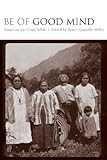
Bruce Granville Miller, ed. Be of Good Mind: Essays on the Coast Salish. Seattle: University of Washington Press, 2008. 323 pp. $29.95 (paper), ISBN 978-0-7748-1324-2.
Reviewed by Sean Carleton (Simon Fraser University)
Published on H-Canada (May, 2009)
Commissioned by Stephanie Bangarth (King's University College, UWO)
The Contested Landscapes of the Coast Salish World
In 1987, anthropologist Wayne Suttles published Coast Salish Essays, a selection of the important contributions he had made since the 1940s to an understanding of the indigenous peoples of the Pacific Northwest Coast. Now, twenty years later, Bruce Granville Miller’s Be of Good Mind has been published as a “sequel to Suttles’ Essays” (p. 24). Comprised of ten essays written by individual scholars working in the field of Coast Salish studies, Be of Good Mind successfully engages with, and moves beyond, the work of Suttles to highlight the contested landscapes of the historic and contemporary Coast Salish world. In doing so, Be of Good Mind challenges the colonial conceptions of Coast Salish peoples as passive, peripheral, and homogenous, and instead posits a new view of the diverse indigenous peoples of northwestern Washington and southwestern British Columbia as active agents of transformation in their own lives. The collection thus makes a strong contribution to the emerging literature on indigenous histories that seeks to uncover local understandings of culture, identity, and social change. In addition, Be of Good Mind examines the changes occurring in the field of Coast Salish studies, by taking stock of its historical roots, by grappling with the opportunities of the present, and by commenting on the challenges that lie ahead.
While each essay offers its own approach to the study of Coast Salish peoples, together they speak to a number of important issues. For example, several essays seek to problematize colonial boundaries and borders. Specifically, Miller (introduction) and Alexandra Harmon (chapter 1) highlight that the literature on Coast Salish peoples has tended to split historically linked indigenous communities based on which side of the American/Canadian border they reside. In contrast, the essays of Be of Good Mind argue that such a practice fails to acknowledge the alternative ways in which indigenous peoples understood their community networks prior to contact and before treaties and borders. Further, Harmon contends that a bordered view of Coast Salish peoples not only is a “legacy of colonialism,” but also provides historians with a “default focus of study” that belies the fact that indigenous peoples “were not so easily sorted and segregated” (p. 38). To illustrate her point, Harmon introduces the figure of George Swanaset whose overlapping kin and social ties stretched across borders. As such, as a child, Swanaset attended different residential schools--one in the Nooksack district and one on Vancouver Island. Harmon thus claims that despite the existence of borders, Coast Salish peoples “continued to associate with each other in ways that hinged more on [indigenous] notions of kinship and respect for local customs than on government edicts” (p. 39). In short, Coast Salish community organization transcends colonial borders, and historical studies need to grapple with this complexity.
Another issue addressed by several essays in Be of Good Mind is that Coast Salish peoples did not abandon indigenous ways of ordering the world as a result of colonialism--particularly in relation to family and webs of kinship. Harmon (chapter 1), Sonny McHalsie (chapter 3), Rocky Wilson (chapter 4), Keith Carlson (chapter 5), and Crisca Bierwert (chapter 6) all point out that while overlapping Coast Salish networks of families and communities existed, such social ties were constantly shifting because of tribal and intertribal marriages and migrations. These essays further argue that Coast Salish collective identity was fluid and historically constructed, and emphasize the fact that, for many indigenous peoples, their spirit force and identity was firmly rooted in the landscapes of the Pacific Northwest Coast. For example, McHalsie comments on the strong connection between Stó:lō culture and history and the Coast Salish landscapes. He introduces Elder Tillie Gutierrez’s saying of “S’ólh Téméxw te ikw’elo. Xolhmet te mekw’stam it kwelat,” which, for McHalsie, basically means, “This is our land and we have to take care of everything that belongs to us” (p. 85). While McHalsie specifically refers to land and indigenous title, Brent Galloway (chapter 7) asserts a similar argument about indigenous languages in his essay about the revival programs that are being developed in the Nooksack and Stó:lō territories. Thus, many essays in Be of Good Mind share McHalsie’s idea that indigenous stories of spirit and life force are embedded in space and place, and are thus central to Coast Salish understandings of the world.
A third and related issue explored in the essays by Daniel Boxberger (chapter 2) and David Schaepe (chapter 8) are the connections between people, place, and politics, and the legal struggles of Coast Salish peoples for land claims, resource rights, and self-determination in the Pacific Northwest. While these scholars view Coast Salish landscapes--physical, cultural, legal, and economic--as theatres of struggle, noticeably absent from their analyses in particular, and from Be of Good Mind in general, is a deeper engagement with how Coast Salish peoples historically encountered, and continue to deal with, capitalism. Indeed, the collection does not provide a sustained analysis of the transformative power of capitalism regarding social relationships in the Coast Salish world, and thus perpetuates a problematic historiographical trend that fails to adequately explore the connections between colonialism and capitalism in Canadian history. As a result, colonial governments and actors are deconstructed and critiqued, but the agents of capitalism--those who set up colonial governments and funded (and continue to fund) colonial actors to further capitalist interests--avoid the sting of scholarly analysis. Since a central aim of Be of Good Mind is to encourage new ways of thinking about the Coast Salish world, my hope is that new scholarship will pay closer attention to the intersection of colonial processes and capitalist state building in the Pacific Northwest and beyond.
However, Be of Good Mind encourages scholars to pursue a different historiographical path. In the introduction, Miller identifies a shift in the literature on Coast Salish peoples that is characterized by a “rapprochement” of archaeology, linguistics, history, ethnography, and other scholarly disciplines (p. 7). It is clear that the future study of the Coast Salish world resides in the new ideas, perspectives, and approaches that are posited by the rich array of multidisciplinary research showcased in Miller’s collection. For Miller, what is most insightful about the state of contemporary research is that scholars are working with and are sometimes even hired by indigenous communities. This “side-by-side” scholarly approach to the study of the Coast Salish past is exciting, because it seeks to not simply reinsert indigenous voices into nonindigenous stories (p. 10). Instead, by engaging with indigenous epistemologies and ways of knowing about the world, the new scholarly work contained in Be of Good Mind--most notably that of Carlson, Bill Anglebeck (chapter 9), and Colin Grier (chapter 10)--is creating spaces for alternative understandings that allow the indigenous peoples of the Pacific Northwest to participate in the processes of constructing their past and shaping their future. This is truly an encouraging historiographical shift. And yet more work is necessary that thinks through the tactics and strategies of struggle needed for the present. Specifically, new work must link indigenous communities, not just with nonindigenous forms of scholarship but with nonindigenous communities. This will require both indigenous and nonindigenous peoples to confront, in admittedly different and unique ways, their embedded existence in the highly contested landscapes of the Coast Salish world that the essays of Be of Good Mind have started to chart.
If there is additional discussion of this review, you may access it through the network, at: https://networks.h-net.org/h-canada.
Citation:
Sean Carleton. Review of Miller, Bruce Granville, ed., Be of Good Mind: Essays on the Coast Salish.
H-Canada, H-Net Reviews.
May, 2009.
URL: http://www.h-net.org/reviews/showrev.php?id=24616
 | This work is licensed under a Creative Commons Attribution-Noncommercial-No Derivative Works 3.0 United States License. |

