



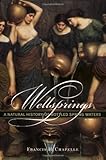
Frank Chapelle. Wellsprings: A Natural History of Bottled Spring Waters. Piscataway: Rutgers University Press, 2005. xvi + 279 pp. $25.95 (cloth), ISBN 978-0-8135-3614-9.
Reviewed by Philip Morgan (Keele University)
Published on H-Water (June, 2009)
Commissioned by Justin M. Scott-Coe (Monte Vista Water District; Claremont Graduate University)
Message in a Bottle
Francis Chapelle has worked as a hydrologist with the U.S. Geological Survey for over a quarter of a century. He has written an engaging, if somewhat discursive book which is part popular science, part popular history. Referencing is light and there is no bibliography. Whilst the detail is sometimes complex, the outline of his thesis is clear enough. The modern history of bottled water in the United States belongs to the first quarter of the nineteenth century, initially as a delivery system for a medicalized product, evolving to the provision of drinking water in response to the terrible tap, and nearly disappearing in the face of the widespread chlorination of municipal water supplies after 1913. The revival of bottled water from the late 1970s, in Chapelle’s view, has been a response to changing fashions and the aspiration for a healthier lifestyle. In his exploration of the mechanisms which underpinned changing fashions, the author argues that consumers are heirs to a long tradition of reverence for pure water which is intelligible in anthropological terms. A focus on the drinker of bottled water and the business of bottling water is matched by elucidation of the water itself--its natural history. For these reasons the chronological span of the book is much broader than the last two centuries and accounts for the presentation of fourteen chapters in three distinct parts.
In part 1, Chapelle outlines the history of bottled water, a master narrative in which the rise of Saratoga Springs, New York, after 1819; the pioneering introduction of chlorination of municipal water in Philadelphia in 1913; and the marketing campaign of Perrier water following the opening of a New York office in 1976 provide the markers. The apparent paradox that bottled water's revival occurred in New York where tap water quality is very high, as opposed to, say, Florida, where tap water has a distinctive and sometimes unpleasant taste, leads to a consideration of the place of water in a variety of historical cultures, including Asian and European. This approach is somewhat discursive and has a tendency to flatten and simplify debates on the moral economy of water in the early modern period, the role of water deities and votive offerings in pagan and Christianized cultures, and classical explanations of the nature of water. Inevitably there are some slips. Rag wells in Northumberland in the United Kingdom are so named, not because a water spirit admired scraps of rag, but because the pilgrim washed an infected limb with well water, transferring the malady to the rag. As the rag or "clouty" rotted, so the illness might fade from the sufferer. Additionally, the transference of curative powers from water deities to Christian saints and thence to the water itself is followed without reference to the "reformation" of water which seems to have occurred in Protestant cultures in the sixteenth century.
The medical use of spring water, largely based on an empirical knowledge of different waters as well as observable and reproducible effects, is integrated with a similar long narrative on the development of the fields of geology and hydrology. Chapelle is at his best in these sections, providing elegant and accessible summaries of the transformation of knowledge about how waters flow above and below the earth, of how and why springs differ from each other, and of the emerging science of analytical chemistry. The approach is anecdotal, with vignettes of characters like the English geologist William "Strata" Smith, who first used geological maps showing strata and famously unblocked the great spring at Bath, jostling with others like Edwin Drake who developed successful oil drilling in Texas in the 1850s. Some of this territory has been covered in Christopher Hamlin’s pioneering work;[1] however, students often find Hamlin’s thesis challenging and might deal better with it after Chapelle’s readable synthesis of the history of the required science.
No water actually reaches the bottle until chapter 4, which finally reviews the equally long history of water delivery methods. The critical developments mostly occur in the eighteenth century and involve the bottling of water to deliver the cure to patients, rather than bringing the patients to the spring. Jackson’s Spa in Boston was bottling mineral water in the 1760s, advertisements for bottled mineral waters are common in British archives from the 1740s, and examples of supplying Buxton water to noble households for the treatment of gout are known from the sixteenth century. Until the early twentieth century bottled water for medical use remained a high-status product, and its marketing was richly allusive and resonant of the long history of sacred and medicalized water. The Poland Springs’ "Moses" bottles from the 1870s are a case in point. There is a brief consideration of more recent bottling materials, notably polycarbonates, polyvinyl chloride (PVC), and high-density polyethylene (HDPE).
At what point bottled water began to compete with municipal piped water as drinking water is not quite clear. The provision of local networks of water delivery using large glass containers has until quite recently been a distinctive North American phenomenon. The European tradition of urban water-carrying, in London or Paris, largely disappeared in the course of the eighteenth century in the face of piped networks. In the United States it survived long enough to sponsor the rise of the cooler. This book is more concerned with the contest in the microbiological arena, bottled water competing with the micro-organically rich municipal supplies in a story which stretches from Snow’s pump in London, England in the cholera-ridden 1840s to the Milwaukee municipal water crisis of 1993. Water isn’t sterile, but in reality all ages have understood that waters are different by the admixture of other substances, visible and invisible. But, fashion and choice, partly driven by microbiology, are here read as an introduction to the business of bottled water which occupies the second part of the book.
In the second part of the book, three chapters consider the issue of fashion and style, the bottled-water market, and issues of water law as they impinge on bottled water. It is often argued that earlier societies, like the late W. C. Fields, eschewed water for drinking because of its possible contamination. In reality the association of water and poverty has been more pervasive. Water gets fairly good press in the Bible, but early Christians had begun to associate it with asceticism. In the second century the Shepherd of Hermas recommended bread and water for fasting; in fifteenth-century England Margaret, Countess of Shrewsbury prescribed it as a punishment for her children’s swearing. It remained the drink of the poor, and those impoverished by circumstances. Chapelle begins his review with the traditional story of the Mayflower pilgrims and their readmission to the ship for beer at Christmas after months of local water. He attributes the revival of water-drinking to the adoption of the European habit of taking the waters in the eighteenth century at centers like Stafford Spring, Connecticut or Yellow Springs in Philadelphia, and the subsequent bottling of local waters. There is some overlap here with material presented in part 1, although the narrative of modern marketing carries the discussion further.
The "invention" of hydration as a medical problem and the role of sport in marketing are argued to be significant. If Americans first drank water for their health, then in preference to municipal water, and finally because it represented an aspirational lifestyle of health and well-being, what issues informed their choice of one product over another? Since the revival of bottled water in the 1980s, the major choice has been between natural and processed waters, the latter represented by brands such as Dasani and Aquafina. In 2000 no single producer had a greater than 8 percent market share. Much of the story here makes fascinating reading for the non-industry reader, as Chapelle explains the processes whereby some municipal waters are purified by the act of removing dissolved solids, whilst others are subsequently flavored to create an optimum taste. Unlike European consumers, Americans have generally preferred waters with low levels of dissolved solids, which are less mineralized. The causal explanations, however, seem to me to be more speculative. American consumers, so it is argued, identify more with bottled water as a generic product than they do with particular brands.
The final section here chronicles the environmental problems of a burgeoning industry and its impact on recharge rates in several aquifers, notably Ice Mountain, Wisconsin. Water law is an important area, but here it might profitably be related to earlier European debates about the moral economy of the conduit in the early modern period. That modern bottled water has also revived debates about water as a common good available to all says a good deal about the durability of themes in water history.
The third part of the book is a review of the geography of American bottled water derived from hydrologic regions. Natural bottled waters are determined by the effects of geology on aquifers, springs, and surface waters, but each locality has also produced variant business histories. The integration of geology and business history is a particular virtue of this part of the book. Later chapters deal with the Northeast, exemplified by the history of Poland Springs, and Florida, where the search for acceptably tasting bottled water raises the important issues of age in natural waters. In the Southwest, most of the waters of the Ogallala Aquifer are high in dissolved solids and this region has been important in the development of purified waters.[2] In contrast, Pepsi market-tested their purified water, Aquafina, in the Southwest after a process which involved the removal of solids. The fondness of Californians and those in the Pacific Northwest for bottled water is exemplified by the story of Calistoga Springs. The final proposition of the book is that variety, choice, and quality are what have determined the success of bottled waters, and that qualities learnt in childhood are important in determining attitudes to particular products.
A favorite question in my undergraduate honors examinations has been "account for the rise of bottled waters." The materials for an answer are packed into this book, enlivened by revealing case studies of bottling companies, scientists, and businessmen. The hydrology which underpins almost every section is exemplary, and forces the historian to do what he or she is often reluctant to consider, that is, to put the product back into the landscape and to understand its quality and provenance. But, as to the significant historical questions, I fear that the author has not advanced a compelling thesis to stand alongside earlier concepts like ritual landscapes or the medical marketplace.
Notes
[1]. See Christopher Hamlin, "'Water' or 'Water'?--Master Narratives in Water History and Their Implications for Contemporary Water Policy," Water Policy 2 (2000): 313-25.
[2]. One can identify here the revival of the nineteenth-century ideas of Dr. Friedrich Kreysig of Carlsbad in Germany. He had argued that the medical effects of water might be reproduced by adding to purified water, thus creating an artificial mineral water.
If there is additional discussion of this review, you may access it through the network, at: https://networks.h-net.org/h-water.
Citation:
Philip Morgan. Review of Chapelle, Frank, Wellsprings: A Natural History of Bottled Spring Waters.
H-Water, H-Net Reviews.
June, 2009.
URL: http://www.h-net.org/reviews/showrev.php?id=24476
 | This work is licensed under a Creative Commons Attribution-Noncommercial-No Derivative Works 3.0 United States License. |

