



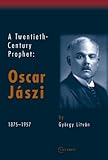
György Litván. A Twentieth-Century Prophet: Oscár Jászi, 1875-1957. New York: Central European University Press, 2006. 570 pp. $59.95 (cloth), ISBN 978-963-7326-42-4.
Reviewed by Matthew Lungerhausen (Winona State University)
Published on HABSBURG (December, 2009)
Commissioned by John C. Swanson (University of Tennessee at Chattanooga)
A Glass Half Full? The Life and Times of Oscar Jaszi
György Litván’s biography offers a comprehensive narrative of Oscar Jászi’s personal life, intellectual development, and varied careers as a civil servant, academic, politician and journalist. Key sections of the book focus on Jászi’s role in the Chrysanthemum Revolution, his activity as an organizer of the democratic emigration in Vienna during both Béla Kun’s Soviet republic and the early years of Miklós Horthy’s regency, as well as his later career as a college professor and public intellectual in America. The book also contains a valuable analysis of his major intellectual works. Litván’s discussion of the genesis and writing of the Dissolution of the Habsburg Monarchy (1929) will be of particular interest to the members of HABSBURG.
The book is organized chronologically and can be divided roughly in half. The first half concerns the European part of Jászi’s life, while the second half deals with his emigration to the United States. Jászi’s life in Europe is divided into three distinct periods. The first four chapters deal with Jászi’s childhood, early career as a civil servant, and work as an editor of Huszadik Század. Chapters 5 through 7 address the outbreak of World War One, the founding of the Civic Radical Party, Jászi’s wartime journalism, and his participation in the October 1918 revolution. Litván takes care to analyze Jászi’s work as minister of nationalities and role the peace-making process at the end of the war. One of his goals for the book was to dispel the notion that Mihály Károlyi and Jászi were responsible for the Treaty of Trianon and the partition of the Kingdom of Hungary after the war. It provides some interesting details on the period between the end of the war in November 1918 and the Soviet republic in March 1919, but it is a little bit in the weeds. Some Anglophone readers might find this section excessively detailed.
Chapters 8 through 10 are devoted to Jászi’s exile in Vienna. Jászi fled Hungary shortly after the establishment of the Soviet republic, and did not return after its dissolution. Despite Jászi’s early anticommunism, he was lumped in with Béla Kun, along with Károlyi, and held responsible for the Communist dictatorship. Much of his time in Vienna was devoted to journalism about conditions in Horthy’s Hungary, searching for support among the Western democracies to overthrow the regency, and advocating for the creation of a Danubian confederation. To further these projects, Jászi traveled extensively in Romania, Yugoslavia, and Czechoslovakia to meet with other émigrés, conduct field research, and negotiate with Little Entente politicians like Eduard Beneš and Tómaš Masaryk.
The last half of the book, roughly chapters 11 through 20, is devoted to Jászi’s experiences in the United States. His first trip to America was a speaking tour to raise money and awareness for the democratic wing of the Hungarian emigration. It was at this point he first became acquainted with Karl Geiser, a professor of political science at Oberlin College. This meeting would prove pivotal, since eventually it would lead to a job that would allow him and his second wife Recha Rundt, to settle in the United States. Teaching college would also prove to be Jászi’s enduring vocation in the second act of his life. Although he still sustained hopes for some sort of Danubian confederation, and remained engaged in the struggle for a "democratic Hungary," Jászi made a profound mark on his students and colleagues at Oberlin.
Litván’s implicitly argues that Jászi’s political activism, plus his scholarly writings on nationalism and the history of dual monarchy made him a prophetic voice in the wilderness. In a positive sense, Jászi can be seen as an advocate for many appealing developments in Hungary and the region of central Europe writ large. Most important of these is a modern civic liberalism that advocates for equal rights based on citizenship, not nationality, and supports the loose federalism of the European Union. These values have become embedded in the institutional and governmental structures of post-Communist central Europe, even if it is not always perfected in the practice of politics.
But Jászi’s prophetic career can also be seen in a negative light as well. He suggested that ethnocentric, or chauvinistic, nationalism would plague central Europe for some time to come, especially if Hungary remained a dictatorship. It must have been cold comfort to Jászi for World War Two to prove him right. The failure of Horthy to secure a lasting revision of the Treaty of Trianon through alliances with Nazi Germany and Fascist Italy must also be seen as one of Jászi’s moments of foresight. Unfortunately, Jaszi’s solution, a federal, or confederal, system of states in the Danube basin was not a workable alternative. Neither the Great Powers, like France and Great Britain, nor the Little Entente had any intention of revising the borders of the rump Hungarian state. Even if democrats like Jászi had been in charge in the 1920s, there would have been very little they could have done to either secure new borders or protect the rights of the Hungarian minority communities in the successor states. In this respect, war, enmity, and dictatorship were inevitable outcomes in central Europe.
Litván casts Jászi as a political thinker who appreciated the enduring value of democratic and human rights around the world, while remaining cognizant of the limits of those rights in conditions of social and economic injustice. In addition to advocating for minority political rights Jászi was a proponent of land reform both before and after World War One. He was also noteworthy among Hungarian liberals for his early and consistent anticommunism. Jászi’s political thought placed a primacy on individual rights, while still acknowledging the needs of disenfranchised communities, be they disenfranchised Slovaks and Romanians or landless peasants who sought property and political representation in the dualist era. After World War One, Jászi pressed for equal rights for the Hungarian minorities in the successor states on the basis of the same principles.
The sections on Jászi’s political thought and activities also implicitly speak to a Hungarian audience about the waning influence of contemporary liberal thought in Hungary. Jászi’s Civic Radical Party, in the right light, can be seen as a forerunner of modern Hungarian liberal parties like the Alliance of Free Democrats (SZDSZ). Litván may very well be alluding to SZDSZ’s waning electoral fortunes in the past decade and the rise of the radical Right when he states in the last sentence of the last paragraph of the book, “Yet since Jászi’s reburial in Budapest in 1991, there has been little sign that either the nation or the younger generation seeks to draw lessons from either his teachings or his life" (p. 535). This implied lesson of history is at odds with Litván’s stated intention, in the preface of the English edition, to allow the reader to draw his or her own conclusions.
Ultimately, Litván’s biography illustrates Jászi’s shortcomings as a politician and diplomat. He may have had the appropriate analysis of Hungary’s national minority problem before World War One, and a good understanding of what it would take to make a permanent peace in the region, but Jászi was never able to persuade the majority of Hungarians to pursue those policies. Politicians in the successor states also had limited use for Jászi and his plans. Finally, in the Unites States, Jászi’s influence was limited to intellectual venues like the pages of the New York Times and Foreign Affairs. His prescriptions for peace in central Europe were not heard in the halls of power or heeded by his fellow citizens.
The strength of the book is related to one of its greatest weaknesses. A Twentieth-Century Prophet does not have footnotes. The bibliography is one page long and only contains published works in Hungarian, which limits its scholarly usefulness. Fortunately, Litván does discuss the relevant archival sources in the preface, but if the editors were going to include an abbreviated bibliography in Hungarian as a guide to further reading, then they should have also listed some of the existing English-language literature on Jászi as well as a bibliography of his works in English. That said, Litván’s discussion of the primary and secondary sources is reminiscent of the traditional bibliographic essay and provides a useful jumping-off point for further research.
As Litván points out in his introduction, this is the first attempt at a biography of Jászi in any language and it benefits from the strengths and suffers from the weaknesses of breaking new ground. Litván states that he wanted to write a complete biography or “portrait of a life" (p. xiv), but the book will not meet the expectations created by popular and scholarly biographies of American and English political figures. Important life events, like the birth of Jászi’s children, are only mentioned in passing. The reader has to look hard to find the names of his sons or the dates of Jászi’s first marriage. Most of the work is focused on Jászi as a political and intellectual figure. The problem is that Litván does not integrate the details of Jászi’s family and personal life into the narrative of his personal and intellectual development; they just stick out as vignettes of daily life.
This book represents an important, valuable, and worthy contribution to the historiography. A Twentieth-Century Prophet relates to other recent English-language biographies of early twentieth-century Hungarian politicians, such as Gabor Vermes, István Tisza: The Liberal Vision and Conservative Statecraft of a Magyar Nationalist (1985), Ignác Romsics, István Bethlen: A Great Conservative Statesman of Hungary, 1874-1946 (1995), and Thomas L. Sakmyster, Hungary's Admiral on Horseback: Miklós Horthy, 1918-1944 (1994). Litván's biography of Jászi also contributes to the intellectual history of early twentieth-century Hungary. This book could be profitably read along side the classics in this genre like Lee Congdon, The Young Lukács (1983), Mary Gluck, Georg Lukács and His Generation, 1900-1918 (1985), and Lee Congdon, Exile and Social Thought Hungarian intellectuals in Germany and Austria, 1919-1933 (1991). Finally, Péter Hanák's essay "The Start of Endre Ady's Literary Career: 1903-1905," in his The Garden and the Workshop: Essays on the Cultural History of Vienna and Budapest (1998), would provide further context for Jászi's early intellectual career.
A Twentieth-Century Prophet would be a challenging read for an American undergraduate, but it would give them access to an interesting time period of Hungarian history. Sociologists, anthropologists, political scientists, and historians who specialize in the regions of central and eastern Europe will find this volume useful. Since nearly half the book is devoted to Jászi’s experience as an immigrant in America, and his perceptions of his new homeland, it would be of interest to U.S. historians who study the Cold War and immigration history. A Twentieth-Century Prophet is full of relevant information and Litván’s analysis of Jászi’s oeuvre is essential reading for anyone interested in the intellectual history of the region and Jászi’s subsequent contributions to American intellectual life. Jászi and his career have fallen out of view, but Litván’s biography suggest that both the man and his work are due for a reappraisal
If there is additional discussion of this review, you may access it through the network, at: https://networks.h-net.org/habsburg.
Citation:
Matthew Lungerhausen. Review of Litván, György, A Twentieth-Century Prophet: Oscár Jászi, 1875-1957.
HABSBURG, H-Net Reviews.
December, 2009.
URL: http://www.h-net.org/reviews/showrev.php?id=24399
 | This work is licensed under a Creative Commons Attribution-Noncommercial-No Derivative Works 3.0 United States License. |

