

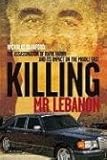
Nicholas Blanford. Killing Mr. Lebanon: The Assassination of Rafik Hariri and Its Impact on the Middle East. I. B. Tauris & Company, Limited, 2006. 256 pp. $29.95 (cloth), ISBN 978-1-84511-202-8.
Reviewed by Hannes Baumann (SOAS)
Published on H-Levant (June, 2009)
Commissioned by Amy A. Kallander (Syracuse University)
Rafiq Hariri: A Journalist’s Account of the Billionaire-Politician
The investigation into the assassination of Rafiq Hariri, which started in February 2009, is set to revive interest in Lebanon’s former prime minister. A good starting point to read up on the billionaire-politician is Nicholas Blanford's Killing Mr. Lebanon. It is a journalistic introduction to Lebanese politics from the civil war (1975-1990) to 2006 intended for a general audience.
In the first chapter, Blanford gives a minute-by-minute account of the morning of Hariri’s assassination. In the second, he describes Hariri’s wartime diplomacy in the 1980s as an envoy of Saudi Arabia’s King Fahd. Hariri used money to gain a seat at the top table: “For Hariri, money was a tool in negotiation as much as a plumber uses a wrench to stop a leak or a sculptor uses a chisel to fashion a block of wood” (p. 30). Hariri’s funds came from Saudi Arabia, either directly from the king or from Hariri’s personal wealth accumulated through his work as a contractor for the Saudi royals. Blanford gives some revealing indications about Saudi’s Lebanon policy, Hariri’s role in executing or even shaping it, relations with the Americans, and the rivalry with revolutionary Iran and its Lebanese ally Hizbullah. However, Blanford never explores these issues and the reader is left wondering what exactly it was that Saudi Arabia was trying to achieve in Lebanon and why the Saudi royals used a contractor as “their man” in the country.
The third chapter describes Hariri’s role as prime minister from 1992 to 1998 and the corruption associated with reconstruction under Syrian domination. Blanford contrasts the “mafia-style racketeering” of the Syrian regime with the billionaire’s “bribery and cronyism,” which he considers to have been essentially harmless (pp. 60-64).Yet if Hariri used money “like a wrench,” then surely it is important to trace the mechanisms by which money was created in the postwar economy, Hariri’s role in this, and how this shaped his politics. Hariri was in control of the institutional levers of the economy. He placed “smart technocratic Lebanese professionals” (p. 4) at the head of the Central Bank, the finance ministry, and the Council of Development and Reconstruction (CDR). The government borrowed heavily from domestic commercial banks, thus stabilizing the currency by drawing in Lebanese-pound deposits.[1] However, very little of this money went into reconstruction; instead the policy represented a massive transfer of wealth to commercial banks and their depositors, and bank lending to private business was “crowded out.” Blanford mentions this process in passing (p. 48). Hariri's role in the reconstruction of Beirut’s city center--a scheme heavily driven by profit maximization--is also somewhat glossed over. By eschewing a detailed analysis of these two rent-creation mechanisms, Blanford misses a chance to examine how the billionaire-politician continued to use money “like a wrench” in the postwar era. While Hariri was in charge of government finance and reconstruction, former militia leaders, Syrian allies, and the prewar political elite used “service ministries” (e.g., education, health, or refugees) as patronage resources. Close Syrian allies controlled foreign affairs and security agencies. Lebanon’s postwar institutions were thus divided up among different groups and Hariri was a central actor both in the carving up and in claiming his share of the pie. Blanford’s contention that Hariri was merely a hapless victim of Syrian racketeering--which certainly did exist--should therefore be treated with caution.
Chapters 4 and 5 track the decline of Hariri’s influence in Syria due to the rise of a young “Alawite faction” (p. 55) around president-to-be Bashar al-Assad, which sidelined Hariri’s primarily Sunni allies, all from an older generation. This led to the election of pro-Syrian president Emile Lahoud as a counterweight to the prime minister in 1998. The eventual “showdown” between the “Hariri camp” and the “Alawite faction” occurred in 2004, when the Syrian regime sought an unconstitutional extension of Lahoud’s term against Hariri’s opposition. In September 2004 the United Nations Security Council passed the U.S.-French sponsored resolution 1559, demanding presidential elections without foreign (i.e., Syrian) interference but also the disarmament of Hizbullah and the withdrawal of Syrian troops from Lebanon. Blanford maintains that Hariri opposed the latter two clauses but the Syrian regime accused Hariri of using his international connections--particularly with French President Jacques Chirac--to pressure Syria. Blanford writes that Hariri sought reconciliation with the Syrian regime through secret late-night meetings with Hizbullah secretary-general Hassan Nasrallah. Moreover, Hariri refused to openly align himself with Lebanon’s anti-Syrian opposition. According to Blanford, Hariri’s assassination is tragic because his efforts at reconciliation went unheeded.
Chapters 6 and 7 deal with Hariri's assassination in February 2005 and its aftermath. Blanford holds Syria’s “Alawite faction” and Lebanon’s security agencies responsible. U.S. neoconservatives used the international investigation into the assassination to pressure Syria but Blanford does not discuss the potentially problematic nature of this type of politicized international justice. Hariri’s son Saad assumed political leadership of the Sunni community and joined the predominantly Christian and Druze anti-Syrian coalition in organizing large-scale demonstrations. The biggest protest happened on March 14, 2005, earning the coalition the name “March 14.” They confronted “March 8,” led by the Shiite Hizbullah, which relied on an alliance with Syria to continue its armed struggle against Israel. Blanford laments the rising sectarianism among the two camps, yet he does not fully explore Rafiq Hariri’s own role in sectarian politics: “Although he was the undisputed leader of Lebanon’s Sunnis, his talent, charm and muscle resonated across the confessional divide, making him a national figure capable of transcending Lebanon’s sectarian hurdles to steer the country independently from the clutches of Syria” (p. 210). This characterization does little justice to the complexities of sectarian leadership. Blanford does not examine how the Saudi billionaire became the “undisputed leader” of his community, what role his charities played, or how Hariri sidelined the established Sunni elite who resented “this immensely wealthy Saudi-backed newcomer” (p. 46). By considering these questions, Blanford could have examined the role that Lebanese political leaders play in reproducing sectarian and clientelist discourses and practices. Blanford mentions the growing sectarian tension between Sunnis and Shiites and accusations against Saad Hariri of pandering to sectarian prejudice in the parliamentary elections of 2005 (pp. 172-173), but fails to follow up on these accusations. Finally, an epilogue describes the author’s experience of the Israeli-Lebanese war of 2006, and concludes that Hariri could have helped contain the war had he been alive.
Blanford relies almost exclusively on interviews conducted after Hariri’s assassination. His choice of interviewees is strongly tilted towards former allies, advisors, and protégés of Rafiq Hariri such as Johnny Abdo, Nohad Mashnouq, Fouad Siniora, and Abdel-Halim Khaddam. Many of these individuals are now close to Hariri’s son. Almost all the interviews were conducted in the midst of the political struggle between members of March 14 and March 8. Blanford does not pause to reflect what effect this may have had on the narratives of his interlocutors. Actually, some of the most interesting insights of the book come from those interviewees who were not an integral part of the “Hariri camp.” Blanford describes members of March 14 in highly positive terms: Nayla Mouawad is “an energetic and attractive woman” (p. 143), Saad Hariri is “tall and well-built” (p. 168), the late Gibran Tueni had “dark 1930s-matinee-idol looks” (p. 182). In contrast, Hariri’s opponents are described as physically unattractive and socially inept: Michel Aoun is a “short, egotistical army general” (p. 170) while Omar Karami is “colorless” (p. 41). Emile Lahoud’s surprisingly positive image has been created by a public relations campaign (p. 68). These characterizations stand in the way of dispassionate analysis.
Blanford should be applauded for digging up a lot of interesting material about Hariri. He constructs the most coherent account of Hariri’s life in the English language thus far, which is no mean feat. However, Blanford fails to evaluate his sources properly and he leaves many questions unasked. The book can be useful for researchers interested in the billionaire-politician or in Lebanese politics since the 1980s but they will have to evaluate the interview material that Blanford presents with a more dispassionate eye.
Note
[1]. For an account of Hariri protégés heading government agencies, see Guilain Denoeux and Robert Springborg, “Hariri’s Lebanon: Singapore of the Middle East or Sanaa of the Levant?” Middle East Policy 2 (1998): 162. The following account of postwar government finance policy is based on Toufik K. Gaspard, A Political Economy of Lebanon, 1948 – 2002 (Leiden: Brill, 2004), 210-221; and Samir Makdisi, The Lessons of Lebanon: The Economics of War and Development (London: I.B. Tauris, 2004), 90-159.
If there is additional discussion of this review, you may access it through the network, at: https://networks.h-net.org/h-levant.
Citation:
Hannes Baumann. Review of Blanford, Nicholas, Killing Mr. Lebanon: The Assassination of Rafik Hariri and Its Impact on the Middle East.
H-Levant, H-Net Reviews.
June, 2009.
URL: http://www.h-net.org/reviews/showrev.php?id=24380
 | This work is licensed under a Creative Commons Attribution-Noncommercial-No Derivative Works 3.0 United States License. |

