



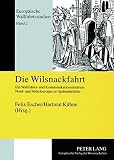
Felix Escher, Hartmut Kühne, eds. Die Wilsnackfahrt: Ein Wallfahrts- und Kommunikationszentrum Nord- und Mitteleuropas im Spätmittelalter. Europäische Wallfahrtstudien. Frankfurt: Peter Lang, 2006. 272 pp. $44.95 (paper), ISBN 978-3-631-54501-0.
Reviewed by James D. Mixson (Department of History, University of Alabama)
Published on H-German (July, 2009)
Commissioned by Susan R. Boettcher
New Roads to Wilsnack
In August 1383, feuding knights burned the village of Wilsnack in Brandenburg. In the rain-soaked ashes of the village church, as the legend dictates, the local priest, Johannes Kabuz, found three dry hosts miraculously preserved with a drop of blood at the center of each. The hosts soon manifested their spiritual power in dramatic ways. They overflowed with blood, healed the sick, and raised the dead. In response to the miracles, pilgrims began to make their way to Wilsnack, while papal and episcopal indulgences quickly financed the rebuilding of the village church. Over the next century, Wilsnack became one of the most popular pilgrimage sites in all of Europe. The cult at its center also became the subject of explosive criticism and debate, both over the authenticity of the Wilsnack hosts and the status of Christ's blood in general. Blood cult and pilgrimage endured at Wilsnack, however, surviving even amid the tensions of the early Reformation. Only after 1552, when a Lutheran pastor burned the Wilsnack hosts, did pilgrimage to the site come to an end.
This volume, the second in a series devoted to the study of pilgrimage in European culture, is the fruit of a scholarly conference held at Wilsnack in June 2005. In a brief introduction, its editors note two dominant scholarly approaches to the pilgrimage site--one focused on the art and architecture of its church, another trained on the intense theological debates its cult inspired. In the introduction, they highlight the strength of the volume. With contributions from history, theology, art history, and architecture, this collection of essays traces Wilsnack's many histories, and situates those histories within the wider geographical and cultural landscape of central Europe. Heinz-Dieter Heimann offers a lively overview of what he calls a terra incognita of possibilities for new research. Heimann suggests, to note only one example, that Wilsnack might be considered more fully as a lively "center of communication," a crucial node in a wider fifteenth-century dynamic of places, practices, and ideas that were becoming more "public."[1]
Six essays map the terra incognita from a variety of vantage points across central Europe. Jan Hrdina traces the connections between Bohemia and Wilsnack, revealing its early importance as a site of "dynastic pilgrimage" for the Luxemburg court in Prague. Ewa Wółkiewicz situates Wilsnack within the broader emergence of Eucharistic piety in fourteenth-century Poland, and shows the site's rapid rise to prominence alongside Aachen and Rome as a destination for pilgrimages of atonement. Wółkiewicz also offers a useful appendix, a table that documents all of the known atonement pilgrimages to Wilsnack that originated in Poland to 1520. Maria Starnawska then shows the attraction of Wilsnack for both royal courtiers and burghers of Poland, as well as the cult's presence in the Christian duchy of Lithuania. Maja Gąssowska reveals the importance of blood cult for the Livonians, who both knew of Wilsnack and fought their own contests in Riga (led by the archbishop of Riga and the Teutonic Knights) over a blood relic and its fledgling pilgrimage site. Dietrich Kurze offers a systematic survey of the archival evidence for pilgrimage to Wilsnack from Hamburg and from twelve other cities and towns along the coast of the North Sea (the essay also includes a transcription, translation, and photograph of one of the many wills that provide the core source base for his work). Enno Bünz offers a similar survey of the largely rural region of Dithmarschen along the west coast of Schleswig-Holstein.
Three more essays turn to Wilsnack itself. Krzysztof Bracha situates Wilsnack's pilgrimage within wider debates over blood cult in the 1440s and 1450s, focusing on three treatises of James of Jüterborg, a Carthusian. At first, Bracha argues, James offered a measured, ambivalent assessment of the cult at Wilsnack. But his later works shifted to open renunciation, not only of Wilsnack, but of pilgrimage in general. Shaped by the religious mood of the "new piety" and the devotio moderna, James came to see the cult at Wilsnack as a kind of mass delusion propagated by demons. Two essays then focus on Wilsnack's spaces and material culture. Alexander Krauß and Detlev von Olk argue for a more refined history of the pilgrimage church at Wilsnack. From archaeological evidence uncovered in the wake of recent excavations, they trace the church's multiple phases from the 1440s (precisely the years in which the cult was becoming most widely controversial) to the 1520s, and link its style to wider regional developments in the same years. Petr Hlaváček and Hartmut Kühne then offer a study of an intriguing artifact, the so-called pilgrim's shoe of Wilsnack. The authors conclude that the shoe (made in the early sixteenth century for a child approximately six years old) may not necessarily have been worn by a pilgrim. Its survival, however, is consistent with a wider culture of votive offerings, especially of articles of clothing.
Three essays conclude the volume by situating Wilsnack in a wider comparative context. Dieter Hoffmann-Axthelm offers a vigorous argument for a revision of the early chronology of the blood cult of Beelitz. Key to the argument is a careful reading of both the archival record and the architectural evidence: the 1247 foundation charter of the Beelitz cult is argued here to be a forgery from the 1390s, and the fourteenth-century renovations of the city church (including a fourteenth-century chapel for housing the blood relic) are read as evidence of a modest town's brief heyday as home to a regional cult. Mateusz Kapustka's contribution explores the links between blood cult and anti-Jewish sentiment. Drawing on examples from Wilsnack, Heiligengrabe, and Breslau, Kapustka shows how a malleable discourse of perversion and profanation inspired visual and architectural statements of "propaganda" against the Jews. Kapustka then explores how the same discursive associations were redeployed in later centuries--both among Protestant polemicists like Martin Luther and Joachim Ellefeldt in Wilsnack, who accused Catholic priests of "superstition" and desecration, and later amid the confessional battles of seventeenth- and eighteenth-century Poland. The last essay in the collection, by Wilhelm Eckhardt, explores the history of the Hessian pilgrimage site of Göttsburen, a site that has been upheld as comparable to Wilsnack in terms of its transregional popularity and longevity. Eckhardt's reading of unpublished account books shows otherwise: Göttsburen indeed enjoyed a brief period of remarkable popularity in the early 1330s, but the accounts also show convincingly that the site fell quickly out of favor. Though it lingered on well into the fifteenth century, Göttsburen never attained a breadth or visibility in any way comparable to the success of Wilsnack.
Coherence is the perennial challenge for essay collections of this kind, especially for those that cut across disciplines--how best to build a set of reasonably coherent findings around a chosen theme? These pages do so with admirable patience and considerable success. They begin to ground pilgrimage to Wilsnack (and to places like Beelitz and Göttsburen) in its many neglected landscapes and in its material culture. They also provide a more contextualized and precise chronology of blood cult and pilgrimage for the late fourteenth and early fifteenth centuries, a period often neglected or misread in older scholarship. Through what are at times impressively meticulous readings of widely scattered charters, testaments, account books, and other archival sources, these essays make a valuable contribution to our understanding of what might be called the spiritual and social topography of pilgrimage and cult across north-central Europe. The strength of this approach, to be sure, often becomes its weakness. As the authors themselves are aware, their conclusions are drawn from an often thin and widely scattered collection of sources, rendering generalization and firm conclusions all the more difficult. In this connection, several steps might have helped draw together the scattered contributions more forcefully--a more explicit and aggressive organizational scheme, for example, with contents broken down by theme and region. A collection of maps and chronologies and a comprehensive index would have aided future scholars interested in exploring the landscape further. Readers may also detect a certain imbalance in the volume, since in most of these essays Wilsnack and pilgrimage are seen mainly through the lenses of the archives, architecture, and material remains. Apart from Bracha's essay the wider intellectual reflection Wilsnack inspired receives little focused attention (though here the editors themselves regret that Anne-Katrin Ziesak's contribution, an essay on the theological controversy surrounding Wilsnack, could not be included in the volume). Readers might now easily transcend the volume's limitations in this regard, however, by reading its essays alongside Caroline Walker Bynum's magisterial work, Wonderful Blood (2006), which places blood at the center of the religious and cultural history of the fifteenth century.
In recent years scholars have begun in earnest to rethink the religious history of the fourteenth and fifteenth centuries--an era now liberated from the prejudice of lateness, waning, and crisis, and from the burdens of explaining the Reformation. This book has its role to play in that broader enterprise. It provides a useful starting point for exploring how blood cult and pilgrimage took root in a variety of particular locales across a broad central European landscape, a landscape that is increasingly allowed to speak in all of its complexity and possibility.[2]
Notes
[1]. Daniel Hobbins, "The Schoolman as Public Intellectual: Jean Gerson and the Late Medieval Tract," American Historical Review 108 (2003): 1308-37, and Authorship and Publicity before Print: Jean Gerson and the Transformation of Late Medieval Learning (Philadelphia: University of Pennsylvania Press, 2009).
[2]. See, for example, John Van Engen, "Multiple Options: The World of the Fifteenth-Century Church," Church History 77 (2008): 257-84; and Howard Kaminsky, "From Lateness to Waning to Crisis: The Burden of the Later Middle Ages," Journal of Early Modern History 4 (2000): 85-125.
If there is additional discussion of this review, you may access it through the network, at: https://networks.h-net.org/h-german.
Citation:
James D. Mixson. Review of Escher, Felix; Kühne, Hartmut, eds., Die Wilsnackfahrt: Ein Wallfahrts- und Kommunikationszentrum Nord- und Mitteleuropas im Spätmittelalter.
H-German, H-Net Reviews.
July, 2009.
URL: http://www.h-net.org/reviews/showrev.php?id=24307
 | This work is licensed under a Creative Commons Attribution-Noncommercial-No Derivative Works 3.0 United States License. |

